AI Agents for SMEs: What They Are, How They Work and How to Get Started in 2026

What AI agents are (and why they're not just chatbots)
You know those chatbots that answer "I didn't understand your question" after three attempts? AI agents are a different thing entirely. While a chatbot follows a rigid script and answers single questions, an AI agent is an autonomous system that perceives context, plans a sequence of actions and executes them to achieve a goal.
In practice: a chatbot tells you the opening hours. An AI agent takes the customer's request, checks calendar availability, proposes three slots, sends a confirmation email and updates the CRM — all by itself.
The fundamental difference lies in three capabilities:
- Autonomy — the agent decides how to reach the goal, it doesn't follow a fixed script
- Tool use — it can access databases, APIs, email, calendars and other business systems
- Multi-step reasoning — it breaks down complex problems into steps and executes them in sequence
It's not science fiction: it's technology available today, accessible even to small businesses. And 2026 is the year it becomes cost-effective to adopt.
Why 2026 is the decisive year for Italian SMEs
The numbers speak clearly. According to ISTAT 2025 data, only 7% of Italian small businesses (10-49 employees) have started AI projects. For medium enterprises (50-249 employees) we're at 15%. This means 93% of small businesses are not yet using AI — and those who start now have an enormous competitive advantage.
But why specifically in 2026?
- Costs have plummeted — tools like ChatGPT, Claude and Gemini offer APIs at negligible costs. What cost €50,000 two years ago can now be done for €500
- No-code platforms are mature — you can create AI agents without writing code, using tools like Make, n8n or Zapier AI
- Google confirms it — according to Google Cloud Italy, 2026 will be "the year of concrete AI value for Italian businesses", moving from experimentation to real implementation
- ROI is proven — 74% of executives who adopted agentic AI achieved a return on investment within the first year
- Gartner predicts that by the end of 2026, 40% of enterprise applications will include dedicated AI agents
For Italian SMEs, the question is no longer whether to adopt AI, but how to do it. And AI agents are the most practical and profitable entry point.
5 practical use cases for your business
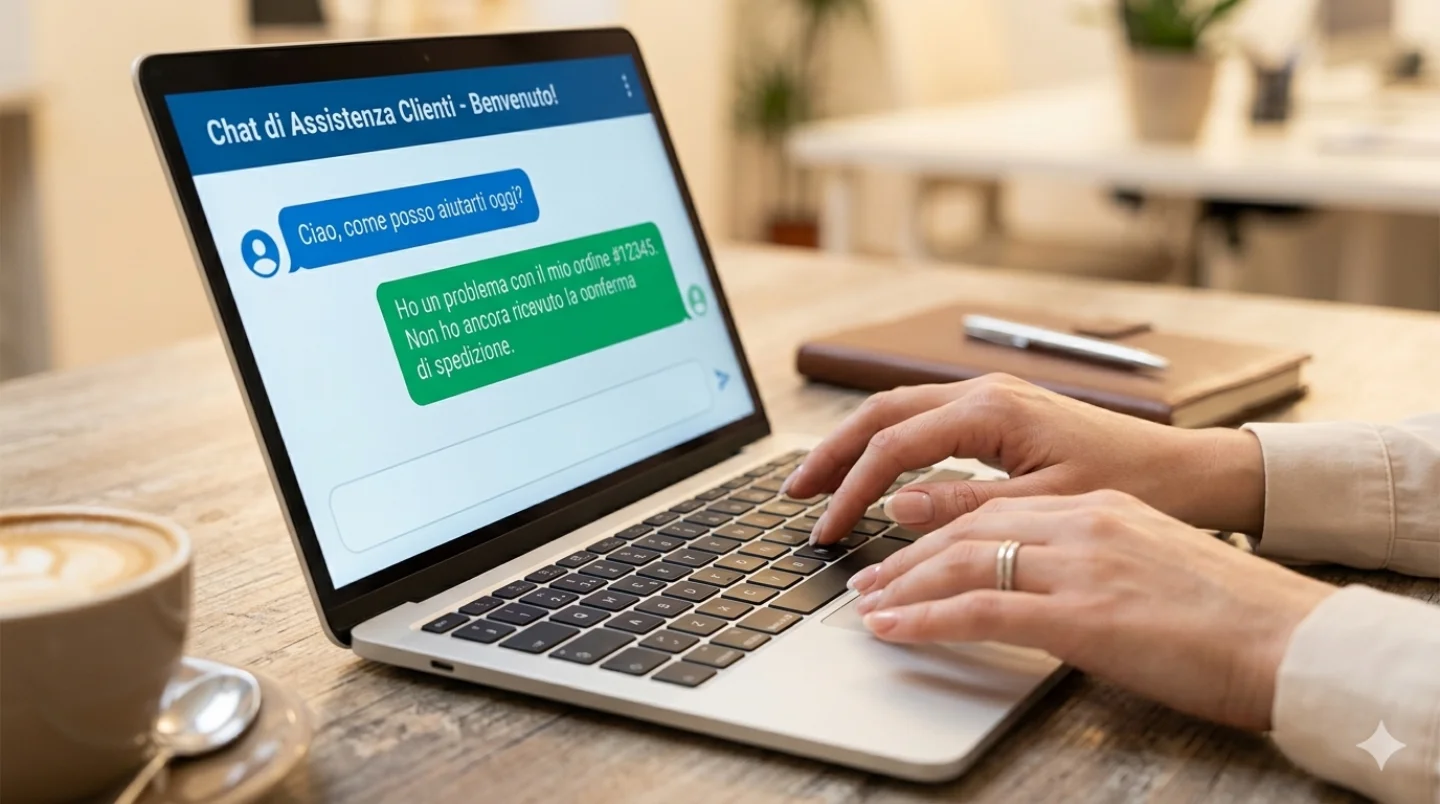
Enough theory. Here are five real scenarios where an AI agent can transform your SME, with measurable results.
1. 24/7 customer assistant
An AI agent connected to your website and WhatsApp answers customers 24 hours a day, in Italian and other languages. It goes beyond FAQs: it can check order status, suggest alternative products if something is out of stock, and escalate to the human team only for complex requests.
Typical result: 30% reduction in time spent on repetitive queries, instant responses even at night and on weekends.
2. Accounting and invoicing automation
The agent receives invoices via email, automatically extracts the data (amount, supplier, due date, VAT number), classifies them by category and enters them into the management system. It flags anomalies, duplicates and upcoming deadlines.
Typical result: saving 10-15 hours per month on manual accounting tasks.
3. Marketing content generation
An AI agent can create drafts of social posts, newsletters and blog articles based on your tone of voice and editorial calendar. It doesn't replace the copywriter, but saves them 50-60% of time on first drafts.
Typical result: from 2 social posts per week to 5, without increasing staff.
4. Lead qualification and sales
When a potential customer fills out a form on your site, the AI agent automatically qualifies them: it analyses the industry, company size, indicated budget and assigns a priority score. Hot leads are immediately forwarded to the sales team with a personalised summary.
Typical result: the sales team focuses only on leads with the highest conversion probability, increasing the close rate by 20-25%.
5. Automated monitoring and reports
The agent collects data from Google Analytics, social media, CRM and management system, and generates automatic weekly reports with charts and insights. It proactively flags anomalies: sudden traffic drops, products running low on stock, customers who haven't ordered in 90 days.
Typical result: data-driven decisions instead of gut feeling, without spending hours on spreadsheets. To learn more, read our guide on business intelligence for SMEs.
Want to find out which AI agent makes the most sense for your business? Ivemind designs and develops custom AI solutions for small and medium businesses. Request a free consultation →
How much it costs: from zero to 3,000 euros

This is the question everyone asks. The good news: implementing an AI agent costs much less than you think. Here are the three realistic tiers.
Basic level: free or nearly so (€0-100/month)
Tools like ChatGPT Team (€25/user/month), Claude Pro (€20/month) or Gemini Advanced (€22/month) give you access to powerful AI models with which you can:
- Generate drafts of emails, social posts and documents
- Analyse data and create reports
- Translate content into multiple languages
- Summarise meetings and long documents
They're not autonomous agents, but they're the first step to understanding where AI can help you.
Intermediate level: €100-500/month
With platforms like Make, n8n or Zapier AI you can create agents that automate real workflows:
- WhatsApp/website chatbot with access to your database
- Email automation and customer response handling
- Automatic classification of documents and invoices
- Integration between CRM, management system and marketing tools
Typical cost: €50-200/month for the platform + €50-300/month for AI APIs (based on usage volume).
Advanced level: €1,000-3,000 (one-off) + €100-300/month
A custom-developed AI agent for your company, integrated with your systems and trained on your data. Includes:
- Business process analysis and opportunity identification
- Agent development with access to all your tools
- Training on your company knowledge base
- Testing, deployment and ongoing support
The typical ROI is 3-6 months: an agent that saves you 15 hours per month of repetitive work pays for itself very quickly.
Remember that you can also fund the investment with digitalisation vouchers and provincial grants. Read our guide on non-repayable grants for small businesses for all the details.
How to get started: 4-step roadmap

You don't need to overhaul your company. Here's a gradual, low-risk path to introducing AI agents in your SME.
Step 1: Identify the bottleneck (1 week)
Ask yourself: where does my team waste the most time on repetitive tasks? Common answers:
- Answering the same customer questions over and over
- Manually entering data from one system to another
- Creating recurring reports and presentations
- Sorting emails and requests
- Translating content for the DACH market
Choose one single process to automate. The smallest possible, but with measurable impact.
Step 2: Experiment with free tools (2-4 weeks)
Before investing, test AI with free or low-cost tools. Use ChatGPT or Claude to simulate the process you want to automate. Does it work? Are the results acceptable? Would your team use it?
This phase costs you zero euros and gives you confirmation that AI is the right solution for that problem.
Step 3: Build your first agent (2-4 weeks)
Choose the right platform for your use case:
- Customer chatbot? → Chatbot platform + OpenAI/Anthropic API
- Document automation? → Make or n8n + AI model
- Automated reports? → Python script + data APIs + AI model
- Complex solution? → Custom development with a technology partner
Start with a limited pilot project: one department, one process, a 30-day test period.
Step 4: Measure, improve, scale (ongoing)
After 30 days, measure the results:
- How many hours did you save?
- How many fewer errors?
- Is the team satisfied?
- Have customers noticed an improvement?
If the numbers are positive, gradually expand to other processes. Each agent that works frees up time and resources for the next one.
The 3 mistakes to avoid
AI is not a magic wand. Here are the most common mistakes we see in Italian SMEs.
1. Starting too big
"I want an AI agent that manages everything: customers, accounting, marketing and sales." Result: overly complex project, long timelines, blown budget, frustrated team. Start with a single process, get concrete results, then expand.
2. Ignoring business data
An AI agent is only as powerful as the data it can access. If your CRM is empty, your management system isn't updated and customer emails are scattered across 5 different inboxes, the agent won't be able to work miracles. Data first, AI second.
3. Not involving the team
72% of AI adoption failures are due to lack of digital culture and change management. If the team perceives AI as a threat ("it'll take my job"), they unconsciously sabotage adoption. Involve people from the start: they're the ones who know the real problems and who will use the tool every day.
AI Act and compliance: what your SME needs to know
Since 2 February 2025, the European AI Act has been in force. It's not an obstacle, but you need to know the basic rules.
Most AI agents for SMEs fall into the "limited risk" category, which only requires:
- Transparency — the customer must know they're interacting with an AI, not a person
- Human oversight — critical decisions (hiring, credit, healthcare) must have human oversight
- Data protection — GDPR compliance for all personal data processed by the agent
In practice: if your chatbot answers product questions and escalates complex requests to a human, you're already compliant. If you use AI to classify invoices or generate internal reports, the regulatory risk is minimal.
Different rules apply for "high-risk" applications (recruiting, credit scoring, surveillance): these require audits, documentation and ongoing monitoring. But for the vast majority of Italian SMEs, these scenarios don't apply.
If your business also needs to comply with the cybersecurity directive, read our guide on NIS2 for SMEs: what to do by October 2026.
Ivemind: your AI business partner
Ivemind is a social cooperative and innovative startup based in Bolzano, South Tyrol. We design and develop custom artificial intelligence solutions for SMEs — from virtual assistants for customer service to business process automation.
With Ivemind you get:
- Free analysis — we identify where AI can have the greatest impact in your company
- Custom development — AI agents integrated with your systems, trained on your data
- Ongoing support — monitoring, optimisation and system updates
- Guaranteed compliance — AI Act, GDPR and NIS2: we take care of it
60% of our profits are reinvested in social inclusion projects. Choosing Ivemind isn't just a technology choice, it's a values choice.
Contact us for a free consultation or discover our artificial intelligence services.
Related articles
AI Chatbot for Your Business: Automating Customer Service 24/7
How a custom AI chatbot can answer your customers 24/7, generate leads and increase sales by 67%. Complete guide with costs and funding.

Business Intelligence for SMEs: Turning Data into Decisions
Is your SME's data scattered across ERP, Excel, and CRM? Discover how Business Intelligence turns it into clear dashboards for better decisions.

AI for Small Businesses: A Practical 2026 Guide (With Non-Repayable Grants)
35.6% of Italian small businesses already use AI, but 56.7% don't know where to start. Real tools, transparent pricing, and grants covering up to 60% to digitise your business.