AI for Small Businesses: A Practical 2026 Guide (With Non-Repayable Grants)

56.7% of small businesses don't know where to start with AI
You've heard about artificial intelligence. Chatbots, automation, virtual assistants. You know you "should do something", but you don't know what. If that sounds like you, you're not alone: according to the latest CNA survey (January 2026), 56.7% of Italian micro and small businesses can't identify how AI could be useful for their operations.
Yet those who've tried it don't go back. 35.6% of Italian small businesses already use artificial intelligence — up from just 5.2% only 18 months ago. And 83.1% of users say it saves them real, measurable time.
The problem isn't the technology. The problem is figuring out where to start, what to choose, and how to integrate AI without turning your workflow upside down. In this guide, we'll show you exactly how — with real applications and non-repayable grants covering up to 60% of the investment.
What AI can actually do for your business
Let's forget about robots and science fiction. Artificial intelligence for a small business means automating repetitive tasks, responding to customers faster, and making better data-driven decisions. Here are five practical applications.
1. A customer assistant that works 24/7
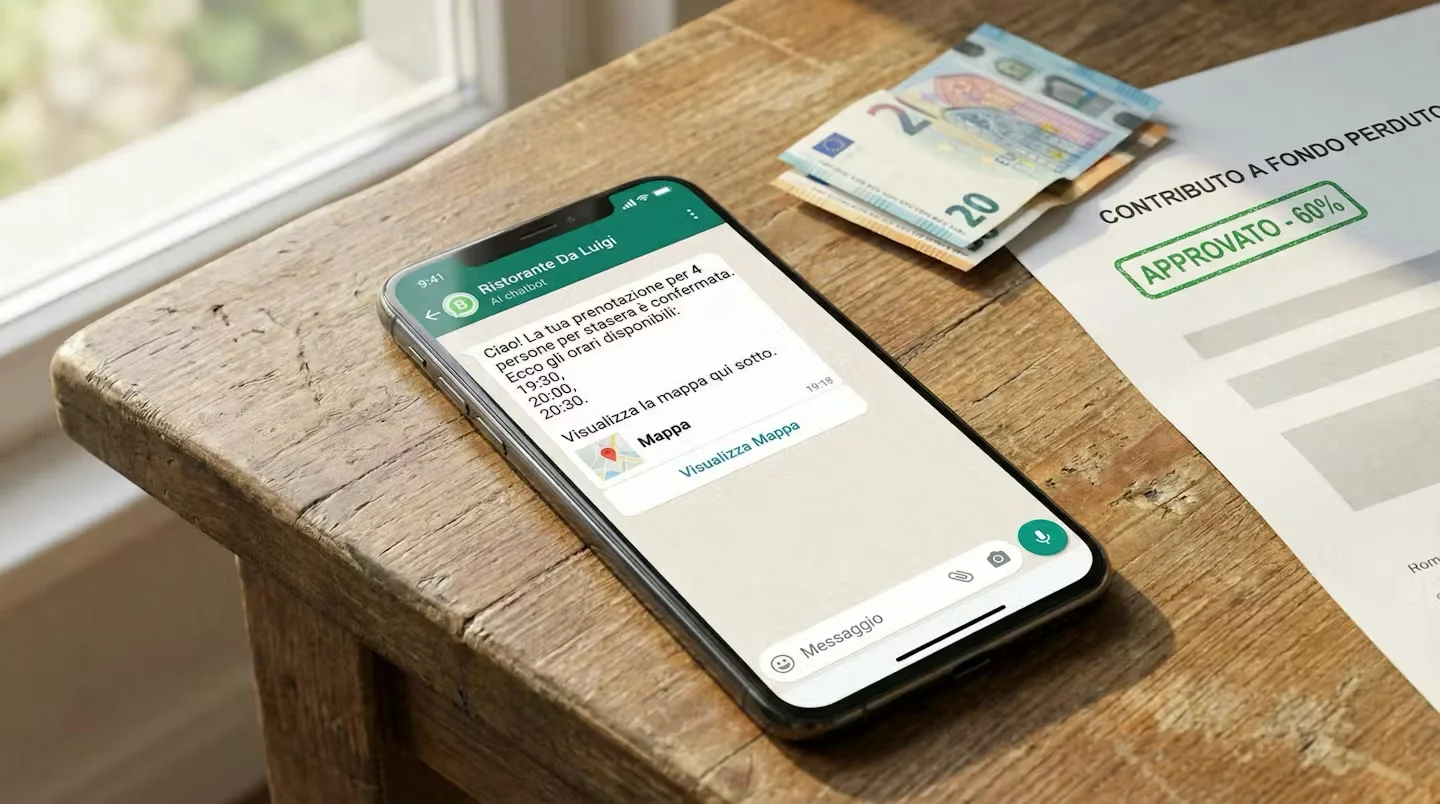
How much time do you spend answering the same questions? Opening hours, availability, prices, directions. A custom AI chatbot can handle 80% of these requests autonomously — on WhatsApp, your website, or social media — even at 3 AM, even on Sundays.
We're not talking about the chatbots from 5 years ago that replied "I don't understand, please repeat." Modern chatbots powered by generative AI understand context, respond naturally, and learn from your knowledge base (price lists, catalogues, FAQs).
- For shops and restaurants — answers questions about hours, menus, reservations, product availability
- For professional offices — books appointments, collects preliminary information, routes enquiries
- For e-commerce — guides customers through product selection, manages returns and order tracking
The difference between a chatbot that works and a useless one lies in proper configuration, training on your specific data, and integration with your systems. A generic chatbot gives generic answers — a chatbot built for your business generates customers.
2. Content creation: texts, emails, social media
Writing the Instagram post, the monthly newsletter, the product descriptions for the website. For many small businesses, digital communication is a full-time job that nobody has time to do. AI changes the game.
With the right tools, configured for your business, you can:
- Generate article drafts for your blog in minutes instead of hours
- Write professional emails in half the time
- Create content calendars for social media with ready-to-use ideas and copy
- Translate content into multiple languages (essential in South Tyrol)
- Adjust the tone from formal to conversational with one click
AI doesn't replace your voice or your expertise — but it eliminates the hours of "blank page syndrome" and helps you communicate consistently. If you want to learn more about digital communication, read our guide on how to advertise your business for free.
3. Smart accounting and management
Bank reconciliation, invoice processing, payment tracking. Tasks that steal hours every week and that AI can simplify dramatically.
A management software with integrated AI can automatically recognise bank transactions and match them to invoices, forecast cash flow, analyse per-product margins, and send automatic alerts for deadlines and payments. What used to take hours now requires just a few minutes of review.
4. Email marketing that personalises itself
Sending the same newsletter to every customer worked in 2015. Today AI allows you to automatically segment your customers and send different messages based on behaviour: who bought, who abandoned their cart, who hasn't visited in 3 months.
An AI-powered email marketing system can:
- Optimise send times for each individual recipient
- Suggest email subject lines that increase open rates
- Predict which customers are at risk of churning
5. Demand forecasting and inventory management
If you run a shop, restaurant, or any business with physical products, you know how costly ordering mistakes are. Too much stock = tied-up capital. Too little = lost customers. AI analyses historical sales data, seasonality, and trends to forecast demand with accuracy impossible for a human.
An Italian food company reduced waste by 30% using machine learning algorithms for demand forecasting. You don't need enterprise-grade systems: with a custom management tool and the right data, even a small business can achieve similar results.
Want to understand which of these solutions makes the most sense for your business? Ivemind develops chatbots, automations, and AI-powered software for small and medium businesses. 47+ projects delivered, free initial consultation. Let's talk →
How much does it cost to integrate AI into your business
One of the main barriers is cost perception. 18.2% of small businesses cite economic constraints as an obstacle. But the reality is different: custom AI solutions for a small business don't require multinational-level investments.
A custom chatbot, an email automation system, or an intelligent management tool start from a few thousand euros — and the return in time saved and customers acquired exceeds the investment within the first months.
But here's the real news: a large portion of this investment can be covered by non-repayable grants.
Non-repayable grants for AI in 2026
This is the part many people don't know about: the Italian government and the Province of Bolzano actively fund AI adoption by small businesses. Not loans — non-repayable grants. Money you don't have to pay back.
Province of Bolzano: up to 60% non-repayable
If you have a micro-enterprise (fewer than 10 employees) based in the Province of Bolzano, you can receive a non-repayable grant of up to 60% on digitalisation projects between €2,000 and €15,000. The provincial budget has been increased to €3.5 million per year through 2028.
What you can fund:
- Chatbots and automation tools with artificial intelligence
- Management software (CRM, ERP) with smart features
- SaaS licences and subscriptions to AI platforms
- Consulting and training on digitalisation
The 2026 deadline is 30 September. If you have a project involving AI adoption, now is the time to move. For a complete overview of grants available in South Tyrol, read our article on non-repayable grants for small businesses in South Tyrol.
MIMIT Voucher: 50% up to €20,000
The Italian Ministry of Enterprise has allocated €150 million for a voucher covering 50% of expenses in cloud computing, cybersecurity, and software solutions integrated with artificial intelligence features.
- Grant: up to €20,000 non-repayable (50% of the project)
- Minimum spend: €4,000
- Who can apply: SMEs and self-employed workers with internet connection of at least 30 Mbps
- Status: provider registration open since 4 March 2026, beneficiary applications coming soon
Nuova Sabatini: grants on investments up to €4 million
For larger investments in Industry 4.0 and AI assets, Nuova Sabatini offers a contribution equal to 3.575% annually on interest rates. On a €100,000 investment, this means approximately €10,000 in non-repayable grants. The 2026-2027 budget is €650 million.
PID Digital Vouchers (Chambers of Commerce)
Local Chambers of Commerce periodically issue digitalisation vouchers for SMEs, with coverage reaching 50-70% non-repayable. The Trento Chamber of Commerce, for example, offers an ESG and Digital grant with up to 70% coverage.
In practice: a €10,000 AI project can cost you just €4,000 using the provincial grant. A custom chatbot, an AI-powered management system, an automation strategy — all at a fraction of the real cost. Contact us and we'll help you find the right grant.
AI Act: what a small business actually needs to do
The European AI Act is the world's first regulation on artificial intelligence. Full application begins on 2 August 2026. But before you panic, here's what it actually means for a small business.
The good news: the vast majority of small businesses don't use "high-risk" AI systems. If you use a chatbot to answer customers or software with AI features, you don't fall into the high-risk categories.
What you need to do:
- Map the AI tools you use in your business
- Ensure your team knows they're using AI tools (mandatory "AI literacy")
- Inform customers when they interact with an AI system (e.g. chatbot)
- Verify that your suppliers' AI tools comply with the regulation
For SMEs, the regulation includes simplifications: free access to regulatory sandboxes, reduced certification fees, and penalties proportional to company size.
Our advice? Don't wait until August. Start now by documenting which AI tools you use, how you use them, and for what purpose. A simple mapping done today prevents headaches tomorrow — and our team can help you do it in just a few hours.
How to get started: 5 concrete steps
Here's the path we propose for businesses starting from zero with artificial intelligence.
1. Process analysis
The first step is understanding where you lose the most time each week. Answering emails? Creating quotes? Managing appointments? Creating social media content? AI is most effective when it automates specific, repetitive tasks. At Ivemind, we always start here: a free analysis of your processes to identify where AI can make a difference.
2. Targeted pilot project
You don't need to revolutionise everything. Start with a single solution for your most pressing problem: a chatbot for customer service, an email automation system, an intelligent management tool. A focused, measurable project with visible results in 30 days.
3. Train the team (2 hours is enough)
40.3% of businesses cite lack of internal skills as the main barrier. But basic AI training doesn't take weeks: 2-3 hours of hands-on training is enough to make any team member productive. The AI Act requires it, and common sense confirms it. We always include training in our projects.
4. Measure the results
After 30 days, we measure results together: how much time did you save? How many queries did the chatbot handle? How much more content did you produce? The numbers guide the next decisions.
5. Scale up (with grants)
Once the first project is validated, it's time to think bigger: a custom chatbot integrated with your management system, tailored automations, an intelligent CRM. This is where non-repayable grants make all the difference. Also discover our ideas to attract customers to your shop using digital tools.
Who's using AI in Italy: real numbers and examples
AI adoption in Italy is accelerating at an unprecedented pace:
- The Italian AI market reached €1.8 billion in 2025, growing +50% in a single year (Politecnico di Milano Observatory)
- 16.4% of Italian businesses with more than 10 employees use AI — up from 8.2% in 2024, doubling in just 12 months (ISTAT)
- 71% of large enterprises already have active AI projects, but SMEs are catching up: 58% say they're interested
Some concrete examples from Italy:
- A hotel chain in Veneto implemented a multilingual AI chatbot for bookings and customer support. Result: direct bookings rose from 32% to 47%, saving €180,000 in booking platform commissions
- Delmet Srl, a manufacturing SME with over 70 years of history, integrated AI and IoT for automated technical support and predictive maintenance, estimating 50-60% savings on repetitive operations
- Restaurants across Italy are using AI chatbots on WhatsApp for automated reservations, reducing no-shows and eliminating phone queues
It's not just tech startups. It's shops, restaurants, professional offices, artisans — businesses like yours that have found the right way to use AI. And if you're thinking about the cost of a website, know that a modern site can integrate AI features from day one.
Ivemind: your AI partner
Ivemind is a social cooperative and innovative startup based in Bolzano, South Tyrol. We develop custom AI solutions for small and medium businesses: intelligent chatbots, process automations, management software with integrated AI, and strategic consulting on digital transformation.
We've helped 47+ companies and organisations build their digital presence, with 100% client satisfaction. 60% of our profits are reinvested in social inclusion projects — choosing Ivemind isn't just a technology choice, it's a choice of values.
What we do for you:
- Free analysis of your processes to understand where AI makes a difference
- Custom solution development — chatbots, automations, intelligent management systems
- Access to non-repayable grants — we guide you through the application
- Team training on daily tool usage
- AI Act compliance — we implement everything to regulation from the start
Contact us for a free consultation or discover our artificial intelligence and IT consulting services.