Dental Practice Management Software: Costs 2026
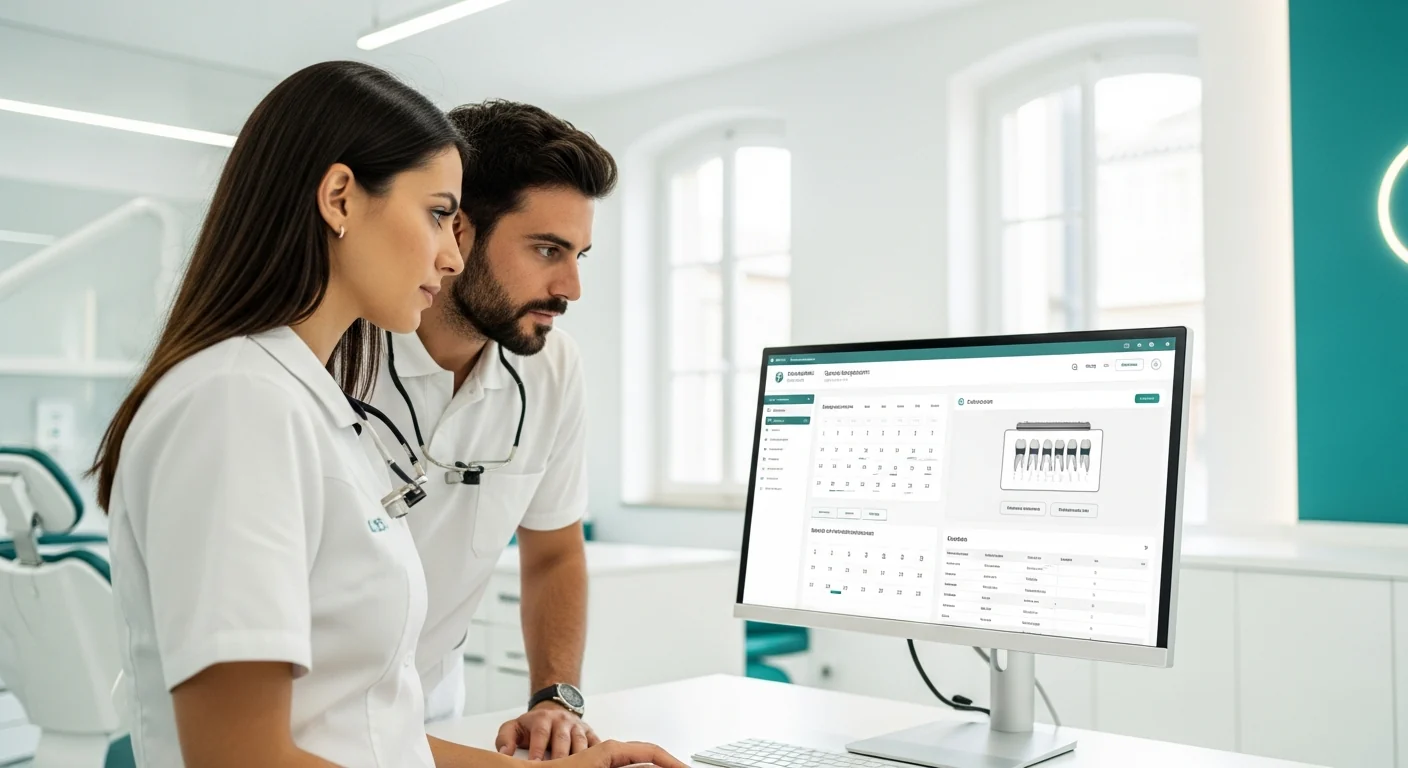
Choosing the right dental practice management software is one of the decisions that weigh most heavily on your cash flow, yet it is almost always made in a hurry. Your diary is full every day, the chairs keep turning, but at the end of the month the figures don't add up the way they should.
Quotes accepted and never collected. Hygiene recalls that no one actually makes. Materials ordered twice because the stock is kept "from memory". The submission to the Health Card System done by hand in January, at the last minute. The problem, almost always, is not how hard you work: it's that the software meant to hold practice, clinic and accounts together is stuck ten years ago — or simply isn't there at all.
In this guide we look at how to choose dental practice management software in 2026: what dental management software really has to do, who the Italian players are, how much it costs and — above all — when a vertical SaaS is enough for you and when a custom solution is the better bet. No sales pitch: we don't sell a dental management system of our own, so we have no reason to convince you that you need custom. When off-the-shelf software is enough, we'll tell you.
Professional English, industry data with sources, no made-up numbers. An informed decision in ten minutes of reading.
Note. This article is for general information purposes. The guidance on the Health Card System (Sistema TS), invoicing and privacy reflects the regulatory framework as at June 2026, but does not replace advice from your accountant, tax adviser or DPO. Always check your specific situation with a qualified professional.
Not sure where to start?
Let's start with a concrete question: what, today, costs you the most time or money? Tell us in two lines and we'll tell you where it makes sense to start — even if the answer is "keep your current software and just integrate the missing piece".
Let's talk, no commitmentThe Italian dental sector in 2026: why your management system has become infrastructure
The dental market in numbers and the push towards digitalisation
The Italian dental sector is large, mature and crowded. As at 31 December 2025, there were roughly 64,000 dentists on the professional register — but that figure needs reading with care: the dentists who actually practise as self-employed professionals are just over 44,000 according to ENPAM data, because many keep their registration without practising.
The figure that best captures this moment in history is a different one: the profession is ageing. More than half of those on the register are 55 or older — about 54% — and a significant share are over 65. Over the past thirty years the number of dentists has almost quadrupled, but growth has now stalled. That means two practical things for anyone running a practice: a saturated market, where efficiency counts for more than volume, and an imminent generational handover, bringing with it acquisitions, takeovers and mergers — all operations in which a practice's information system becomes an asset (or a liability).
On the technology front, digitalisation is accelerating but is not yet complete. According to Dental Tribune Italy, the post-Covid period saw more than 6,500 intraoral scanners installed, with estimated penetration above 40% — but the "process" digital transformation, the kind that touches the diary, the clinical record and the accounts, is still held back precisely by the generational handover.
What "a digital practice" really means, beyond the intraoral scanner
This is where the most common misunderstanding lies. Many practices think they are "digital" because they have an intraoral scanner and imaging software. But that is clinical digital: the visible part. A truly digital practice is one where the diary, clinical record, treatment plans, quotes, stock, invoicing and tax obligations all speak the same language and share the same data, entered once.
The dental market has historically been highly fragmented — made up of single-practitioner practices — but a consolidation is under way towards chains and networks (the so-called DSOs, the organisations that centrally manage multiple practices), with economies of scale. In this scenario the management system is no longer "the electronic diary": it is the infrastructure that decides how much margin is left at year end, how exposed you are to a penalty and how quickly you can grow or be acquired. That is why it is worth choosing well. A dental practice is, after all, a professional firm like any other: the same issues are faced by lawyers, accountants and architects, as we explain in our guide to websites and management software for professional firms.
What a dental management system (really) does
The core functions of dental practice management software
A dental management system holds three worlds together: the clinical (record, dental chart, treatment plans), the operational (diary, stock, recalls) and the administrative (invoicing, accounting, the Health Card System). Whatever the vendor, these are the functions that good dental practice management software simply cannot do without:
- Multi-chair, multi-operator diary and appointments — the operational heart, with availability managed per chair and per practitioner.
- Patient records — details, contacts, history, medical history, consents.
- Dental clinical record — clinical diary, treatments per tooth, periodontal chart, images.
- Dental chart (odontogram) — the graphical map of the patient's mouth (we cover it separately: it is the most distinctive element).
- Treatment plans and quotes — sequence of treatments, therapeutic alternatives, acceptance.
- Day book, invoicing and payments — with the healthcare constraints we will see (no e-invoicing via the Exchange System for private patients).
- Materials and devices stock — inventory, orders, expiry dates, batch traceability.
- Automatic hygiene recalls — the recurring-revenue lever that reduces no-shows.
- Reporting and practice dashboards — turnover, productivity, quote acceptance rate.
If your current software fails to cover one of these points, every month you are burning hours on manual workarounds and parallel Excel sheets.
Advanced functions of a dental management system in 2026
These functions were once "premium". Today, in the top products or in purpose-built solutions, they have effectively become standard:
- Imaging/radiology integration (DICOM) — panoramic X-rays, intraoral radiographs and intraoral scanners linked directly to the clinical record.
- Graphometric signature for consents — paperless informed consents, with legal validity.
- Multichannel patient communication — SMS, email and WhatsApp (with open rates markedly higher than SMS).
- Sterilisation traceability — a computerised log integrated with the autoclave and a barcode reader.
- Online booking and marketplace integration — connection to platforms such as MioDottore/Doctolib.
- Management dashboards and business intelligence — margin per treatment, productivity per chair, forecasting: a theme we explored in our guide to business intelligence for SMEs.
- Applied AI — support for diagnostic imaging, dictation of the periodontal chart, virtual assistants. This is the current frontier, present in the most advanced products.
The difference between a standard single practice and a structured clinic is played out almost entirely here: in the advanced functions and in how they integrate with one another.
The odontogram and the dental clinical record: the clinical heart
There is one function that distinguishes a genuine dental management system from a CRM or a generic medical management system: the odontogram. It is the graphical representation of the patient's dental formula — the map, often in 2D or 3D, of caries, previous restorations, missing teeth and deciduous teeth in mixed dentition. It is linked directly to the clinical record and the treatment plan, and no generalist management system truly replicates it.
The dental clinical record revolves around the odontogram: medical history, clinical diary, treatments recorded per individual tooth, periodontal chart, images, prescriptions and consents. It is the document that, in the event of a dispute, proves what was done, when and why. That is why it must be retained to standard (we cover this in the regulatory section) and protected for the sensitive data it is.
Treatment plans, quotes and patient acceptance
The treatment plan grows out of the clinical record: the sequence of treatments, the therapeutic alternatives, plus quotes linked to the same plan. A good slice of a practice's turnover is decided here, because the treatment plan is also a commercial tool: presenting it clearly, with options and timings, raises the acceptance rate.
A good management system handles the entire cycle: from the proposal to the signed acceptance (always better with a graphometric, paperless signature), through to the link with invoicing and recalls. When these steps are integrated, you stop chasing quotes that were accepted but never collected — one of the most common cash leaks in dental practices.
Hygiene recalls and patient communication
Hygiene recalls are the most underrated recurring-revenue lever. A patient who comes back every six months for hygiene is a loyal patient, caught early on any new needs, and a predictable source of revenue. The problem is that manual recall does not scale: the "to call back" list keeps growing, and nobody actually calls.
A serious management system automates the cycle: it generates the list of patients due, sends the reminder on the right channel and records the outcome. In a well-organised dental practice this means a fuller diary with no new marketing, simply by recovering patients you already have.
SMS, email, WhatsApp and appointment reminders
Patient communication today is multichannel: SMS for the essential reminder, email for documents, WhatsApp for quick confirmation (with much higher open rates). Well-made appointment reminders cut no-shows, which are pure cost: a chair left empty at the last minute cannot be recovered.
This also opens up the question of the online diary: giving patients the chance to book for themselves, around the clock, from the website or an app. We have written a dedicated guide on websites with online booking for medical practices, because the point of contact with the patient often starts there. And on the automation front, a chatbot for booking and recalls can handle the first enquiries and qualify contacts without tying up the front desk.
The 3 categories of dental management software
When we talk about dental management software, there are three distinct families: free/entry-level, commercial vertical SaaS, and custom-built. They have completely different targets, costs and logic.
Free dental management software: when it makes sense (and when it doesn't)
There are a few free or near-free dental management software options — typically the free tiers of multi-profession products. They make sense in one specific case: a newly opened practice, a single operator, very low volumes, no advanced needs, a testing phase.
When they stop making sense: as soon as the practice becomes operational with real numbers. The typical limits of the free tier are few simultaneous logins, reduced clinical functions (the odontogram and periodontal chart are often limited or absent), no imaging integration, forum-only support, and clunky data export the day you want to switch systems. "Free" becomes expensive the moment a Health Card System submission fails, or a patient file cannot be reconstructed in five minutes.
SaaS dental management software: the Italian players
The Italian vertical market for SaaS dental management software is mature and well covered. Here we describe the positioning of the main players, without passing "best in absolute terms" verdicts — because the best one depends on your practice. One important note: almost all enterprise vendors do not publish their price lists, so where there is no official price we speak of "pricing on request", without inventing figures.
- XDent — part of the CompuGroup Medical (CGM) group, a major international player in healthcare IT. It is a technologically advanced enterprise vertical, with AI functions for imaging and a virtual assistant; according to vendor sources it is used by several thousand practices. Pricing on request. Official site: xdent.it.
- OrisLine / OrisDent (Henry Schein One group) — among the most widespread verticals in Italy, now part of a large international dental group, with a "software + services" approach and a strong focus on usability. The range distinguishes the cloud version (OrisDent Air) from the desktop/installed versions (OrisDent Evo/Q). Pricing on request. Site: orisline.com.
- Windent (Zucchetti group) — designed for practices and structured networks, with a rich ecosystem and many integrations with other dental software; according to the vendor it is installed in some thousands of practices. Pricing on request.
- GipoDental (Docplanner/MioDottore group) — a dental vertical and a solution for multi-specialty clinics, with native integration to the MioDottore marketplace. Pricing on request.
- AlfaDocs — modular cloud, strong on paperless management and electronic signature, automatic recalls, with integrated Health Card System submission. One of the few with a public price reference, in the order of a little over €100/month for the basic configuration.
- Appuntoo — multi-profession, simple, with the Health Card System and WhatsApp included and a public price list: it has a free plan (with a patient limit) and modestly priced monthly plans. Useful as an entry-tier reference.
- There are also long-standing verticals and installed/desktop solutions from other suppliers (for example the dental offering from Evident/Euronda), further proof of how well covered the market is.
For up-to-date, neutral comparisons between products there is industry material such as Infodent's comparisons of practice management software. The bottom line, plainly put: for a standard single practice, a good vertical SaaS is almost always the right choice — faster, already compliant, maintained. No one should rebuild from scratch the odontogram or clinical record that these products already do well.
Custom dental management system: when the investment is worth it
A custom dental management system is software (or, more often, a layer — a software stratum built on top of the management system you already use) modelled on your particular organisation's process: your nomenclature, your automations, your integrations, your management reports. It is the logic of custom-built management software, applied to dentistry.
Be careful, though: custom does not exist to replace the odontogram or the clinical record of an XDent or an OrisLine — rebuilding them would be a waste. It exists to do what SaaS does not: consolidate multiple sites, integrate systems the vendor does not connect natively, build a patient app with your own brand, create bespoke management dashboards, handle a complex migration. In the most common pattern, custom extends the SaaS, rather than throwing it away.
SaaS or custom? Do the maths first.
For many practices a good vertical SaaS is more than enough: it costs less, it's ready right away and it already includes Health Card System submission. Custom only makes sense in specific cases. If you want to work out which of the two you're in before spending a penny, we'll help you do the maths — total cost over 5 years, integrations included.
Request a total cost assessmentHow much a dental practice management system costs
The cost of a dental management system depends on the model you choose. Let's look at the three blocks: the SaaS subscription, the custom investment and the hidden costs — which are the ones that blow up the quotes.
SaaS: a fee per chair/user
SaaS is paid as a subscription, typically per login, per workstation or per chair, plus any additional modules (signature, WhatsApp, recalls, marketplace). The few verified public figures serve as a reference: entry-level multi-profession products start in the order of a few tens of euros a month (with some limited free plans); dental verticals with a public reference sit in the order of a little over €100/month and up, while the enterprise products (XDent, OrisLine, Windent, GipoDental) are quoted bespoke, generally in a medium-to-high bracket. The advantage of a subscription is that it includes updates, hosting, security and compliance; the drawback is that it is a perpetual recurring cost, with a degree of vendor dependence.
Custom: a one-off investment
Custom is a higher initial investment but a one-off one. A complete clinical management system built from scratch is a major project, running from tens of thousands of euros upwards depending on scope — and it is rarely the right choice, precisely because the existing verticals already cover the clinical side well. A custom layer on top of an existing SaaS (an integration, a dashboard, a patient app) costs far less and makes sense far more often. Maintenance and evolution work out, by industry convention, at around 15-20% a year of the initial investment.
Hidden costs: migration, training, imaging integration
In both SaaS and custom, the quotes rarely tell the whole story. The costs that emerge later are:
- Data migration — recovering years of records, X-rays and treatment plans from the old system; it is the trickiest item and almost never included.
- Team training — days spent getting the front desk and operators to autonomy.
- Imaging integration — connecting scanners and X-ray systems in DICOM may require specific configuration.
- Separate modules — graphometric signature, WhatsApp, marketplace and advanced recalls are often outside the base fee.
The rule: always compare the total cost over several years, never the brochure fee.
SaaS vs custom comparison: real costs over 5 years
Here is a structured comparison between the two routes. The values should be read as industry estimates and orders of magnitude, not as official price lists nor as Ivemind prices: the only verified public figures concern some of the vendors cited above.
| Item | Vertical SaaS | Custom / bespoke layer |
|---|---|---|
| Initial cost (setup, migration, training) | Low to medium | High |
| Recurring cost | Monthly fee per chair/user, perpetual | Maintenance ~15-20%/year |
| Time to go live | Days/weeks | Months |
| Regulatory compliance (Health Card System, e-invoicing, GDPR) | Included and kept up to date by the vendor | To be designed and maintained |
| Customisation / integrations | Limited to the vendor's APIs | Total |
| Ownership / dependence | Vendor dependence | Ownership of code and data |
| 5-year total cost (order of magnitude) | Fee × 60 months + initial setup | One-off investment + maintenance |
| When it's worth it | Single practice / standard needs | Multi-site, integrations, app with your own brand |
| In one line | Ready, compliant, cheap right away; grows in cost per chair | Pricier at the start, but yours and bespoke; grows in value |
The logical break-even point is simple: full custom makes sense when the volume (chairs, sites, users) or the specific needs make the SaaS fee accumulated over five years comparable to or higher than the one-off investment — or when the SaaS simply does not do what you need (integrations, BI, an app with your own brand). For everything else, a good subscription-based dental management software, well chosen and well configured, is the more rational route. The same SaaS-vs-custom logic applies that we analysed for another sector in our guide to real estate management software for agencies.
The criteria for choosing the best dental management software
When you evaluate the best dental management software for your practice — regardless of vendor or type — these are the non-negotiable criteria. They are the same principles as in our deep dive on how to choose management software, applied to dentistry:
- Real clinical coverage — odontogram, clinical record, periodontal chart, treatment plans: do they work the way you work, or do you have to adapt?
- "Turnkey" compliance — automatic submission to the Health Card System, correct handling of healthcare invoicing, GDPR. These are essential requirements, not optional extras.
- Imaging integration — does it connect the intraoral scanner and X-ray systems in DICOM with no manual steps?
- Patient communication — automatic recalls, SMS/email/WhatsApp reminders, online diary.
- 5-year total cost — calculate the cumulative figure, not the monthly fee.
- Data ownership and exportability — in what format do you export? In how much time? Is there an exit cost?
- Support and roadmap — declared response times and how many client requests actually get implemented each year.
A management system that wins on six criteria out of seven is an excellent choice. One that wins on four is to be discarded, even if it has the lowest fee. And always involve those who will use the software every day — the front desk and operators — in the final trial: the most powerful management system is useless if the team goes back to WhatsApp and Excel "because it's faster".
When SaaS is enough vs when you need custom — the decision tree
Vertical SaaS or a custom solution? Answer seven questions. Count the "Yes" answers: 0-2 Yes → a good vertical SaaS is enough. 3-4 Yes → SaaS plus a few integrations. 5+ Yes → it's worth considering custom.
| # | Question | Signal towards custom if "Yes" |
|---|---|---|
| 1 | Multiple sites/chairs that need to share the diary and records in real time? | Multi-site |
| 2 | Do you need to integrate systems the SaaS doesn't connect natively? | Missing integrations |
| 3 | Do you want a patient app with your own brand, not the supplier's generic one? | Loyalty/branding |
| 4 | Do you need bespoke management dashboards beyond the standard reports? | Business intelligence |
| 5 | Are you migrating years of clinical data from an old system? | Complex migration |
| 6 | Do your processes force you to "bend" the software with workarounds? | Non-standard process |
| 7 | Do you expect to grow (sites, services, mergers) in the next 24-36 months? | Scalability |
In detail:
1. Do you have more than one site, or chairs in different practices, that have to share the diary and records in real time?
→ Multi-site is the first real reason to consider custom.
2. Do you need to get the management system talking to systems the SaaS doesn't integrate natively? (specific DICOM imaging, marketing CRM, the practice's accounting software, the external lab's management system)
→ When integrations are missing or cost more than custom, you consider going bespoke.
3. Do you want a patient app with your own brand (bookings, reminders, treatment plans, payments) and not the supplier's generic app?
→ An app with your own brand is a loyalty lever: hard to have when it carries the supplier's brand. On costs and timings, see how much a business app costs.
4. Do you need bespoke management dashboards (margin per treatment, productivity per chair/practitioner, quote acceptance rate) that the standard reports don't give you?
→ Management BI often goes beyond the vertical's reporting.
5. Are you migrating from an old management system and have years of clinical data to recover without losing it?
→ A complex migration is a project in its own right, one that gets planned.
6. Are your processes unusual enough to make you constantly "bend" the standard software with workarounds and parallel Excel sheets?
→ That's the signal that your process isn't the industry standard.
7. Do you expect to grow (new sites, new services, a merger with other practices) in the next 24-36 months, and do you need a system that scales with you?
→ Custom scales with you; SaaS scales in cost per chair/user.
If you answered "No" to almost everything, stop. Custom would be money badly spent. Choose a vertical SaaS well and configure it properly — that's the first thing we tell you too.
Did you recognise yourself in the "custom or integration" profile?
Did you follow the decision tree and count 5 or more "Yes"? The next step isn't quoting for software, it's understanding what you already have and what needs connecting. Together we'll map your flows (diary, record, invoicing, imaging, Health Card System) and tell you what can be integrated, what should be rebuilt and what's best left as it is.
Book a technical callIntegration with imaging, radiology (DICOM) and graphometric signature
The advanced clinical side of a dental management software is played out on the integration with clinical digital. The reference is the DICOM standard, the format used by intraoral scanners, panoramic X-ray units and intraoral radiography systems. A well-integrated management system brings the image straight into the patient's record, associated with the tooth and the treatment plan, with no downloading and re-uploading by hand. This is where "clinical digital" (the scanner) and "process digital" (the management system) finally meet.
The other key paperless function is the graphometric signature for informed consents: the patient signs on a tablet, the document stays linked to the record with legal validity, and the practice removes paper from consents. Combined with compliant retention (see below), the graphometric signature is one of the simplest ways to reduce risk in the event of a dispute and to speed up acceptance.
When these integrations are not native to the SaaS — because you use an unusual imaging system, or a specific CAD-CAM flow (digital design and manufacturing of the prosthesis) — it is one of the typical cases where a custom layer pays off: you build the connector once and eliminate double data entry for good.
Regulation: the Health Card System, invoicing and tax deductions
This is where the real value of an Italian dental management system lies, and it is also where generalist products fail. Three 2026 regulatory constraints should be treated as essential software requirements.
Transmitting healthcare expenses to the Health Card System
Dentists are required to transmit healthcare expenses to the Health Card System (Sistema Tessera Sanitaria), which feeds the pre-filled tax return. From 2025 the frequency has returned to annual: the submission must be made by 31 January of the following year (for 2025 data the deadline slipped to 2 February 2026, because the 31st fell on a Saturday), but progressive submissions during the year are permitted and recommended.
On the penalties front it pays to be precise, because this is a tax matter. The base penalty is €100 per document that is omitted, late or incorrect, with an annual cap. But no penalty applies if the correct submission is made within 5 days of the deadline (or of the Revenue Agency's notice); if the correction arrives within 60 days, the penalty is reduced to one third; and voluntary amendment (ravvedimento operoso) is in any case available. Translated: errors are not a catastrophe if handled in good time, but software that alerts you to rejected records makes exactly that difference.
What the software must guarantee: automatic bulk submission to the Health Card System (patient's tax code, date, type of expense, amount, traceable/non-traceable payment flag) and management of rejections and corrections. It is a function to check before choosing: it saves you the January rush and the penalties.
E-invoicing and the Exchange System ban for healthcare services
Here there is an important and now definitive development. From 2026 there is a permanent ban — no longer an annual extension — on issuing electronic invoices via the Exchange System (Sistema di Interscambio, SdI) for healthcare services provided to private individuals. The legal basis is Legislative Decree no. 81 of 12 June 2025, which made the rule structural to protect health data.
In practice: invoices to private patients are issued on paper or as a traditional PDF (not FatturaPA XML, not via the Exchange System), handed over in person or sent by email. The "electronic" obligation is discharged towards the Health Card System, not towards the Exchange System. The software must handle this distinction correctly — invoice to a private patient vs B2B/B2G invoice — and must not mistakenly route patient invoices to the Exchange System. A generalist management system that doesn't know this rule creates work for you, rather than removing it.
On the tax deductions front, it's worth recalling that dental expenses are deductible at 19% on the portion exceeding the threshold, but since 2020 only if paid by traceable means (cash to a private dentist does not entitle the patient to the deduction). The management system must therefore record and flag the payment method and report it to the Health Card System — one more reason to integrate POS terminals and electronic payments.
GDPR and health data: the special category under Article 9
In a dental practice every patient leaves behind a piece of health data: an X-ray, a consent, a diagnosis. These are special categories of data under Article 9 of the GDPR — the ones the Italian Data Protection Authority (Garante) protects with the strictest rules, and which, in the event of an inspection, make the difference between "everything in order" and a penalty. A dental management system is not compliant simply because it works: it must treat this data for what it is.
Register of processing activities, health dossier and retention
The register of processing activities is considered by the Garante a necessary measure for any organisation processing special categories: every practice, even a small one, must keep it (the exemption for those with fewer than 250 employees does not apply to anyone processing health data). It records what is collected, for what purpose, where it is stored, who has access and for how long. The health dossier is a further, optional form of processing, and requires explicit consent, clear information notices, and the patient's right to obscure individual events and to withdraw consent.
What the software must guarantee: access control and an activity log ("who saw what", with no passwords shared between operators), encryption, user profiling, consent management, and adequate hosting and backups. The Garante has already penalised untracked access to health dossiers, and any data breaches must be notified within 72 hours. For anyone wanting to dig deeper into how data security rules are evolving, it is also useful to understand the picture on NIS2 and obligations for small businesses.
On retention: for private practices there is no explicit statutory obligation to keep the record, but the code of professional conduct and protection in the event of a dispute lead to keeping it for at least ten years (in line with the limitation period for professional liability), as with radiographic images. The software must guarantee compliant retention, backups and exportability — because the patient has the right to a copy of the treatments performed.
Sterilisation traceability and stock management
There is no national rule mandating specific software for sterilisation, but the technical reference points are the guidelines and good practices on sterilisation traceability, in keeping with professional liability (the Gelli-Bianco Law). Traceability reconstructs every phase of the process — washing, packaging, sterilisation, storage — typically with labels or barcodes generated by the autoclave, to be kept for about ten years.
What the software can do: keep a computerised sterilisation log and associate the sterilisation batch with the patient and the treatment. It is extremely valuable information in the event of a dispute, because it allows you to prove that the instruments used on that patient, on that day, had been correctly processed. It is a function that advanced dental management systems integrate with the autoclave and a barcode reader, whereas a generalist product does not offer it.
The same applies, on a broader scale, to stock: inventory of consumables, implants and medical devices with batch number and expiry date. A management system that links material consumption to the treatment and the patient gives you three things at once: automatic reordering when stock drops below a threshold, traceability of the implanted device (useful in the event of a manufacturer recall) and the real material cost per treatment, an item that directly affects margin and that almost no one actually measures. It is the kind of data that, aggregated in a dashboard, turns "stock by memory" into a profitability lever.
How to fund the investment: 2026 grants and credits
Before signing off an investment above €10,000, it is worth half an hour to check the active grants in your area: reductions of 30-60% on the final cost are common. The typical channels for a practice digitalising in 2026:
- Provincial and chamber of commerce digitalisation vouchers — non-repayable contributions for the digital transformation of micro and small businesses, available in many provinces and regions. For Trentino-Alto Adige we have gathered the references in non-repayable contributions for small businesses in South Tyrol.
- Transition 5.0 — a national tax credit for digital and green technologies, also applicable to management software with automation and AI components.
- Regional and sector grants — many regions have lines dedicated to the digitalisation of professional and healthcare services.
The rule of thumb remains: the grant should not drive the technology choice (don't buy the wrong software because "it's funded"), but it can significantly cut the cost of the right one.
The 3 most common mistakes in choosing dental management software
1. Choosing on the lowest monthly fee
You compare only the per-chair monthly price and sign. Six months later: the recall module is a separate cost, the graphometric signature is paid extra, imaging integration is "supported" but at your expense. The real cost is double the list price you compared. Always compare the total cost over five years, never the brochure fee.
2. Underestimating clinical data migration
The practice has years of records, X-rays and treatment plans in the old management system. You decide to switch and discover that the export is partial, the images have to be downloaded one by one, the history is lost. Migration is the most delicate part of changing systems: it must be planned, not improvised. Check before signing in what format you export, in how much time and with what support.
3. Ignoring the specific Italian obligations
This is the most expensive mistake in dentistry. A management system that does not natively handle submission to the Health Card System, correct healthcare invoicing (no Exchange System for private patients) and the GDPR requirements for Article 9 data does not save you time: it makes you lose it, and it exposes you to penalties. Check these three points before anything else.
Ivemind: custom dental management systems and integrations
Choosing a dental management system is not a decision to be made starting from a price list or a glossy demo. It starts from a simple question: what, today, is costing you time or money? If it's one thing, an integration is probably enough. If it's five, and you have multiple sites, perhaps it's time to consider something of your own.
Why talk to us (and why sometimes we'll tell you not to)
- We don't sell a dental management system of our own. We have no software to push on you, so we have no reason to convince you that you need custom. When a vertical SaaS is enough, we'll tell you — and we'll help you choose it well.
- We start from the flows, not the code. First we map how you actually work (diary, record, quotes, Health Card System, stock, recalls), then we decide what gets integrated, what gets rebuilt and what's best left untouched.
- We treat health data for what it is: a special category under Article 9 of the GDPR. Security, access control and traceability are the starting point, not an extra at the end of the project.
- We know the real Italian constraints, not the theoretical ones: submission to the Health Card System, the ban on e-invoicing via the Exchange System for private patients, the deductibility of medical expenses, the patient's right to object.
- We work in phases, with an exit point at every step. No monolithic twelve-month projects in the dark: first an analysis, then a clear scope, then development in increments you can see and validate.
- We're a software development agency based in Trentino-Alto Adige. The relationship is direct: you talk to the people who build it, not a call centre 800 km away.
The first step is free and takes no longer than a conversation: you tell us how you work, we tell you where it makes sense to start — even when the answer is "keep what you have". We reply to everyone, in person, usually within one business day. No aggressive demos, no contract lying in wait: just a concrete assessment of your flows.
Tell us about your practice
We build custom management systems and integrations, but the first thing we do is tell you whether you really need one. Sometimes the best solution is a well-configured vertical SaaS; sometimes it's a custom layer on top of what you already use. In either case, we start from your real flows, not from a price list.
Tell us about your practiceFrequently asked questions
What is the best dental management software in Italy?
+
There is no best dental management software in absolute terms: it depends on the size of the practice, the volumes, the integrations needed and the budget. Among the most widespread Italian verticals are XDent (CGM group), OrisLine/OrisDent (Henry Schein One group), Windent (Zucchetti), GipoDental (Docplanner), as well as solutions such as AlfaDocs and Appuntoo for leaner tiers. For a standard single practice a good vertical SaaS is almost always the right choice; for multi-site clinics or those with complex integrations, a custom solution (often a layer on top of the SaaS) offers more control.
How much does a dental practice management system cost?
+
It depends on the model. A vertical SaaS is paid as a subscription, usually per user or per chair, with a modest and predictable monthly cost that includes updates and Health Card System submission — from the few tens of euros a month of entry products up to the bespoke quotes of the enterprise verticals. A custom solution is a higher but one-off initial investment, with maintenance of around 15-20% a year, and it makes sense when integrations or multiple sites push up the costs and limits of SaaS. In the article you'll find a table on total cost comparing the two scenarios. If you'd like an estimate for your own case, ask for one in two minutes .
Is there a reliable free dental management software?
+
There are free or entry-level plans (typically of multi-profession products), useful for a newly opened practice, with a single operator and very low volumes, or for a testing phase. But the limits arrive quickly: few logins, reduced clinical functions (the odontogram and periodontal chart are often limited), no imaging integration, forum-only support, clunky export. For an operational practice, the hidden cost in lost time and regulatory risk soon exceeds the price of a well-chosen paid management system.
What's the difference between a SaaS dental management system and a custom one?
+
A SaaS dental management system is a subscription, shared with many practices, with standard functions and customisation limited to the vendor's APIs; it includes compliance and updates. A custom solution is built around your flows, integrated with your systems and owned by you, but it requires more investment and time. SaaS suits practices with standard processes; custom suits multi-site, complex integrations, an app with your own brand or management BI. In most real cases the better route is not to replace the SaaS, but to add a custom layer on top of what already handles the record and odontogram well. If you're unsure, let's talk : we'll tell you frankly what suits you, even if it's "stick with the SaaS".
Does the management system handle submission to the Health Card System?
+
Serious dental management systems do, and it's a function to check before choosing. From 2025 submission to the Health Card System has returned to annual, by 31 January of the following year (for 2025 data, 2 February 2026), but you can submit progressively during the year. Good software automates the bulk submission, handles rejections and flags errors in time: correction within 5 days of the deadline avoids the penalty, and within 60 days reduces it to one third. Checking the quality of this function, rather than taking it for granted, is the priority.
Is a dental management system GDPR-compliant for health data?
+
It can be, and it must be checked — don't take it for granted. Dental clinical data are a special category under Article 9 of the GDPR, and compliant software must guarantee access control (no passwords shared between operators), traceability of who sees what, consent management for the health dossier, encryption and adequate backups. These are requirements that the Italian Data Protection Authority considers necessary for anyone processing health data, and that the Authority has already penalised when absent. A well-configured cloud system is often more secure than a PC in the practice with a shared file.
Does dental management software integrate with intraoral scanners and X-rays (DICOM)?
+
Advanced management systems do: they use the DICOM standard to connect the intraoral scanner, the panoramic X-ray unit and intraoral radiography systems directly to the patient's record, associating the image with the tooth and the treatment plan. When the integration is not native — because you use an unusual imaging system or a specific CAD-CAM flow — a custom connector is built: it is one of the cases where a custom layer on top of the SaaS pays off, because it eliminates double data entry for good.
Is a custom management system worth it for a multi-site dental clinic?
+
Often yes, but rarely as a total replacement of the vertical. Multi-site is the first real reason to consider custom: you need to consolidate the diary and records across sites, centralised governance, differentiated price lists and workflows, and above all management dashboards that compare margin and productivity by site, chair and operator. The typical solution is a custom layer (data consolidation, BI, a patient app with your own brand) on top of the vertical SaaS that already handles the clinical side well. It is the route that captures the value of custom without rebuilding the odontogram from scratch.
Related articles
Real Estate Management Software: 2026 Guide for Agencies and Agents
Which real estate management software should you choose in 2026? Honest SaaS vs custom comparison, real prices of leading Italian vendors, 7-question decision tree and Casawow Immobiliare case study in Trentino-Alto Adige.
How to Choose the Right Management Software for Your SME
Off-the-shelf, SaaS or custom? Guide to choosing the right management software for your SME. 5-year cost comparison and 7 evaluation criteria.
Optical Store Software: the System for Opticians RiVedi
RiVedi is the optical store software built for the optical shop: Sistema TS with protocol, compliant clinical data, lenses as a matrix and WhatsApp recalls, all in the cloud.