
How to Build a Successful E-commerce for Your Small Business
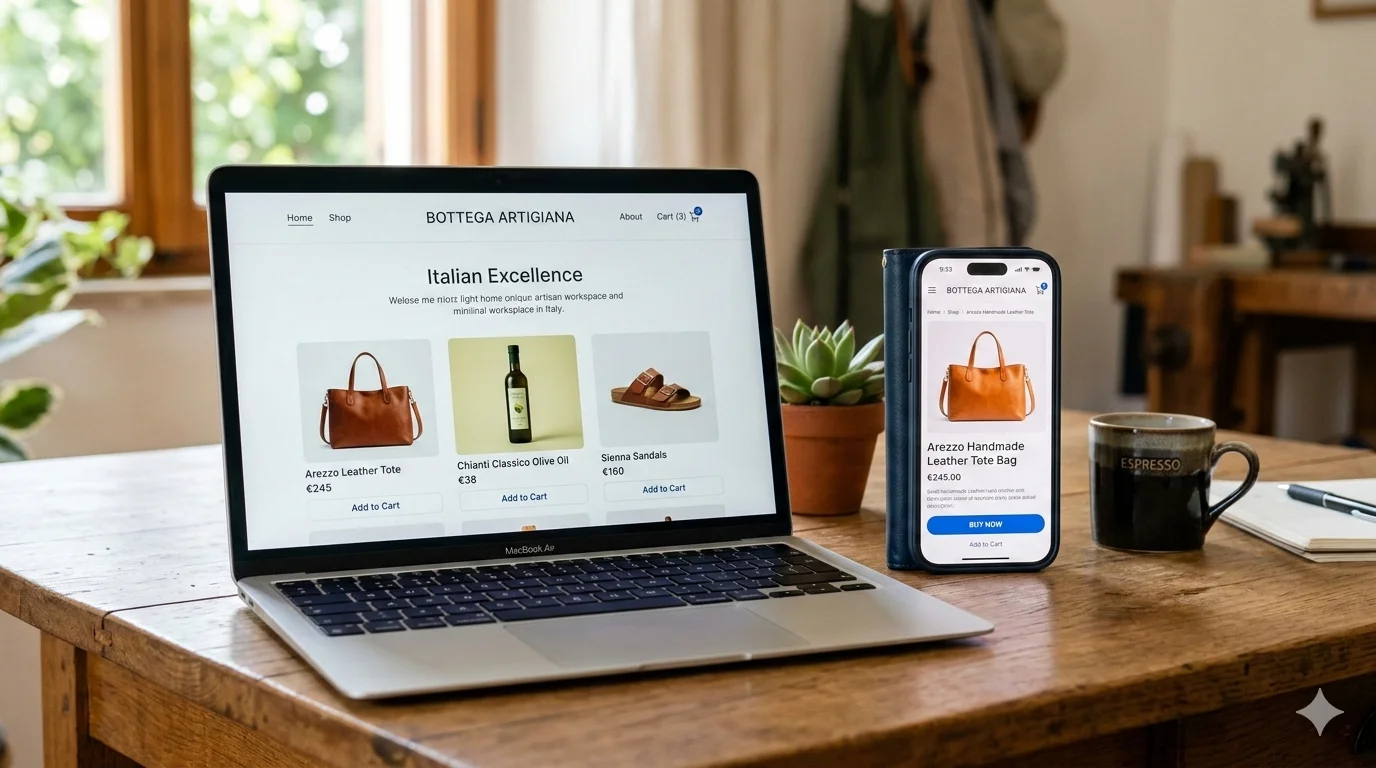
87% of Italian small businesses don't sell online. Here's why that's a problem (and an opportunity)
E-commerce in Italy surpassed €85 billion in 2024, growing 6% year over year. But here's the number every business owner should pay attention to: only 13% of Italian SMEs sell online — compared to an EU average of 18%. That means 87% of small businesses are leaving money on the table.
It's no longer a question of "whether" to open an online store. The question is how to do it right, avoiding the mistakes that doom most e-commerce sites to failure within the first 12 months. In this guide, we'll show you the pillars of an e-commerce that actually works, how much it costs, how to fund it, and why going DIY might cost you more than a professional investment.
Why your business needs an e-commerce in 2026
The numbers speak for themselves. Italian SMEs that have adopted e-commerce see an average 8.8% increase in revenue and a 64% improvement in margins compared to offline-only businesses. But the advantages go beyond revenue:
- Sell 24/7, 365 days a year — your physical store closes at 7 PM. Your e-commerce doesn't. 43% of online purchases happen outside traditional business hours
- Reach customers everywhere — you're no longer limited to your area. A shop in Bolzano can sell to Milan, Rome, Munich
- Reduce operating costs — no additional rent, no extra staff, automated inventory management
- Collect customer data — every visit, every purchase, every abandoned cart tells you something. Data that helps you make better decisions
- Compete with the big players — a well-built e-commerce levels the playing field. Your handcrafted product competes on equal footing with national chains
63% of online purchases in Italy happen on mobile. Your potential customer is on the couch, on the train, during lunch break — searching for exactly what you sell. If they can't find you online, they'll find your competitor.
The 5 pillars of an e-commerce that actually sells
Opening an online store is easy. Making one that sells is a different story. Here's what separates a successful e-commerce from one that collects digital dust.
1. Mobile-first design: the store that fits in your pocket
79% of e-commerce traffic comes from smartphones. But here's the problem: the cart abandonment rate on mobile is 86% — versus 73% on desktop. Why? Because most online stores are designed for desktop and then "adapted" for mobile.
A professional e-commerce is designed starting from mobile: thumb-friendly navigation, large buttons, 3-tap checkout, fast-loading images. Design isn't aesthetics — it's revenue. A site that loads in 2 seconds instead of 5 can triple its conversion rate.
2. A product catalogue that drives sales
Online, customers can't touch, try, or smell your products. Photos and descriptions are your sales staff. You need:
- Professional photos — at least 3-4 per product, with zoom, detail shots, and context of use
- Descriptions that sell — not "Blue t-shirt size M", but "Organic cotton t-shirt, slim fit, perfect for the office and weekends"
- Clear variants — colours, sizes, materials with real-time availability
- Customer reviews — 93% of consumers read reviews before buying
A well-structured catalogue with smart filters, advanced search, and personalised suggestions can make the difference between a visitor who buys and one who leaves your site.
3. Secure and diverse payment options
In Italy, payment preferences are evolving rapidly. Digital wallets now account for 35% of online purchases, surpassing card payments (31-33%). If your e-commerce only accepts credit cards, you're losing customers.
A modern e-commerce must offer:
- Credit and debit cards — Visa, Mastercard, American Express
- Digital wallets — PayPal, Apple Pay, Google Pay
- Local payment methods — Satispay is growing rapidly among Italian consumers
- Cash on delivery — still preferred by 12% of Italian online shoppers
- Buy now, pay later — instalment payments increase average order value by 20-30%
Security is non-negotiable. SSL certificate, PCI-DSS compliance, 3D Secure authentication — these are requirements that a professionally developed e-commerce includes by default.
4. Integrated logistics and shipping
53% of abandoned carts in Italy are caused by shipping costs that are too high or delivery times that are too long. Logistics isn't a detail — it's a decisive factor for your online store's success.
A professional e-commerce integrates:
- Automatic shipping calculation — real-time rates based on weight, dimensions, and destination
- Integrated tracking — customers follow their package without leaving your site
- Automated returns management — Italian law requires a 14-day return window. A clear, simple return process builds customer trust
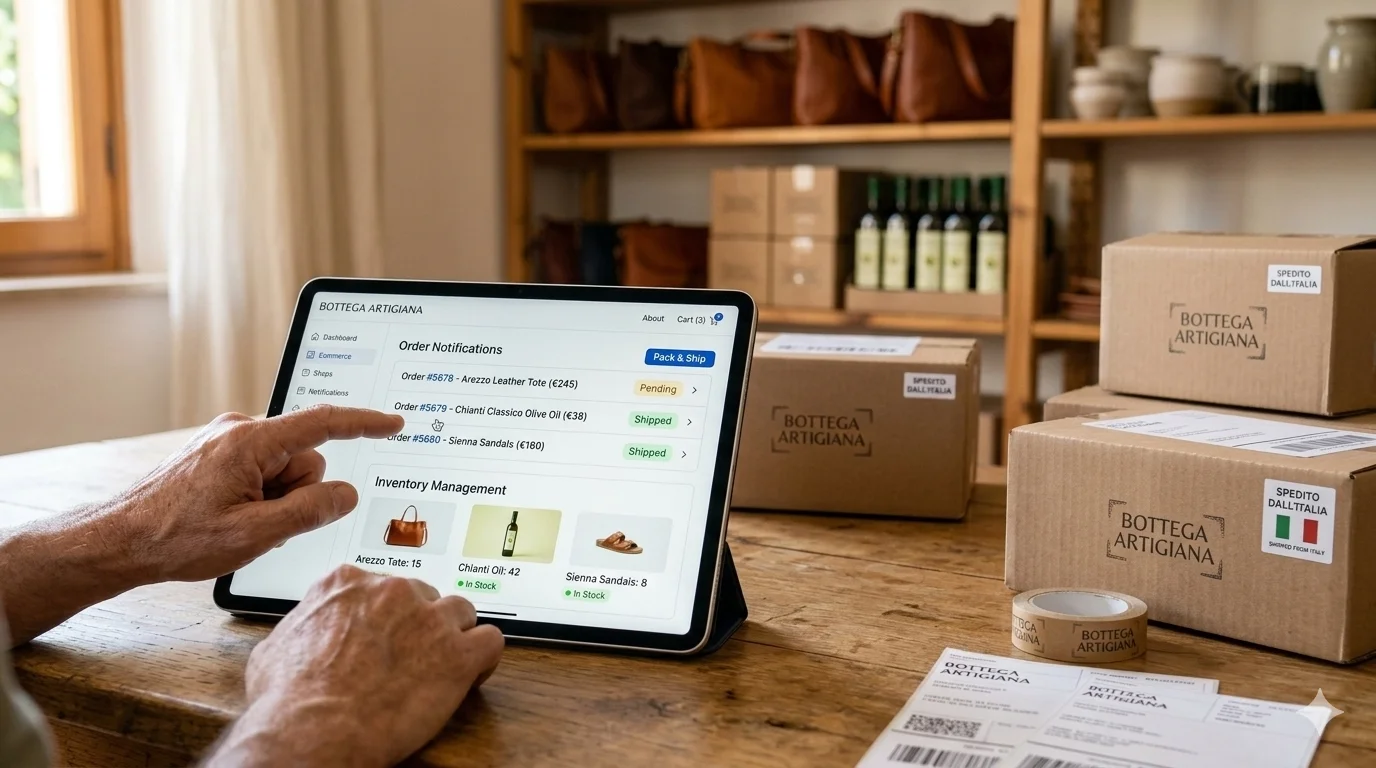
- Warehouse synchronisation — inventory updated in real-time between physical store and online, preventing sales of out-of-stock products
For businesses in South Tyrol selling to Italy, Austria, and Germany, managing cross-border shipping requires specific expertise — from intra-EU VAT to bilingual Italian-German labels.
5. SEO and visibility: getting found on Google
A beautiful, functional e-commerce that's invisible on Google is like a shop in a dead-end alley. SEO (Search Engine Optimisation) is what brings organic customers — without paying for advertising for every single visitor.
An SEO-optimised e-commerce includes:
- Readable URLs — "/products/handmade-leather-shoes" instead of "/prod?id=47291"
- Optimised titles and descriptions for the keywords your customers search on Google
- Structured data — information that displays price, availability, and reviews directly in Google search results
- Fast loading speed — Google penalises slow sites. An e-commerce must load in under 3 seconds
- Integrated blog — useful content that attracts organic traffic and builds authority in your industry
Want to learn more about how Google visibility works for a local business? Read our guides on how to appear on Google Maps and how to list your business on Google for free.
Want to take your business online with an e-commerce that actually sells? Ivemind designs and develops custom online stores for small and medium businesses — from mobile-first design to full integration with your management system. Let's talk →
How much does a professional e-commerce cost
This is the question everyone asks. And the honest answer is: it depends on what you need. Just like a traditional website (we covered this in detail in our article on how much a website costs for a small business), the price varies based on project complexity.
Here are the realistic price ranges for a professional e-commerce in Italy:
- Basic e-commerce (up to 50 products) — €3,000 to €5,000. Simple catalogue, integrated payments, responsive design. Ideal for testing online sales with a contained investment
- Intermediate e-commerce (50-500 products) — €5,000 to €15,000. Advanced filters, variant management, courier integration, multilingual. The right choice for established shops that want to sell seriously online
- Advanced e-commerce (500+ products) — €15,000 to €40,000+. ERP/management system integration, marketplace, advanced customisation, combined B2B and B2C. For businesses with complex catalogues and significant volumes
On top of development costs, there are recurring costs: hosting (€50-200/month), maintenance and updates (€100-300/month), and payment processing fees (1.5-3% per transaction).
Going DIY with pre-built templates costs less upfront, but costs more in the long run: limited customisation, poor mobile performance, insufficient SEO, no integration with your systems. And when the template isn't enough, you start over — spending double.
Funding and grants for your e-commerce
Here's the news many business owners don't know: the Italian government and the Province of South Tyrol actively fund e-commerce creation for small businesses. Non-repayable grants — money you don't have to pay back.
Transition 5.0: tax credit up to 45%
The Transition 5.0 plan provides a tax credit for investments in digital capital goods, including software and e-commerce platforms. For small businesses, the credit can reach up to 45% of the investment. In practice: on a €10,000 e-commerce, you can recover up to €4,500 in tax credits.
Province of South Tyrol: up to 60% non-repayable
If your business is based in the Province of South Tyrol, you can access a non-repayable grant of up to 60% on digitalisation projects between €2,000 and €15,000. An e-commerce falls perfectly within eligible expenses. The provincial budget is €3.5 million per year through 2028. Read our complete guide on non-repayable grants for small businesses in South Tyrol for all the details.
Want to know exactly which grants you can get for your e-commerce? Ivemind helps you identify the right funding programmes and prepare the application. The first consultation is free. Let's talk →
MIMIT Voucher: 50% up to €20,000
The Italian Ministry of Enterprise has allocated €150 million for a voucher covering 50% of digitalisation expenses. E-commerce platforms, order management software, and CRM integrations are among eligible expenses.
- Grant: up to €20,000 (50% of the project)
- Minimum spend: €4,000
- Who can access: SMEs and self-employed professionals
Nuova Sabatini
For larger investments, the Nuova Sabatini programme offers an interest contribution of up to 3.575% annually. On a €50,000 e-commerce project, that means approximately €5,000 in non-repayable grants. The 2026-2027 budget is €650 million.
In practice: a €10,000 e-commerce can cost you just €4,000 by combining the provincial grant. An investment that pays for itself with your first online sales.
The 5 mistakes that kill an e-commerce
The failure rate for e-commerce sites in the first 12 months is staggeringly high. In our experience, these are the most common — and most costly — mistakes.
1. "I'll do it myself with a template"
Generic templates are tempting: a few hundred euros and you have an online store. But a template doesn't know your business. It doesn't know that your customer needs to filter by material, that your shipping has different rates for South Tyrol and the rest of Italy, that your management system uses a specific protocol. After 6 months of frustration and missed sales, you start over — spending double.
2. Ignoring mobile
63% of online purchases happen on smartphones. An e-commerce that doesn't work perfectly on mobile loses more than half of potential customers. It's not enough that it "looks OK": it needs to be fast, intuitive, and allow purchases in just a few taps.
3. Neglecting SEO
You can have the most beautiful online store in the world, but if nobody finds it on Google, you won't sell anything. SEO isn't an add-on for later — it's the foundation you build everything on. An e-commerce without SEO is like opening a shop in the countryside with no sign. Read our guides on how to promote your business to understand how important online visibility is.
4. Not integrating your systems
If you're manually updating inventory, transcribing orders into your management system, and copying invoices one by one, your e-commerce isn't working for you — it's creating more work. Integration with your management system, electronic invoicing (mandatory in Italy), and shipping systems is what makes an e-commerce sustainable long-term.
5. Launch and forget
An e-commerce isn't a brochure website. It requires constant updates: new products, seasonal promotions, SEO content, data analysis, conversion optimisation. Businesses that sell online successfully dedicate at least 5-10 hours per week to store management — or rely on a partner to do it for them.
Ivemind: your e-commerce partner
Ivemind is a social cooperative and innovative startup based in Bolzano, South Tyrol. We design and develop custom e-commerce solutions for small and medium businesses — from mobile-first design to full integration with your management system, from SEO to payment configuration.
We don't sell templates. We build online stores that sell, designed around your business, your customers, and your goals. We've helped 47+ companies and organisations build their digital presence, with 100% client satisfaction.
With Ivemind you get:
- Market analysis — we study your customers, your competitors, and online opportunities before writing a single line of code
- Mobile-first design — every element designed to convert on smartphones, where 63% of purchases happen
- Full integration — management system, electronic invoicing, couriers, payments: everything connected and automated
- Built-in SEO from day one — your e-commerce is born already optimised for Google, with structured data and perfect URLs
- Ongoing support — we don't abandon you after launch. Updates, optimisations, technical assistance
- Grant assistance — we guide you through accessing non-repayable funds to reduce your initial investment
60% of our profits are reinvested in social inclusion projects — choosing Ivemind isn't just a technology choice, it's a values choice.
Contact us for a free consultation or discover our e-commerce development services. Want to also integrate artificial intelligence into your business? We can help with that too.