
How to Sell Online in 2026: Amazon, Marketplace or Your Own E-commerce?

In 2026, Italian e-commerce is worth over 58.8 billion euros (data from the Politecnico di Milano B2C Observatory), representing a 13% increase from the previous year. Yet according to ISTAT figures, only 14.4% of Italian SMEs sell online. That means 85% of small and medium-sized businesses are leaving a nearly 60-billion-euro market untouched. Not because they lack products to sell, but because they lack clear information on how to sell online effectively and sustainably.
If you're reading this guide, you're probably in one of these situations: you have a physical business and want to expand into online sales, you have a product and aren't sure whether Amazon or your own e-commerce store makes more sense, or you want to understand the real costs of selling on Amazon before taking the plunge. In all these cases, you're in the right place.
In this guide we break down every option in detail: from Amazon to alternative marketplaces, from building your own e-commerce store to the tax and legal considerations. With real numbers, commissions updated for 2026, and a concrete roadmap for anyone starting from zero. Because selling online isn't hard — but doing it without a strategy is the fastest way to lose money.
Selling online in 2026: the state of the market in Italy
Before choosing where to sell, you need to understand the context. The Italian e-commerce market has reached a maturity that few would have predicted a decade ago. Italy's 35.2 million digital consumers (59% of the population) spend an average of 1,670 euros per year online per capita. This isn't a niche market — it's a mass market.
The top-selling categories online in Italy in 2026 are:
- Consumer electronics: 8.6 billion euros
- Fashion and apparel: 6.1 billion euros
- Food and grocery: 4.8 billion euros (+18% over 2025)
- Furniture and living: 4.2 billion euros
- Beauty and personal care: 2.9 billion euros
But the most relevant figure for an SME isn't total volume — it's the distribution of sales. Amazon dominates with roughly 35% of the Italian e-commerce market, but the remaining 65% is split among thousands of independent online stores, vertical marketplaces, and niche platforms. This means there's still room — plenty of room — for those who enter with the right strategy.
Another key statistic: 78% of Italian shoppers begin their product search on Google, not on Amazon. This busts the myth that Amazon is the only gateway to online commerce. For businesses with a well-positioned e-commerce store, organic visibility on Google represents a powerful customer acquisition channel — with zero commissions.
Mobile commerce (purchases from smartphones) now accounts for 55% of all online transactions in Italy. Anyone selling online in 2026 without a flawless mobile experience is automatically excluding more than half of their potential customers.
Amazon: real costs, commissions and when it makes sense
Let's start with the 800-pound gorilla in the room. Amazon Italy receives over 120 million monthly visits and lists approximately 200 million products in its catalogue. Selling on Amazon means accessing an enormous customer base — but at what price? Let's look at the real costs in detail, because when it comes to how much it costs to sell on Amazon, the answer is almost always "more than you think".
The two Amazon selling plans
Amazon offers two options for sellers:
Individual Plan:
- No monthly subscription fee
- Fixed commission of 0.99 euros per item sold (in addition to the category referral fee)
- Suitable for those selling fewer than 40 items per month
- No access to advanced tools (advertising, reports, Buy Box)
Professional Plan:
- Monthly fee of 39.00 euros + VAT
- No per-item fixed commission (only the category referral fee)
- Required for those selling more than 40 items per month
- Access to all selling tools, including Amazon Ads advertising
Referral fees by category
Here's where the real cost lies. On every sale, Amazon retains a percentage referral fee that varies by category. The Amazon selling costs updated for 2026:
- Electronics: 7-8%
- Computers and accessories: 7%
- Clothing and accessories: 15.45%
- Shoes and handbags: 15.45%
- Home and garden: 15.45%
- Grocery and household: 8-15%
- Beauty and personal care: 8-15%
- Books: 15%
- Sports and outdoors: 15.45%
- Toys: 15.45%
- Jewellery: 20.39%
Important: these percentages apply to the total price paid by the customer, including shipping charges. If you sell a product for 50 euros with 5 euros shipping, the 15% referral fee is calculated on 55 euros, not 50.
FBA (Fulfilled by Amazon) logistics costs
Most successful Amazon sellers use the FBA (Fulfilled by Amazon) service: you ship your products to Amazon's warehouses, and they handle storage, shipping, returns, and customer service. It's convenient, but comes at a significant cost:
- Fulfilment fee: from 2.70 euros (small and light items under 400g) to 15+ euros for large and heavy items
- Monthly storage: 26-36 euros/cubic metre per month (with 50% surcharges during October-December)
- Long-term storage: additional penalties for products sitting in warehouses beyond 181 days
- Returns processing: included in the FBA cost, but returned products often come back in non-resaleable condition
Concrete example: real margin on a 30-euro product
Let's take a product in the "Home and Garden" category sold at 30 euros with free shipping (included in the price):
- Selling price: 30.00 euros
- Amazon referral fee (15.45%): -4.64 euros
- FBA cost (standard item): -4.50 euros
- Product cost (purchase/production): -8.00 euros
- VAT (22% on net): -5.41 euros
- Net margin: 7.45 euros (24.8%)
That same product sold on your own e-commerce store, with no marketplace commissions and negotiated shipping costs of 4 euros, would yield a net margin of roughly 12.50 euros (41.6%). The difference is enormous — but sales volume on Amazon can be significantly higher, at least initially.
When selling on Amazon makes sense
Amazon makes sense in specific situations:
- Launch phase: to test product demand without investing in a full e-commerce store
- High-volume, low-competition products: where sales volume offsets reduced margins
- Established brands: using Amazon as an additional channel (not the only one)
- Products with margins above 40%: that can absorb commissions while maintaining profitability
When it does NOT make sense: products with margins below 30%, heavy or bulky products (high FBA costs), markets with intense competition from Chinese sellers, products requiring personalised after-sales support.
Other marketplaces: Etsy, eBay, Facebook Marketplace
Amazon isn't the only marketplace. Depending on your product, there are alternatives that can offer better margins, less competition, and a more targeted audience.
Etsy
Etsy is the go-to marketplace for handmade, vintage, and creative products. With over 95 million active buyers worldwide, it's an excellent platform for artisans, artists, and small Italian producers — especially those selling Made in Italy goods.
Etsy costs in 2026:
- Listing fee: 0.20 USD per product listed (lasts 4 months)
- Transaction fee: 6.5% on total price (including shipping)
- Payment processing fee: 4% + 0.30 euros per transaction
- No mandatory monthly subscription (though Etsy Plus at 10 USD/month offers additional tools)
The overall cost on Etsy runs around 10-12% per transaction — significantly less than Amazon. The audience is also very different: they're looking for uniqueness, story, craftsmanship. If you sell handmade products, ceramics, artisan jewellery, or local specialty products, Etsy is often a better choice than Amazon.
eBay
eBay remains a relevant marketplace in Italy with approximately 25 million monthly visitors. Unlike Amazon, eBay is better suited for used products, collectibles, refurbished electronics, and niche items.
eBay costs in 2026:
- Free listings: 50-100 listings/month at no charge (depending on account type)
- Final value fee: 10-13% (varies by category)
- eBay Store subscription: from 19.95 euros/month (Basic) to 349.95 euros/month (Premium)
- Payment processing costs: included in the final value fee
eBay is particularly interesting for those selling surplus stock, refurbished products, or vintage items. Commissions are comparable to Amazon, but competition from large sellers is generally lower.
Facebook Marketplace and Instagram Shopping
Facebook Marketplace has a unique advantage: zero commissions on local sales (seller meets buyer in person). For shipped sales, the commission is 5% or 0.40 euros for orders under 8 euros.
Instagram Shopping, integrated with Facebook Commerce, lets you tag products in posts and stories, turning your feed into a shopfront. It's not a marketplace in the traditional sense, but it's a powerful sales channel for visually attractive products — fashion, food, design, home decor.
The limitation of Facebook/Instagram is that they work best as complementary channels to your own e-commerce store, not as standalone sales channels. They don't offer Amazon's logistics infrastructure or Etsy's specialisation.
Vertical and specialised marketplaces
Don't forget sector-specific marketplaces: platforms dedicated to food, crafts, or Made in Italy products. These marketplaces have lower volumes but a far more qualified audience and often lower commissions (6-10%). For an SME with niche products, they can be the ideal entry point into online sales.
Your own e-commerce store: total freedom but strategy required
Selling on a marketplace is like opening a shop in a shopping centre: you get guaranteed footfall, but you pay high rent and must follow the landlord's rules. Your own e-commerce store is like opening a shop on the high street: you're the owner, you set the rules, but you need to bring in customers yourself.
In 2026, creating an e-commerce store has never been more technically accessible. But "accessible" doesn't mean "easy to make work". A successful online store requires strategy, investment, and specific expertise.
The concrete advantages of your own e-commerce store
- Zero sales commissions: you only pay payment processing costs (1.4-2.9% + 0.25 euros per transaction with major gateways)
- Customer data ownership: emails, purchase history, preferences — essential data for marketing and customer retention
- Total brand control: design, communication, shopping experience — everything reflects your identity
- Higher margins: without 15-20% commissions, net margin increases significantly
- Independence: no risk of account suspension, no rule changes imposed by third parties
- SEO and organic traffic: a well-optimised e-commerce store generates continuous traffic from Google without advertising costs
- Scalability: you can expand your catalogue, add features, and enter new markets without limits
Real e-commerce costs in 2026
For an Italian SME, the costs of a professional e-commerce store break down as follows:
- Basic e-commerce development (100-500 products): 3,000-8,000 euros one-off
- Advanced e-commerce development (500+ products, custom features): 8,000-20,000 euros one-off
- Hosting and infrastructure: 200-600 euros/year
- Maintenance and updates: 500-2,000 euros/year
- Payment gateway: 1.4-2.9% + 0.25 euros per transaction
- SSL, domain, email: 50-200 euros/year
For a deeper dive into costs and options for building a bespoke e-commerce store, see our complete guide to creating an e-commerce store for small businesses.
The hidden cost: marketing
This is where many fail. Building an e-commerce store without a marketing plan is like opening a beautiful shop in a dead-end alley. Nobody will find it. Marketing costs for an e-commerce store in the first 12 months include:
- SEO and content marketing: 300-1,000 euros/month (but generates lasting results)
- Google Ads: 500-2,000 euros/month for a launching e-commerce store — find out how much Google Ads really costs for an SME
- Social media marketing: 300-800 euros/month (management + content)
- Email marketing: 20-100 euros/month (platform) + time for content creation
In total, a launching e-commerce store requires a marketing investment of 1,500-4,000 euros/month for the first 6-12 months. That sounds like a lot, but compare it to Amazon commissions: on 10,000 euros/month in revenue, Amazon takes 1,500-2,000 euros in commissions. Every month. Forever. The marketing investment in your own e-commerce store, by contrast, builds an asset that grows over time.
If you're based in South Tyrol, be aware that there are grants and funding programmes that can cover a significant portion of the initial investment in digitising your business.
E-commerce without a warehouse: dropshipping
One of the most frequently searched topics is selling online without a warehouse. The answer exists and it's called dropshipping: you sell products you don't physically hold in stock. When a customer places an order, it's forwarded to the supplier who ships directly to the end customer.
Dropshipping pros: near-zero initial investment for inventory, no unsold stock risk, potentially unlimited catalogue.
Dropshipping cons: razor-thin margins (10-20%), no control over quality or delivery times, fierce competition (everyone sells the same products), total dependence on the supplier, often long delivery times (7-20 days if the supplier is in Asia).
Dropshipping in 2026 isn't dead, but it's much harder than online gurus promise. It only works with niche products, reliable European suppliers, and a very aggressive marketing strategy. For the majority of Italian SMEs, it makes more sense to start with a small catalogue of your own products and grow gradually.
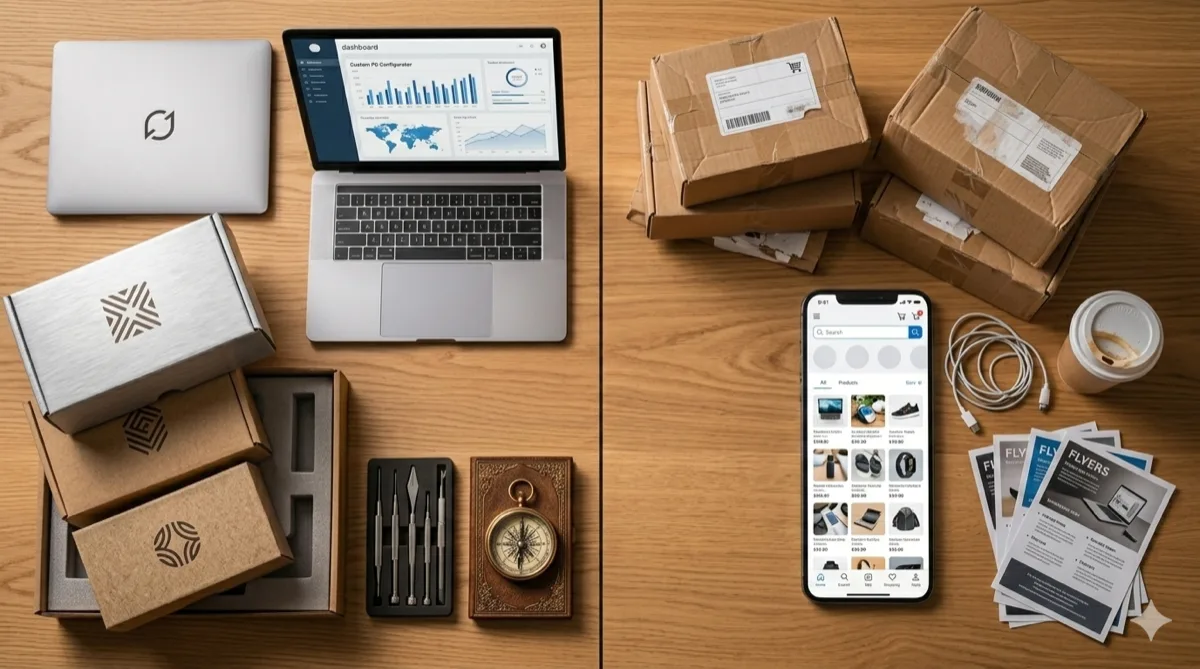
Marketplace vs own e-commerce store: direct comparison
Let's get to the heart of the matter. Marketplace or own e-commerce store? The answer, as is often the case, is "it depends" — but we can make it much more concrete with a direct comparison.
Cost comparison on 100,000 euros/year revenue
Selling on Amazon (FBA):
- Monthly subscription: 468 euros/year
- Referral fees (15% average): 15,000 euros/year
- FBA costs (average 4 euros/order across 3,000 orders): 12,000 euros/year
- Amazon Ads (minimum competitive spend): 3,000 euros/year
- Total cost: approximately 30,468 euros/year (30.5% of revenue)
Own e-commerce store:
- Maintenance and hosting: 1,500 euros/year
- Payment gateway (2% average): 2,000 euros/year
- Marketing (SEO + Ads + social): 18,000 euros/year
- Logistics and shipping (average 4 euros/order across 3,000 orders): 12,000 euros/year
- Total cost: approximately 33,500 euros/year (33.5% of revenue)
The overall costs in year one are surprisingly similar. But there's a fundamental difference: Amazon costs grow proportionally with revenue (the more you sell, the more you pay). Your own e-commerce costs, by contrast, grow much less — because organic traffic from SEO increases without additional costs, and fixed costs (hosting, maintenance) remain stable. In year two, with doubled revenue, Amazon costs 30% more. Your own e-commerce might cost only 10-15% more.
The data ownership factor
There's an element that doesn't appear in any financial calculation but is worth more than any commission: customer data. On Amazon, you don't know who your customers are. You don't have their emails, you don't know their preferences, you can't re-contact them. If Amazon closes your account tomorrow, you lose everything. With your own e-commerce store, you have a customer database you can nurture, build loyalty with, and reactivate. It's a business asset that grows in value over time.
The hybrid strategy: the smart choice
The truth is that you don't have to choose one or the other. The winning strategy for most SMEs is a hybrid approach:
- Start with a marketplace (Amazon or Etsy) to validate your product and generate initial revenue
- Invest early profits in your own e-commerce store — build your primary sales channel
- Use the marketplace as a secondary channel for volume and visibility, while your e-commerce becomes the core of the business
- Gradually migrate customers from the marketplace to your own store (with exclusive offers, loyalty programmes, premium content)
This strategy gives you the best of both worlds: the volume of the marketplace and the profitability of your own e-commerce store. To implement it properly, however, you need a well-structured digital marketing strategy.
Do you need a VAT number? Tax rules for selling online
One of the most commonly searched questions is whether you can sell online without a VAT registration. The answer is yes, but with very specific limits that have become even stricter in 2026.
When you can sell without VAT registration
In Italy, you can sell online without a VAT number (partita IVA) only in very specific cases:
- Occasional sales: selling personal used items (clearing out your wardrobe, selling your old phone) doesn't require VAT registration. The Italian tax authority considers these "occasional" sales not subject to taxation, provided they aren't habitual
- Occasional freelance work: if you sell services (not products) on an occasional basis, you can invoice with an occasional services receipt up to 5,000 euros/year in net fees
- Hobby sales: selling handmade items as a hobby, without regularity and without business organisation, may fall under occasional sales
When VAT registration is mandatory
VAT registration becomes mandatory the moment your selling activity becomes habitual and continuous. There is no precise revenue threshold below which you are automatically "occasional" — it's a qualitative concept, not a quantitative one. In practice, if:
- You have an organised product catalogue
- You sell regularly (multiple times per month)
- You advertise to promote sales
- You buy products with the specific intention of reselling them
- You have a professional seller account on a marketplace
...then the Italian tax authority will consider you a business in all respects, and VAT registration is mandatory. It's not a question of "how much" you invoice, but "how" you sell.
The flat-rate scheme: the most common choice for beginners
For those registering for VAT to sell online, the Italian flat-rate scheme (regime forfettario) remains the most advantageous option in 2026:
- Maximum revenue: 85,000 euros/year
- Substitute tax rate: 15% (reduced to 5% for the first 5 years of activity)
- Profitability coefficient for commerce: 40% (you pay tax on only 40% of revenue)
- No mandatory electronic invoicing below 25,000 euros (though it's still recommended)
- INPS social security contributions: approximately 4,200 euros/year fixed + a percentage on income above the threshold
In practice, with the flat-rate scheme at 5%, on a revenue of 50,000 euros you pay: taxable income (40%) = 20,000 euros, substitute tax (5%) = 1,000 euros, INPS contributions = approximately 5,800 euros. Total tax burden: approximately 6,800 euros on 50,000 in revenue — an effective rate of 13.6%. Not bad at all.
However, note that the flat-rate scheme doesn't allow you to deduct VAT on purchases. For a business with high merchandise costs, the standard scheme may be more advantageous. Consult an accountant specialising in e-commerce before choosing.
Specific obligations for online selling
Those selling online with VAT registration must also:
- Register with the Chamber of Commerce (Business Register)
- Submit a SCIA (Certified Notification of Business Start) to the municipality
- Comply with the 14-day right of withdrawal for consumers
- Publish general terms and conditions of sale on the website
- Provide clear information on prices, shipping, and return policies
- Comply with GDPR for personal data processing
How to get started: the roadmap for selling online from scratch
Enough theory. Here's a practical 7-step roadmap for anyone who wants to start selling online in 2026, starting from zero.
Step 1: Validate the product (week 1-2)
Before investing a single euro, make sure there's real demand for your product online. Here's how:
- Search for your product on Amazon and analyse competitor reviews: what do people like? What's missing?
- Use Google Trends to check demand trends over time
- Check search volumes on Google (free tools like Ubersuggest or Google Keyword Planner)
- Create a simple landing page and invest 100 euros in Google Ads to test real interest
If nobody is searching for your product online and nobody clicks on your ads, perhaps the product isn't suited for online sales — or it needs repositioning.
Step 2: Define your tax structure (week 2-3)
If you've validated your product and intend to sell regularly, register for VAT. The recommended choice for beginners: flat-rate scheme with ATECO code 47.91.10 (online retail of any type of product). Start-up cost with an accountant: 200-500 euros.
Step 3: Choose your initial sales channel (week 3-4)
For the first 3-6 months, the best choice for most SMEs is to start with a marketplace:
- Amazon if you sell commercial or mass-market products
- Etsy if you sell artisan, handmade, or creative products
- eBay if you sell used, refurbished, or niche products
The goal of this phase: understand the market, gather initial feedback, generate your first sales, and learn the craft of being an online seller.
Step 4: Build your own e-commerce store (month 2-4)
In parallel with marketplace sales, begin developing your professional e-commerce store. Don't wait until you have high revenue: the time needed to rank on Google and start receiving organic traffic is 4-8 months. The sooner you start, the sooner you reap the rewards.
Essential elements for an effective e-commerce store in 2026:
- Professional, mobile-first design
- Product pages with high-quality photos, detailed descriptions, and reviews
- Secure payment system with multiple options (card, PayPal, bank transfer)
- Clear and visible return policy
- SEO optimisation across all pages
- Blog for content that attracts organic traffic
- Integration with Google Analytics and monitoring tools
If you operate in South Tyrol or bilingual areas, consider creating a bilingual e-commerce store to reach both the Italian and German-speaking markets.
Step 5: Activate digital marketing (month 3-6)
An e-commerce store without marketing is a shop without a sign. Priorities for the first months:
- On-page SEO: optimise every product page for relevant keywords
- Google Ads: Shopping and Search campaigns for the highest-converting commercial keywords
- Social media: create content showing the product in use, tell the brand's story
- Email marketing: start building your email list from day one — it's the most valuable asset in your online business
For a comprehensive overview, see our complete guide to digital marketing for SMEs.
Step 6: Optimise and scale (month 6-12)
After the first few months, you'll have real data to work with. Analyse:
- Which products sell the most (and which ones just take up space)
- Where customers come from (Google, social media, paid ads, direct traffic)
- What the customer acquisition cost (CAC) is for each channel
- What the average order value is and how to increase it (cross-selling, up-selling, bundles)
This phase is crucial: it's where most online sellers make the difference between a business that merely survives and one that thrives.
Step 7: Diversify and consolidate (year 2+)
Once your e-commerce store generates stable traffic and sales:
- Expand your catalogue with complementary products
- Consider entering new marketplaces (not just Amazon — each marketplace is an additional channel)
- Implement a loyalty programme to increase customer lifetime value
- Consider internationalisation: selling abroad from your Italian e-commerce store
The 5 mistakes that cause online sellers to fail
In years of consulting with SMEs looking to sell online, we've seen the same mistakes repeated with striking regularity. Here are the five most common — and most costly.
1. Starting without calculating real margins
This is the number one mistake. The seller calculates: "the product costs me 10 euros, I sell it for 30, I make 20". But they haven't accounted for: marketplace commissions (4.50 euros), shipping costs (4 euros), packaging (1 euro), average returns (8% of products come back), advertising costs (3 euros to acquire a customer), taxes (between 5% and 15% depending on the scheme). The "profit" of 20 euros turns into a real margin of 4-6 euros. If you haven't done these calculations before starting, you risk selling a lot and earning nothing — or worse, losing money on every sale.
2. Depending on a single sales channel
Putting all your eggs in one basket is dangerous in any business, but in online commerce it's potentially fatal. Sellers who depend 100% on Amazon live in constant anxiety: an algorithm change, an account suspension (even unjustified), a commission increase — and revenue drops to zero overnight. Your own e-commerce store is your insurance policy against these scenarios.
3. Ignoring logistics
Logistics is the Achilles' heel of most first-time online sellers. Selling online without a warehouse is possible (dropshipping), but service quality almost always suffers. If you manage your own warehouse, underestimating the time and space needed to store, package, and ship is a mistake you pay for dearly — in returns, negative reviews, and lost customers.
The solution: invest in a warehouse management system (even a well-structured Excel spreadsheet at the beginning), establish a shipping routine (same times, same process), and negotiate rates with at least 2-3 carriers so you always have a backup.
4. Underestimating customer service
Online, customer service is even more important than in a physical shop. The customer can't touch the product, can't speak to a shop assistant, can't come back the next day to complain in person. If they have a problem and don't receive a response within 24 hours, they leave a negative review. And one negative review on Amazon or Google carries more weight than ten positive ones.
Minimum time to dedicate to customer service: 1-2 hours per day for an e-commerce store with 5-20 daily orders. This is non-negotiable.
5. Not investing in content and brand
Photos taken with a phone on the kitchen table, descriptions copied from the supplier, zero storytelling. On a marketplace where there are hundreds of products similar to yours, the only differentiator is you: your brand's story, the quality of your photos, the care in your descriptions, the overall experience you deliver. Sellers who invest in quality content have conversion rates 2-3 times higher than those who don't.
For an SME, this means: professional product photography (cost: 10-30 euros per photo with a product photographer), original SEO-optimised descriptions, product-in-use videos, and an "About Us" page that tells the story behind the brand.
The next step: from theory to action
Selling online in 2026 isn't a choice between Amazon and your own e-commerce store — it's a multi-channel strategy that evolves over time. You start where the risk is lowest (a marketplace), build your own channel (the e-commerce store), and integrate all touchpoints into a coherent digital marketing strategy.
The numbers are clear: the market is there, the tools exist, and the barriers to entry have never been lower. But "lower" doesn't mean "non-existent". You need a strategy, specific expertise, and someone to guide you through the critical decisions — from tax structure to technical platform, from marketing to logistics.
At Ivemind, we help Italian SMEs sell online successfully. From e-commerce design and development to digital marketing strategy, from SEO to marketplace integration. We don't sell pre-packaged solutions: we analyse your business, your products, and your market to build a bespoke pathway.
Want to understand which online selling strategy is right for your business? Contact us for a free consultation. We'll analyse your situation together — products, margins, competition, budget — and propose a concrete plan to start selling online with the right strategy, without wasting money on blind trial and error.
Your next customer is searching for your product on Google right now. The question is: will they find you, or a competitor?
Related articles
Email Marketing for Small Business: How to Create a Newsletter that Converts in 2026
How to create a professional newsletter, build a mailing list and do email marketing with a ROI of €36 for every euro spent. Practical guide for SMEs.
Digital Marketing for SMEs: the Complete Guide to Getting Started in 2026
SEO, social media, email marketing, advertising: the complete digital marketing roadmap for SMEs with realistic budgets and priorities.
How to Build a Successful E-commerce for Your Small Business
Complete guide for small businesses: the 5 pillars of an e-commerce that sells, costs, grants up to 60%, and mistakes to avoid.