Management Software for Restaurants and Hotels: How to Choose the Right System in 2026
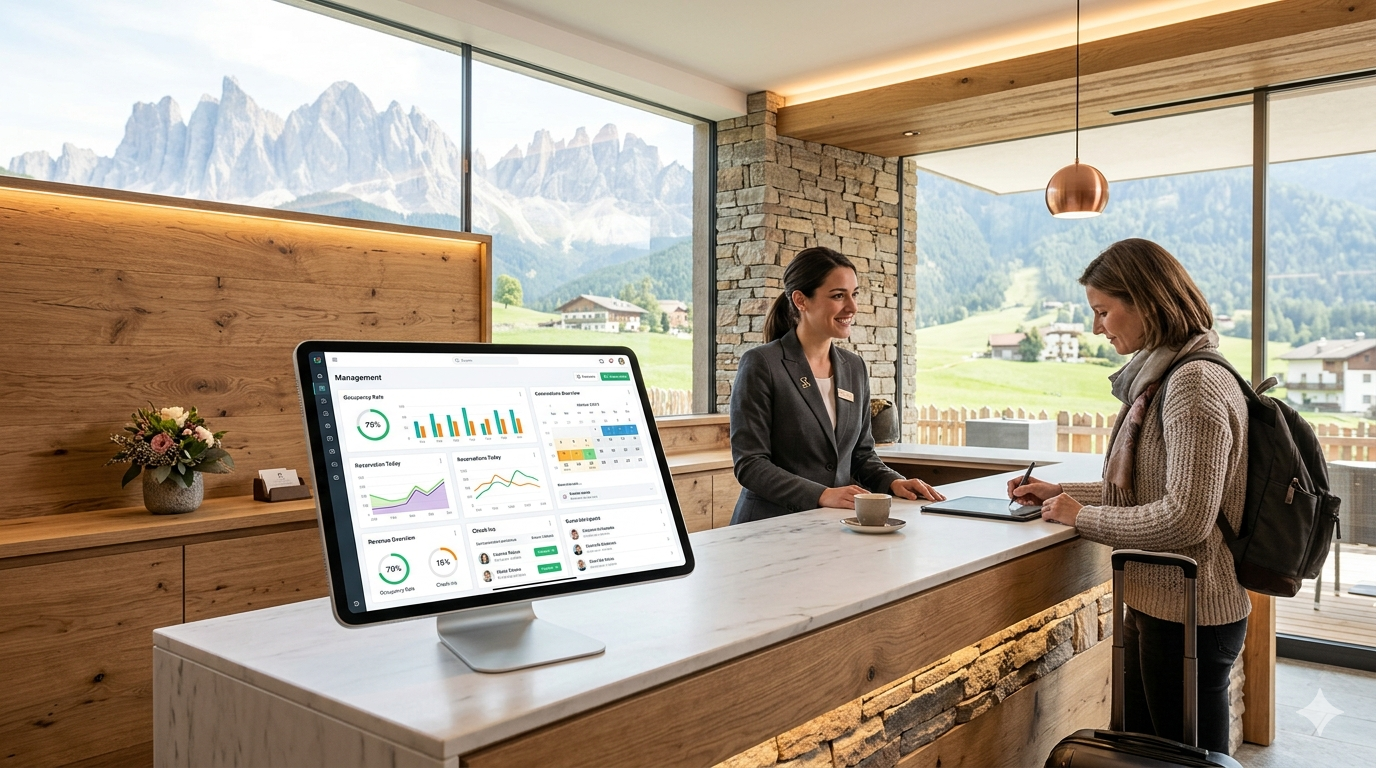
Why your restaurant or hotel needs management software in 2026 — not just a website
If you run a restaurant, hotel, B&B or pizzeria, you probably already have a website. Perhaps you even have a digital menu and online booking system. Great: that's the first step. But a website is your storefront — management software is the engine that runs everything behind the scenes.
Restaurant management software or hotel management software handles daily operations: orders, inventory, staff scheduling, invoicing, reservations, check-in, housekeeping. Without efficient management software, even the most beautiful website in the world won't save you from operational chaos.
The numbers speak clearly:
- According to FIPE (Italian Federation of Public Establishments), 68% of Italian restaurants that adopted management software reduced food waste by 15-25%
- Federalberghi 2025 data shows that hotels with a channel manager integrated into their management system record 22% more direct bookings compared to those managing channels manually
- ISTAT certifies over 35 million tourist overnight stays every year in Italy in 2025 — a volume that no establishment can manage with pen and paper or Excel spreadsheets
In Italy, where tourism is one of the driving sectors of the economy and seasonality demands intense peaks, restaurant management software or hotel management software is not a luxury — it's an operational necessity. And this applies to every type of hospitality business: from the B&B management system for a small family guesthouse to the hotel management system for a 100-room property, from the pizzeria management system to the downtown bar management system.
The difference between a business that thrives and one that merely survives often comes down to this: the ability to manage operations efficiently. A restaurant with 50 covers still using paper order pads loses an average of 45 minutes per day to errors, rewrites and miscommunication between front of house and kitchen. Over a month, that's 22 lost hours. Over a year, more than 260 hours — over an entire working month.
For hotels, the situation is even more critical. A 25-room property managing reservations with an Excel spreadsheet and manually updating availability on Booking.com and Expedia risks overbooking (with consequent terrible reviews), loses bookings during peak periods and cannot optimise rates based on real demand.
In this guide, we help you choose the right software. We compare the most popular SaaS solutions with custom development, show you real costs and explain how to fund the investment with non-repayable grants.
What restaurant management software must do
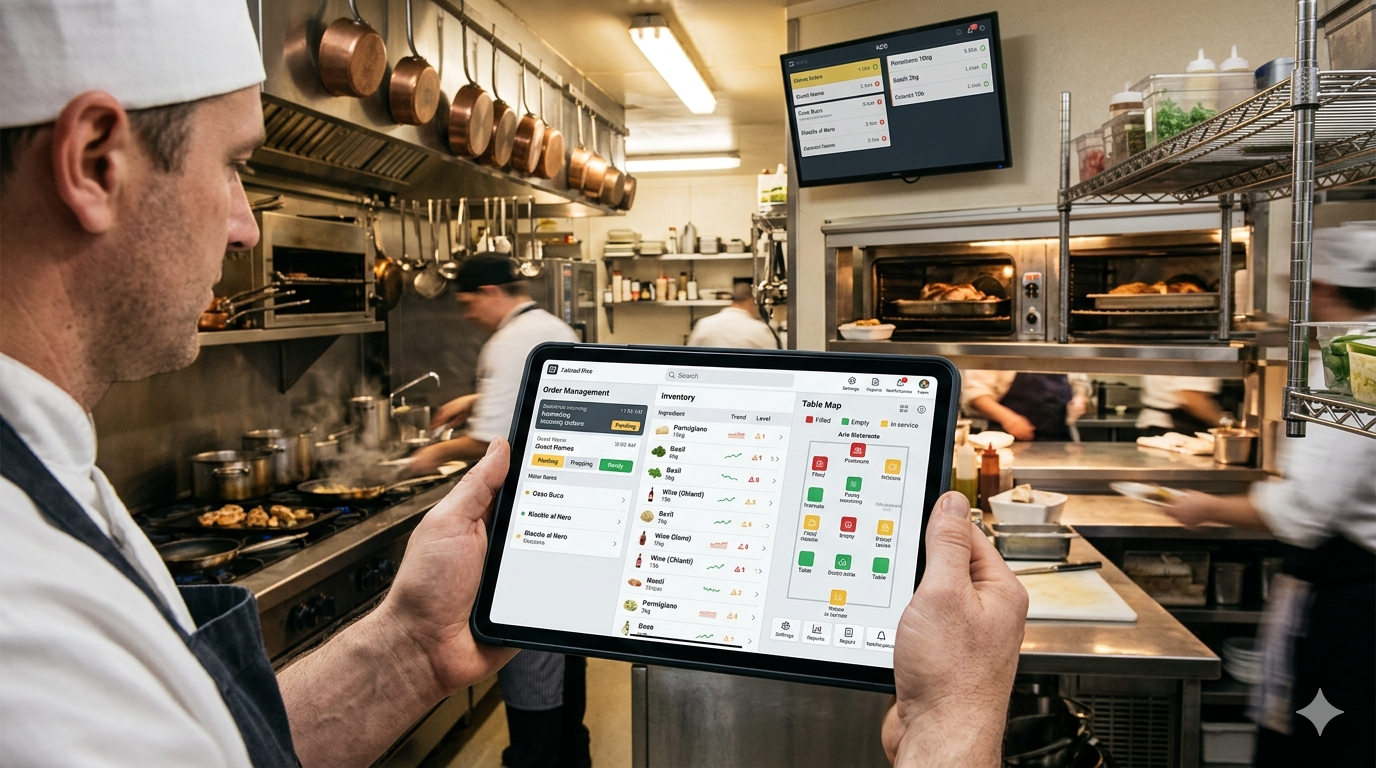
A modern restaurant management system is not just an advanced cash register. It's a platform that connects the dining room, kitchen, warehouse and administration in a single digital workflow. Here are the essential features.
Order management and POS
The core of every restaurant management software is the order-taking system. It must allow:
- Tablet or smartphone ordering — the waiter selects dishes, adds notes (allergens, modifications) and the order arrives instantly in the kitchen
- Table management — visual map of the dining room with each table's status (free, occupied, waiting for the bill)
- Integrated POS — card payments, contactless, Satispay, bill splitting between multiple people
- Digital menu integration — if you already have a digital menu with QR code, the management system must sync automatically for prices and availability
For a pizzeria management system, additional features are needed: home delivery management, integration with delivery platforms (Glovo, Deliveroo, Just Eat), takeaway orders with estimated preparation times. In many parts of Italy, where restaurants serve both local German-speaking customers and Italian and foreign tourists, the management system must support multilingual menus and handle regional variations (think Schlutzkrapfen or canederli alongside classic pizza).
For a bar management system, priorities differ: speed of checkout, drink dispensing management with mandatory registration for alcoholic beverages, quick counter product counting and integration with customer loyalty programmes.
Inventory control and food cost
Food waste costs Italian restaurants an average of €8,000-15,000 per year. Good management software reduces this cost with:
- Automatic stock deduction — when a dish is ordered, raw materials are automatically deducted from inventory
- Real-time food cost calculation — you know exactly how much each dish costs you and what the margin is
- Low stock alerts — automatic notifications when an ingredient drops below threshold
- Supplier orders — automatic purchase order generation based on consumption
Staff management
In a sector with high turnover and seasonal work — especially in seasonal tourist destinations, where summer and winter seasons require different staffing levels — the management system must offer:
- Shift planning — visual calendar with drag-and-drop, compliance with maximum hours and mandatory rest periods
- Digital time tracking — staff clock in via smartphone or tablet, with geolocation
- Labour cost calculation — how much staff costs as a percentage of daily revenue
- Seasonal contract management — deadlines, renewals and documentation for seasonal workers, with automatic alerts for residence permit expiry dates
According to FIPE data, staff costs represent on average 35-40% of an Italian restaurant's revenue. Having this figure under control in real-time — not at the end of the month when it's too late — allows timely intervention in shift planning.
Accounting and electronic invoicing
Since 2019, electronic invoicing has been mandatory in Italy. The management system must:
- Issue electronic invoices in XML format compliant with the SDI (Sistema di Interscambio)
- Generate daily receipts and automatically send them to the Revenue Agency
- Export data for the accountant in standard formats
- Handle multilingualism — in many tourist areas, invoices and receipts often need to be in multiple languages including Italian and German
Reporting and analytics
A modern management system transforms operational data into strategic information:
- Best-selling dishes and margin per dish
- Revenue trends by time slot, day of the week, season
- Staff productivity
- Waste and food cost trends
To learn more about how artificial intelligence can enhance these analytics, read our AI guide for small businesses.
Allergen management and HACCP compliance
An often underestimated but essential aspect of restaurant management software: compliance with allergen regulations and HACCP. EU Regulation 1169/2011 requires listing the 14 allergens present in each dish. A modern management system must:
- Link each recipe to allergens — automatically, based on the technical specification ingredients
- Update allergens on the digital menu in real-time when a recipe changes
- Alert the waiter about allergens when taking an order from a customer with declared intolerances
- Track ingredient batches for HACCP traceability
In the event of a health authority inspection, having this data organised digitally saves hours of work and reduces the risk of fines.
What hotel and B&B management software must do
A hotel management system — often called a PMS (Property Management System) — has different needs from a restaurant. If you already have a website optimised for direct bookings, the PMS is the system that manages everything that happens after the booking. And for a B&B management system, the core features are the same, just on a smaller scale.
Reservation management and channel manager
This is the most critical feature of every hotel management software:
- Reservation calendar — daily, weekly and monthly view of all rooms with status (available, booked, occupied, under maintenance)
- Channel manager — automatic synchronisation with Booking.com, Expedia, Airbnb, HRS and other portals. When a room is booked on one channel, it automatically closes on the others
- Booking engine — direct booking system integrated into the website, to reduce OTA commissions (which reach 15-25% of revenue)
- Dynamic rate management — prices that automatically adjust based on occupancy, season, local events and competitor rates
Check-in, check-out and guest registration
In Italy, every accommodation facility is required to report guest data to the Police via the Alloggiati Web portal. Good hotel management software automates this process:
- Digital check-in — the guest fills in their data online before arrival, with document scanning
- Automatic police reporting — the guest registration form is completed and transmitted without manual intervention
- ISTAT management — automatic generation of mandatory tourism statistics
- Fast check-out — pre-compiled bill with all extras, digital payment, invoice dispatch
Housekeeping and maintenance
The housekeeping module is essential for properties with more than 10 rooms:
- Room cleaning list updated in real-time after each check-out
- Automatic room assignment to cleaning staff
- Fault reporting — the housekeeper photographs the problem and opens a maintenance ticket
- Minibar tracking — recording of consumption to charge to the guest's bill
Revenue management
Revenue management is the art of selling the right room, to the right guest, at the right price, at the right time. An advanced PMS offers:
- Demand analysis — occupancy forecasting based on historical data, events and search trends
- Dynamic pricing — algorithms that suggest (or automatically apply) the optimal price
- Segment analysis — performance by sales channel, customer type, length of stay
- RevPAR and KPIs — dashboard with key indicators: Revenue Per Available Room, ADR, occupancy rate
In Italy, where tourism generates over 400 million overnight stays per year and competition between properties is fierce, a revenue management system can make the difference between a mediocre season and a record one.
Tourist tax and local compliance
An important aspect for the Italian market: the tourist tax. Each tourist municipality applies different rates (varying by municipality: e.g., Rome €3-7, Bolzano €2.50, Florence €2-5, Rimini €0.50-3). The management system must:
- Automatically calculate the tax based on the municipality, property category and guest age
- Charge it to the bill separately from the accommodation fee
- Generate periodic reports to send to the municipality for payment
- Manage exemptions — children under a certain age, residents, stays for health reasons
Across Italy, accommodation facilities must also report guest data to ASTAT (the Provincial Statistics Institute), in addition to the national ISTAT. A good B&B management system or hotel management system automates both requirements with a single data entry.
SaaS or custom software? An honest comparison
This is the fundamental question: is it better to go with a SaaS management system (Software as a Service, subscription-based) or custom management software developed to your specifications? The answer is not one-size-fits-all — it depends on your situation.
SaaS solution: advantages and limitations
Advantages:
- Operational immediately — you sign up, configure and start using it in a few days
- Low initial cost — monthly fee from €50 to €200, no upfront investment
- Updates included — the vendor handles maintenance, security and new features
- Technical support — support included in the fee
Limitations:
- Limited customisation — you must adapt to the software, not the other way around. If your workflow differs from what's provided, you make do
- Growing cost — €50/month seems little, but over 5 years that's €3,000. With additional modules, multi-user licences and integrations, it easily reaches €200-400/month
- Vendor dependency — if the vendor closes, changes pricing or discontinues a feature, you have no alternatives. Your data is on their server
- Standard integrations — it integrates with systems the vendor supports, not necessarily with yours
Custom software: advantages and limitations
Advantages:
- Built for you — it exactly replicates your processes, you don't have to change the way you work
- Full ownership — the software is yours, the data is yours, no third-party dependency
- Unlimited integrations — it connects to any system: POS, channel manager, accounting, property automation
- Scalability — it grows with you, adding features when needed
- Competitive advantage — software that no competitor has is a strategic asset
Limitations:
- Higher initial cost — from €5,000 to €15,000+ for development (but fundable with public grants)
- Development time — from 2 to 6 months for a complete system
- Maintenance is your responsibility — you need a reliable technology partner for updates and support
When to choose what
Choose SaaS if: you have a standard business (traditional restaurant, B&B with few rooms), limited budget and no special integration needs.
Choose custom software if: you have complex or non-standard processes, manage multiple locations, want to integrate existing systems (POS, home automation, specific accounting), or want a competitive advantage that competitors cannot replicate. To learn more about the benefits of custom software, read our article on custom management software for SMEs.
Not sure which solution is right for you? Ivemind offers a free consultation to analyse your needs and recommend the best solution — even if we're not the ones developing it. Book a free call →
Best restaurant management software in 2026
Here's an overview of the most popular solutions in Italy for restaurant management and pizzeria management, with real pros and cons.
Zucchetti (Zmenu / Zucchetti Hospitality)
The Italian giant of management software. Offers complete solutions for restaurants with integrated POS, inventory, staff and accounting.
- Pros: complete ecosystem, strong in the Italian market, native integration with electronic invoicing and payroll
- Cons: dated interface, steep learning curve, pricing not always transparent, limited customisation without vendor intervention
- Ideal for: restaurant chains and medium-large establishments that want a single vendor for everything
Tilby (formerly Scloby)
Italian startup acquired by Zucchetti, but maintaining a modern identity. Cloud-based POS with an intuitive interface.
- Pros: modern and easy-to-use interface, good delivery integration, transparent pricing (from around €69/month)
- Cons: advanced features (inventory, staff) less mature than enterprise competitors, internet connection dependency
- Ideal for: single restaurants, bars, slice pizzerias, medium-volume businesses
RistorManager
Italian software specialising in restaurants, with a strong focus on food cost control and inventory.
- Pros: excellent food cost module, advanced inventory management, good value for money
- Cons: less modern interface, limited integrations with external systems
- Ideal for: restaurants that want rigorous control over costs and margins
Lightspeed Restaurant
International solution based in Canada, widely used in Europe. Powerful POS with advanced analytics.
- Pros: excellent POS, great reporting, good integrations (Deliverect, MarketMan), multilingual support
- Cons: above-average pricing (from around €90/month), Italian support not always immediate, some Italy-specific features (invoicing, guest registration) require additional modules
- Ideal for: medium-large restaurants with international clientele, multi-location chains
Custom development with Ivemind
If no SaaS solution covers your needs, custom-built management software gives you exactly what you need:
- Pros: total customisation, integration with any existing system, software ownership, no growing monthly fees
- Cons: higher initial investment, 2-4 months development time
- Ideal for: businesses with non-standard processes, chains seeking competitive advantage, establishments combining restaurant and accommodation
Restaurant management software comparison 2026
| Software | Price/month | POS | Digital menu | Inventory | Ideal for |
|---|---|---|---|---|---|
| Zucchetti | €100-300 | ✅ | ✅ | ✅ | Structured restaurants, chains |
| Tilby | €69-199 | ✅ | ✅ | ✅ | Modern restaurants and bars |
| RistorManager | €50-120 | ✅ | ❌ | ✅ | Pizzerias, trattorias |
| Lightspeed | €79-289 | ✅ | ✅ | ✅ | Fine dining, multi-location |
| Custom Ivemind | €5,000-12,000* | ✅ | ✅ | ✅ | Restaurants with specific needs |
*One-time investment, no monthly licence fees.
Best hotel and B&B management software in 2026
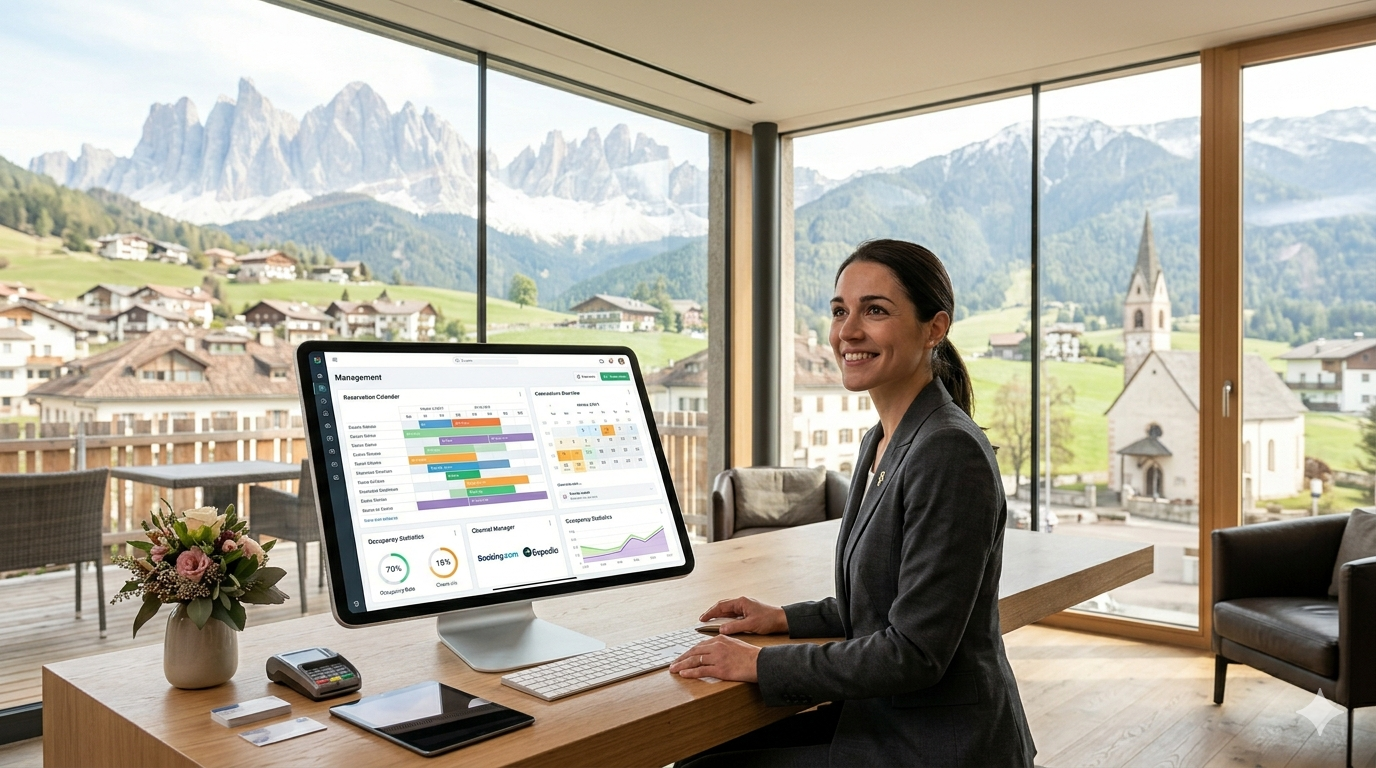
The PMS (Property Management System) market for hotels is more mature and international. Here are the most relevant solutions for the Italian market.
Slope
Italian cloud-based PMS, very popular among Italian accommodation facilities, particularly in the Northeast.
- Pros: Italian and German interface, integrated channel manager, booking engine, automatic Alloggiati Web and ISTAT management, excellent value for money (from around €79/month)
- Cons: basic revenue management compared to major international players, limited customisation
- Ideal for: independent hotels, B&Bs, garni and guesthouses throughout Italy
Mews
Next-generation PMS based in Prague, growing rapidly in Europe. API-first approach highly appreciated by technologically advanced hotels.
- Pros: modern architecture, excellent API for integrations, advanced check-in/out automation, good revenue management
- Cons: high price (from around €150/month), learning curve, limited Italian support
- Ideal for: boutique and lifestyle hotels, properties focused on technological innovation
Cloudbeds
American all-in-one platform with strong international presence. Combines PMS, channel manager, booking engine and revenue management.
- Pros: all-in-one solution, powerful channel manager (200+ channels), integrated pricing intelligence, good mobile app
- Cons: complex interface, pricing based on room count (from around €100/month for small properties), Italian localisation could be improved
- Ideal for: medium-large properties heavily dependent on OTAs, hotels with international clientele
Little Hotelier
A SiteMinder product, designed specifically for small properties: B&Bs, guesthouses, farm stays.
- Pros: ease of use, accessible pricing (from around €56/month), integrated SiteMinder channel manager, ideal for those without technical skills
- Cons: limited features for larger properties, basic reporting, few customisation options
- Ideal for: B&B management, small guesthouses, farm stays with fewer than 15 rooms
Custom development with Ivemind
For properties with specific needs — for example a hotel with restaurant, spa and equipment rental — a custom PMS offers decisive advantages:
- Complete integration between hotel management, restaurant management and other systems (spa, ski room, bike rental)
- Native bilingual interface in Italian/German, with the possibility of adding English and other languages
- Specific automations for the South Tyrolean context: connection with the provincial tourism portal, municipal tourist tax management, integration with the property's home automation systems
Hotel and B&B management software comparison 2026
| Software | Price/month | PMS | Channel Manager | Booking Engine | Ideal for |
|---|---|---|---|---|---|
| Slope | €59-199 | ✅ | ✅ | ✅ | Independent hotels |
| Mews | €150-500 | ✅ | ✅ | ✅ | 4-5 star hotels |
| Cloudbeds | €100-350 | ✅ | ✅ | ✅ | Medium-large properties |
| Little Hotelier | €49-129 | ✅ | ✅ | ✅ | B&Bs and small hotels |
| Custom Ivemind | €8,000-15,000* | ✅ | ✅ | ✅ | Hotels with specific workflows |
*One-time investment with tourist tax and statistics integration.
How much does restaurant and hotel management software cost: real prices
Here are the real costs you should expect, with no surprises. We distinguish between SaaS solutions and custom development.
SaaS costs: monthly subscription
SaaS management systems use a subscription model. Note: the base price is often just the starting point.
- Restaurant SaaS management: from €50 to €200/month for the base module. With POS hardware, additional modules (inventory, staff, delivery), and multi-station licences, the real cost settles between €100 and €350/month
- Hotel SaaS management: from €60 to €250/month for the base PMS. With channel manager, booking engine and revenue management, the real cost is between €150 and €500/month
- B&B SaaS management: from €40 to €100/month for entry-level solutions like Little Hotelier
Over 5 years, a SaaS costs you between €6,000 and €30,000 — without you owning anything at the end.
Custom development costs with Ivemind
Ivemind develops custom management software with transparent pricing and no surprises:
- Basic project (€5,000-8,000) — management system with core features: order or reservation management, invoicing, basic reporting. Ideal for a bar management system, a small pizzeria or a B&B
- Medium project (€8,000-15,000) — complete system with POS, inventory, channel manager, staff management, integration with external systems. The most common choice for established restaurants and hotels with up to 30-40 rooms
- Complex project (€15,000+) — multi-location or multi-business platform (hotel + restaurant + spa), advanced revenue management with AI, home automation integrations, custom mobile app
To these costs, add a maintenance and hosting fee of approximately €100-300/month, which includes updates, support and backups.
The 5-year economic comparison often favours custom development:
- Average SaaS: €200/month x 60 months = €12,000 (and you own nothing)
- Custom Ivemind: €10,000 development + €150/month x 60 months = €19,000 (and you own the software)
The difference is only €7,000, but with custom development you have proprietary, personalised software with no constraints. And with non-repayable grants, the initial cost can be reduced by 40-60%.
Integration with digital menu and booking system
A management system doesn't live in isolation. It must communicate with all the other systems in your business. The two most important integrations for restaurants and hotels are the digital menu and the booking system.
Digital menu + restaurant management
If you already have a digital menu with QR code, the management system must synchronise in real-time:
- When a dish is sold out in inventory, it disappears from the digital menu
- Price changes propagate automatically
- Orders from the digital menu (if the customer orders directly from the table) enter the management system's kitchen workflow
- The digital menu becomes an upselling channel: automatic suggestions for wine, desserts, daily specials
Booking engine + hotel management
For hotels, the integration between website with direct bookings and management system is essential to reduce OTA commissions:
- Direct bookings from the website automatically enter the PMS
- Availability updates in real-time across all channels
- Guest data is collected once and shared between booking engine, PMS and CRM
- Automatic pre-stay and post-stay emails are sent from the management system without manual intervention
With a custom-built system, these integrations work natively, without third-party plugins or connectors that can break with every update.
How to fund your management software: grants and incentives
The investment in restaurant management software or hotel management software can be significantly reduced thanks to public digitalisation funds. In Italy, several opportunities exist.
Regional digitalisation vouchers
Many Regions and Provinces (e.g., Bolzano, Trento, Lombardy, Emilia-Romagna) fund business digitalisation projects with non-repayable grants of up to 60% of eligible expenses. Management software falls within fundable expenses.
Chamber of Commerce grants
Local Chambers of Commerce offer periodic calls for SME digitalisation with grants of 40 to 50%. Management software projects are among the most funded.
MIMIT grants (Ministry of Enterprise)
At national level, the Ministry of Enterprise and Made in Italy periodically issues digitalisation vouchers for SMEs with grants of up to 50%.
Practical example
A hotel invests €12,000 in custom management software with Ivemind. With the provincial voucher at 60%, the net cost drops to €4,800. Within 2 years, the operational savings generated by the management system far exceed the residual investment.
For full details on available funds, read our complete guide on non-repayable grants for small businesses.
Tax credits and depreciation
Even without accessing grant programmes, investing in a management system is still advantageous from a tax perspective. Management software is a depreciable business asset over 3-5 years. For custom software, you can also discuss with your accountant the Industry 4.0 tax credit for investments in intangible assets, which in 2026 is still active for intangible goods (software, IT systems).
Checklist: how to choose the right management software in 10 questions
Before choosing restaurant management software or hotel management software, answer these 10 questions. They will help you define your real needs and avoid costly mistakes.
- 1. How many locations do you need to manage? A single location has different needs from a chain with 3-4 venues
- 2. What systems do you already use? POS, cash register, accounting software, channel manager — should the new system integrate with existing ones or replace them?
- 3. How many people will use the system? 2-3 users or 15-20? SaaS costs often grow with the number of licences
- 4. Do you need multilingual support? In tourist areas, a management system that doesn't support multiple languages including Italian and German is a problem
- 5. What budget do you have? Consider the total 5-year cost, not just the monthly price
- 6. How standard is your workflow? If you follow classic processes, SaaS works fine. If you have particularities, you need custom
- 7. Do you need to work offline? In the mountains, connectivity can be unstable — the management system must work without internet too
- 8. What reports do you need? Food cost, RevPAR, staff productivity — define key metrics before choosing
- 9. Who will provide support? A vendor with Italian support, availability and guaranteed response times makes all the difference
- 10. Can you access public funding? Check before deciding: a 60% grant completely changes the cost/benefit analysis
If you've answered all 10, you already have a clear picture of your needs. If you're unsure about some answers, a free consultation with an expert can help clarify them.
Frequently asked questions about restaurant and hotel management software
How much does restaurant management software cost?
SaaS restaurant management software costs from €50 to €200/month (Tilby, Lightspeed, RistorManager). A custom-built solution requires an initial investment of €5,000-15,000 but eliminates monthly licence fees and offers full customisation.
What is a channel manager for hotels?
A channel manager is software that automatically synchronises your hotel's availability and prices across all booking portals (Booking.com, Expedia, Airbnb) and your website. It eliminates overbooking risk and allows you to manage all channels from a single interface.
Which management software should a B&B choose?
For a B&B with fewer than 10 rooms, lightweight solutions like Little Hotelier (€49/month) or Slope (from €59/month) are ideal. They include PMS, channel manager and booking engine. For larger properties, consider custom management software with tourist tax and statistics integration.
Can a restaurant use a digital menu without management software?
Yes, a QR code digital menu can work independently. However, integrating it with restaurant management software allows automatic price and availability updates, allergen management and data collection on most-ordered dishes.
What grants exist for digitising a restaurant or hotel in Italy?
Many Regions and Provinces offer digitisation grants for tourism. For example, the Province of Bolzano offers grants of up to 50% for digitisation projects. The PNRR Tourism plan provides tax credits of up to 80% for hotels and accommodation facilities investing in digitisation, with a cap of €40,000 (increased to €100,000 for 4+ star hotels).
Ivemind: your custom management software partner
Ivemind is a social cooperative and innovative startup headquartered in Bolzano, operating throughout Italy. We develop custom management software for restaurants, hotels, B&Bs and hospitality businesses throughout Italy.
Why choose Ivemind for your management software:
- We know Italian hospitality — we work with restaurants and hotels across Italy, we understand the specific needs: bilingualism, seasonality, provincial regulations, integration with local tourism portals
- Free consultation — we analyse your processes and recommend the best solution, even if it's a SaaS and not our own development
- Transparent development — detailed quote, clear milestones, no cost surprises
- Grant support — we help you identify and apply for public funding to reduce the investment
- Ongoing maintenance — updates, support and post-launch optimisation
60% of our profits are reinvested in social inclusion projects. Choosing Ivemind is not just a technology choice, it's a values choice.
Discover our management software development services or contact us for a free consultation.
Related articles
AI Agents for SMEs: What They Are, How They Work and How to Get Started in 2026
What AI agents are, how much they cost and how to implement them in your SME. 5 practical use cases, real costs from zero to 3,000 euros and a step-by-step roadmap to get started.
Business Intelligence for SMEs: Turning Data into Decisions
Is your SME's data scattered across ERP, Excel, and CRM? Discover how Business Intelligence turns it into clear dashboards for better decisions.
AI Chatbot for Your Business: Automating Customer Service 24/7
How a custom AI chatbot can answer your customers 24/7, generate leads and increase sales by 67%. Complete guide with costs and funding.