Social Media for Small Business: Which Platform to Choose and How to Start in 2026
Italy is home to over 6 million registered businesses and approximately 4.7 million active SMEs (ISTAT 2025 data). Of these, 72% have at least one social media page — but only 18% use it strategically and consistently. The remaining 82% post something once in a while, without a strategy, without a clear objective, and wonder why social media for business "doesn't work". Spoiler: it works extremely well. But only if you know what you're doing.
If you run a small or medium-sized business in 2026 and you're trying to figure out whether it's worth investing time and money in social media, this guide is for you. We break down everything: which platform to choose, how to create an effective social media content plan, how much a social media manager costs, how to measure results and — most importantly — how to avoid the mistakes that waste time and money for the majority of Italian SMEs. With concrete data, prices updated to 2026, and practical advice you can apply starting tomorrow.
Social media for SMEs: does it really work?
The question is legitimate. As a business owner, every euro and every hour must produce a return. So: does social media produce concrete results for an SME? The numbers say yes — but with some important nuances.
Let's start with the context. In Italy in 2026 there are 43.5 million active social media users, equal to 73.8% of the population. The average time spent on social media is 1 hour and 48 minutes per day. This isn't a niche — your customers are there, every day, for nearly two hours. The question isn't whether to be present — it's how to be present.
Here's what the data says about SMEs that use social media strategically:
- 78% of Italian consumers discovered a new local product or service through social media in the past year
- SMEs with an active and consistent social presence see an average 23% increase in website traffic
- 67% of customers check a business's social profiles before purchasing or making contact
- Businesses that post consistently (at least 3 times per week) see an engagement rate 40% higher than those who post sporadically
- The cost of acquiring a customer through organic social media is on average 62% lower than traditional advertising
But be warned: these results don't happen by magic. It's not enough to create a Facebook business page and post a product photo once a month. Social media works when there's a strategy, consistency, and an understanding of the audience. Without these three elements, it's just another cost that produces nothing.
The real value of social media for an SME isn't direct selling (although that happens too). It's building trust, visibility, and a relationship with the audience. It's the first place where a potential customer "gets to know you" before deciding whether to trust you. In a market where 92% of people trust recommendations from other users more than advertising, your social presence is your digital reputation.
For a complete view of how social media fits into your digital strategy, we recommend reading our complete guide to digital marketing for SMEs.
Instagram, Facebook, TikTok, LinkedIn: which one to choose
You don't need to be on every social platform. In fact, being on all of them is the fastest way to burn resources without getting results. The golden rule for an SME is: it's better to be excellent on one or two platforms than mediocre on five. But how do you choose? It depends on three factors: your audience, your industry, and the type of content you can produce.
Facebook: still king for local businesses
Despite recurring rumours about its "death", Facebook remains the most used platform in Italy with 35.9 million active users. The main age group is 35-65 — exactly the audience with the greatest purchasing power. For local businesses (restaurants, shops, professional practices, artisans), a Facebook business page is still the most effective tool.
Strengths:
- Local groups with thousands of active members (excellent for local visibility)
- Facebook Marketplace for direct sales
- Extremely powerful advertising platform with precise geographic targeting
- Reviews and ratings that influence purchasing decisions
- Events to promote openings, special offers, and initiatives
Ideal for: restaurants, retail shops, professional practices, artisan businesses, local services, B2B with clients over 35.
Instagram: the visual stage for your brand
Instagram for business is the go-to platform for anything that sells through visuals. With 30.3 million users in Italy and a core age group of 25-44, it's the perfect channel for building a strong, visually consistent brand identity.
Strengths:
- Average engagement rate of 1.16% — the highest among mainstream platforms
- Instagram Shopping for direct sales from your profile
- Reels with still-high organic reach (up to 3-5x compared to static posts)
- Stories for daily content, polls, behind-the-scenes
- Collaborations with local micro-influencers accessible even on tight budgets
Ideal for: fashion, food, beauty, design, furniture, tourism, fitness, crafts, photography, any business with a strong visual component.
TikTok: the surprise for bold SMEs
TikTok is no longer just dances and viral trends. With 20.3 million Italian users and exponential growth in the 25-45 age bracket, it's becoming a serious channel for businesses. The real advantage? TikTok's algorithm rewards content, not follower count. A well-made video from an SME with 200 followers can get 100,000 views — something impossible on Instagram or Facebook.
Strengths:
- Unmatched organic reach: a single video can explode even from a brand-new profile
- Virtually zero cost per view (organic content)
- Short video format that humanises the brand and creates connection
- Trending sounds and formats that amplify visibility
Ideal for: restaurants (behind the scenes in the kitchen), artisans (the crafting process), retail (unboxing, new arrivals), services (quick tips, "did you know..."), any business willing to show its human side.
LinkedIn: B2B and professionals
With 20 million Italian users, LinkedIn is the professional social network par excellence. If your clients are other businesses, professional firms, managers, or decision-makers, LinkedIn is where you need to be. The average engagement rate is lower than on other platforms, but the quality of contacts is incomparably higher.
Strengths:
- Business audience with decision-making power and spending budgets
- Thought leadership content that positions you as an industry expert
- LinkedIn Articles for long-form content indexed by Google
- Professional networking that generates concrete commercial opportunities
Ideal for: consultants, agencies, B2B companies, law and accounting firms, training, technology, business services.
The decision matrix for Italian SMEs
Here's a quick guide to choosing:
- Selling to end consumers (B2C) locally? Facebook + Instagram
- Selling visually attractive products? Instagram + TikTok
- Selling to other businesses (B2B)? LinkedIn + Facebook
- Running a restaurant or food business? Instagram + TikTok + Facebook
- Offering professional services? LinkedIn + Facebook
- Running a physical shop and want to attract customers to your store? Facebook + Instagram
Our advice: start with two platforms, make them work for at least 6 months, then evaluate whether to add a third. Consistency beats quantity, always.
How to create a social media content plan (with template)
A social media content plan is what separates an SME that "posts now and then" from one that achieves measurable results. Without a plan, the same thing always happens: the first two weeks you're full of enthusiasm, posting every day, then work takes over, you go a week without posting, you feel guilty, you throw up a random photo, and the cycle starts again. Sound familiar?
A social media editorial calendar solves this problem at the root. Here's how to build an effective one in 5 steps.
Step 1: Define your content pillars
Content pillars are the 3-5 macro categories around which all your posts revolve. Each pillar serves a different objective and keeps your feed varied and engaging. Here's an example for a furniture shop:
- Product (30% of posts): new arrivals, material details, room settings, special offers
- Education (25%): interior design tips, how to choose the right sofa, 2026 trends
- Behind the scenes (20%): the workshop, the team, the suppliers, the selection process
- Social proof (15%): customer photos with products, reviews, completed projects
- Community (10%): local events, collaborations, neighbourhood content
The pillar rule is fundamental: no single pillar should exceed 40% of total content. If you only talk about products, you become a catalogue. If you only talk about yourself, you become boring. Balance is everything.
Step 2: Set your posting frequency
The ideal frequency depends on the platform and your real available resources. Here are the minimum recommended frequencies to see results in 2026:
- Instagram: 3-4 feed posts/week + 5-7 Stories/day + 2-3 Reels/week
- Facebook: 3-5 posts/week + daily interaction in comments and groups
- TikTok: 3-5 videos/week (consistency matters more than perfection)
- LinkedIn: 2-3 posts/week + comments on industry content
Sounds like a lot? Here's the practical rule: only post at the frequency you can maintain for at least 6 months. If you can only manage 2 posts per week on Instagram, do it consistently. That's better than 5 posts the first week followed by silence for a month.
Step 3: Create an editorial calendar template
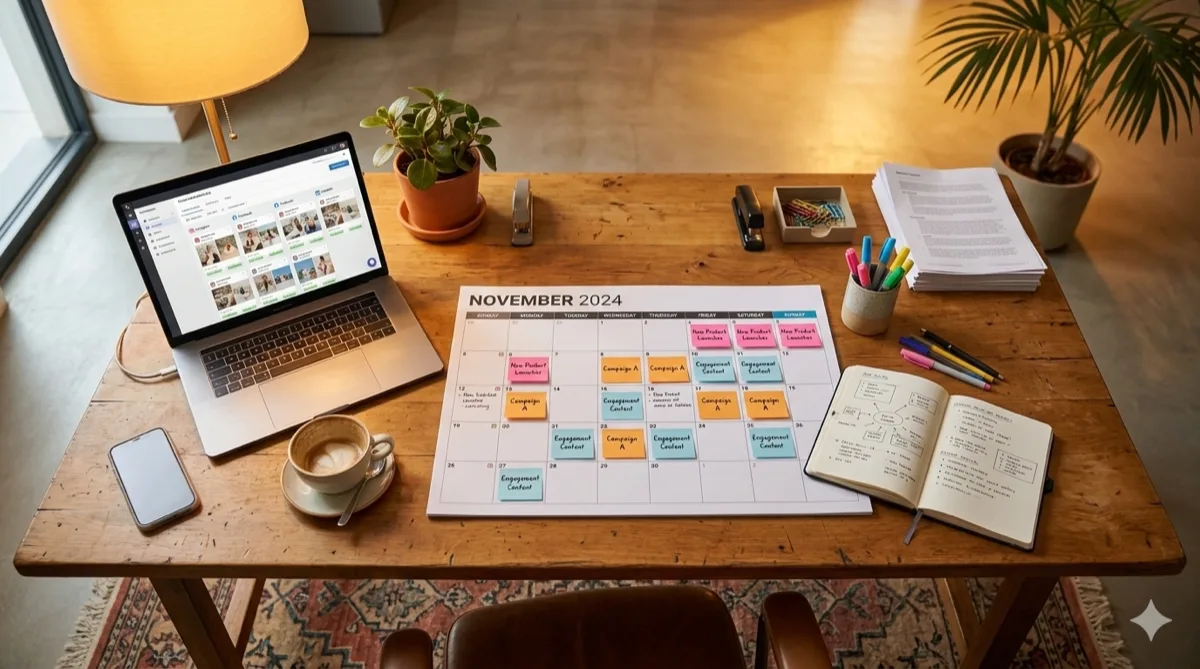
A social media editorial calendar doesn't need to be complicated. A simple spreadsheet with these columns works perfectly:
- Date and time of publication
- Platform (Instagram, Facebook, LinkedIn, etc.)
- Content pillar (product, education, behind the scenes, etc.)
- Format (photo, carousel, Reel, Story, video, text)
- Post text (complete caption with hashtags)
- Visual material (link to photo/video or description)
- CTA (call to action: what do you want the user to do?)
- Status (to create, ready, published)
The secret is the batch creation session: dedicate half a day per month (3-4 hours) to planning and creating content for the next 4 weeks. Write all the captions, prepare all the graphics, schedule everything. Then, during the month, you simply publish and interact — without the stress of thinking "what should I post today?".
Step 4: Schedule your posts
Today there are social media management platforms that let you schedule posts in advance across all platforms from a single dashboard. Indicative costs for an SME: from 15 to 50 euros per month for basic features (scheduling, analytics, multi-profile management). For an SME managing 2-3 social profiles, a basic plan is more than sufficient and pays for itself in time saved from the very first month.
Step 5: Analyse and optimise every month
At the end of each month, dedicate 1 hour to analysis: which posts performed best? Which pillar generates the most interaction? What time is your audience most active? Use this data to optimise next month's plan. It's a virtuous cycle that improves results over time.
Not sure where to start building your content strategy? A marketing consulting service can help you set up the initial content plan and train you to manage it independently.
How much does a social media manager cost in 2026
The question "how much does a social media manager cost" is one of the most searched by Italian SMEs — and the answer depends heavily on what you mean by "social media management". There's an enormous difference between someone who publishes 3 posts a week and someone who builds a complete strategy with content, advertising, and community management.
Here are the real costs in the Italian market in 2026, updated and verified.
Freelance social media manager
A freelance social media manager in Italy in 2026 charges rates that vary significantly based on experience and geographic location:
- Junior (1-2 years of experience): 300-600 euros/month for managing 1-2 profiles (8-12 monthly posts + Stories). They often work remotely and manage multiple clients simultaneously.
- Mid-level (3-5 years): 600-1,200 euros/month for complete management of 2-3 profiles (12-20 monthly posts + Stories + basic community management). Usually includes a content plan and monthly report.
- Senior (5+ years): 1,200-2,500 euros/month for a complete strategy, multi-platform management, quality content creation, active community management, detailed analytical reports. At this level, basic advertising campaign management is often included.
Social media marketing agency
Agencies offer a more structured service — with a dedicated team that includes a strategist, copywriter, graphic designer, and often a photographer/videographer. Costs reflect this structure:
- Basic package: 800-1,500 euros/month — management of 2 profiles, 12-16 monthly posts, professional graphics, content plan, monthly report.
- Standard package: 1,500-3,000 euros/month — management of 2-3 profiles, 16-24 monthly posts, video content creation (Reels/TikTok), community management, advertising strategy, detailed report.
- Premium package: 3,000-6,000 euros/month — complete multi-platform management, monthly photo and video shoots, influencer marketing, advertising budget management, strategy integrated with other digital channels.
On top of these costs, you need to add the advertising budget, which is always separate. For a local SME, an ad budget of 200-500 euros/month is a good starting point; for SMEs with broader growth ambitions, the range starts at 500-1,500 euros/month.
How much should an SME invest?
A practical rule widely used in the industry: an SME should invest between 5% and 15% of revenue in overall marketing, of which 30-50% can go toward social media (including advertising and management). For an SME with annual revenue of 500,000 euros, this translates to an annual social media budget of 7,500-37,500 euros, or 625-3,125 euros per month.
Sounds like a lot? Let's consider the return. A restaurant that invests 800 euros/month in social media management and 300 euros/month in ads, and generates even just 10 new covers per week with an average bill of 35 euros, achieves additional revenue of 1,400 euros/week — over 5,600 euros/month in income against a 1,100 euro investment. That's an ROI of 409%.
DIY vs agency vs freelance: comparison
Each option has its advantages and disadvantages. The right choice depends on your budget, the time you can dedicate, and the level of quality you want to achieve.
DIY management (in-house)
Cost: your time (estimate 8-15 hours/week for serious management of 2 profiles) + scheduling tools (15-50 euros/month) + any ad budget.
Pros:
- You know your business better than anyone
- Immediate reactivity (you can post in real time)
- Maximum authenticity: it's you, with your own voice
- Lowest monetary cost
Cons:
- Requires specific skills (copywriting, graphic design, analytics, advertising)
- Time taken away from running the business
- Risk of inconsistency: when work calls, social media takes a back seat
- Content quality often lower (no judgement — it's normal if this isn't your profession)
When it makes sense: in the early phase, with a limited budget, or if you have a natural talent for content and enjoy doing it.
Freelance
Cost: 300-2,500 euros/month + ad budget.
Pros:
- Specific skills without the cost of an employee
- Flexibility: you can scale up and down easily
- Direct, personalised relationship
- Lower cost than an agency
Cons:
- Dependence on a single person (holidays, illness, other commitments)
- Skills often limited to 1-2 areas (e.g., good copywriter but can't make videos)
- Difficult to assess quality in advance
When it makes sense: SMEs with a budget of 500-1,500 euros/month that want a step up from DIY but don't have the budget for an agency.
Agency
Cost: 800-6,000 euros/month + ad budget.
Pros:
- Complete team of specialists (strategist, copywriter, graphic designer, videographer, ads manager)
- Guaranteed continuity (if one person is unavailable, the team covers)
- Integrated strategic vision across other marketing channels
- Generally higher content quality
- Professional, measurable reporting
Cons:
- Higher cost
- Risk of "generic" communication if the agency doesn't immerse itself in your industry
- Slower reaction times compared to DIY
When it makes sense: SMEs with a budget of 1,500+ euros/month that want professional, measurable results, or businesses in a growth phase that can't afford mistakes.
A good compromise? Many SMEs start with an initial consultation to set up strategy and content plan, then manage content independently with monthly check-ins to optimise. It costs less than full management and leaves you in control.
How to measure results (the metrics that matter)
Here's the uncomfortable truth: most SMEs have no idea whether their social media is working or not. They look at follower count and feel satisfied if it grows, frustrated if it doesn't. But followers are a vanity metric — a number that pleases the ego but says almost nothing about the health of your business.
The metrics that truly matter for an SME are different. Here are the key ones, with benchmark references for 2026.
Engagement rate
This measures how many people actively interact with your content (likes, comments, shares, saves) relative to the number of people who see it. It's the most reliable indicator of your content quality.
2026 benchmarks for SMEs:
- Instagram: 1-3% is good, above 3% is excellent (smaller profiles tend to have higher engagement)
- Facebook: 0.5-1% is average, above 1% is good
- LinkedIn: 2-4% is good for text posts, 1-2% for content with links
- TikTok: 3-6% is average, above 6% is excellent
Reach and impressions
Reach tells you how many unique people have seen your content. Impressions tell you how many times it's been viewed in total. A good impressions-to-reach ratio is between 1.5 and 2.5 — this means your content is being seen more than once, a sign that the algorithm is distributing it well.
Website clicks
How many users click from your social profile to your website? This is the bridge between social media and real conversions. Set up UTM parameters in your links to track exactly which platform and which type of content drives the most traffic to your site.
Benchmark: a CTR (click-through rate) of 0.5% to 2% on posts with links is normal. Above 2%, you're doing an excellent job.
Conversions and leads generated
Ultimately, what matters for your business are customers. How many quote requests, bookings, newsletter sign-ups, or purchases come from social media? To track this, you need two things: UTM parameters on links and an analytics system on your site (even free Google Analytics works perfectly).
Cost per acquisition (CPA)
If you invest in social advertising, CPA tells you how much you spend to acquire a customer. Formula: advertising budget / number of conversions. A sustainable CPA depends on the average value of your customer, but as a reference: for a service SME, a CPA under 30-50 euros is generally good; for an e-commerce, under 10-20 euros per order is the target.
The fundamental point: measure, analyse, optimise. Every month. If you don't measure, you can't improve. If you don't improve, you're wasting money. And if you want to understand how social media integrates with your paid advertising investments, having a complete picture of your metrics is essential for allocating budget the right way.
Social media and your website: how to make them work together
One of the most serious mistakes we see in SMEs is treating social media and their website as two separate worlds. They're not. They are two components of a single digital ecosystem that must function in an integrated way. Social media brings the audience; the website converts them. Without the first, you have no traffic; without the second, you have nowhere to send that traffic.
Here's how to make them work together effectively.
The website as your central hub
Your website is your digital home — the only online space you control 100%. Social media platforms are rented space: you're on someone else's land, and the rules can change tomorrow. Facebook can halve your organic reach (it already has), Instagram can change its algorithm (it does every 6 months), TikTok can be restricted in certain markets. Your website stays.
Every piece of social content should have the ultimate goal of driving the user to your website — where they can fill in a contact form, request a quote, book a service, or make a purchase. The ideal journey is:
- Social: capture attention, generate interest
- Bio/link: direct to the website
- Landing page: convert interest into action
Content that reinforces each other
A single blog article can become 5-10 different social posts: a carousel with the key points, a Reel with the summary, a Story with a poll on the topic, a LinkedIn post with a personal take, a TikTok with the "tip of the day" extracted from the article. It's a virtuous cycle: the blog feeds social media, social media drives traffic to the blog.
The reverse is also true: social content that generates the most engagement can inspire new blog articles — answering the audience's questions and comments. If you're looking for ways to promote your business without spending, this content recycling strategy is one of the most effective approaches.
Retargeting: the superpower of the social + website combination
When a user visits your website, you can add them to a retargeting audience on Facebook and Instagram. This means you can show targeted ads to people who have already visited your site — and who therefore already know you. The conversion rate from retargeting is on average 3-5 times higher than campaigns targeting cold audiences. With even a minimal budget (100-200 euros/month), retargeting produces tangible results.
Visual consistency: a recognisable brand everywhere
Your Instagram profile, your Facebook page, your website, and all offline materials must speak the same visual language: same colours, same tone of voice, same photographic style. A user who finds you on Instagram and then visits your website must immediately recognise that it's the same business. This consistency builds trust — and trust converts. To build an effective coordinated image, a professional design consultation can make all the difference.
The 5 mistakes SMEs make on social media
In years of working with Italian small and medium-sized businesses, we've seen the same mistakes repeated with disarming regularity. Here are the five most common — and how to avoid them.
1. Posting without a strategy
This is the foundational mistake from which all others stem. Posting "when there's time" or "when we have something to say" isn't a strategy — it's the absence of one. Without a clear social media content plan, with defined objectives and content pillars, you're shooting in the dark. Every post should answer the question: "Which business objective does this content serve?"
How to fix it: dedicate 3-4 hours once a month to planning. Use the editorial calendar template described above. Define your content pillars. That alone is enough to go from chaos to strategy.
2. Only talking about yourself
Your business feed is an endless sequence of: "Look at our product", "We're the best", "Buy from us", "Unmissable promotion". The result? People stop following you. Social media is conversation, not monologue. The 80/20 rule works: 80% of content should inform, educate, entertain, or inspire. 20% can directly promote.
How to fix it: before every post, ask yourself: "If I weren't the owner of this business, would this content interest me?" If the answer is no, rethink it.
3. Chasing followers instead of engagement
Having 10,000 followers with a 0.3% engagement rate is worth far less than having 1,000 followers with 5% engagement. Followers that are bought or acquired through tricks (follow/unfollow, generic giveaways) will never become customers. Worse: they confuse the algorithm and reduce the reach of your content to the people who actually matter.
How to fix it: stop watching the follower count. Focus on engagement rate, direct messages, information requests, website clicks. Those are the numbers that pay the bills.
4. Not responding to comments and messages
A user writes you a comment or a direct message and receives a reply after 3 days — or never. Every uncollected interaction is a missed opportunity. The algorithm on every platform rewards interaction in the first 30-60 minutes after publishing: the faster you respond to comments, the more the post gets shown to other people. But more importantly: a user who writes to you is a warm potential customer. Ignoring them is like not answering the shop phone.
How to fix it: set 2-3 daily slots (morning, lunch break, evening) dedicated to responding to comments and messages. 15 minutes each is enough. And don't delegate this task to someone who doesn't know your product or service.
5. Not investing in visual quality
Dark, blurry photos with a finger on the lens. Vertical videos with incomprehensible audio. Graphics made with the most obvious free app, with illegible text and clashing colours. In 2026, the visual quality of content is the first filter: if it doesn't catch the eye within 1.5 seconds of scrolling, your content doesn't exist. You don't need a professional photographer for every post, but you do need a minimum of attention: natural light, clean backgrounds, colour consistency, and a recognisable graphic template.
How to fix it: invest half a day creating 3-5 graphic templates with your brand colours (you can do this even with free tools). Do a professional photo shoot every 3-6 months to have a quality photo archive to use all year. The cost of a basic product shoot? 200-500 euros for a day — an investment that pays for itself with months of quality content.
Your next step: from theory to practice
Social media for business in 2026 is not optional — it's an essential component of any SME's communication strategy. But the secret isn't "being on social media": it's being there with strategy, consistency, and quality. Choose the right platforms for your audience, build a solid content plan, measure results, and optimise every month.
And above all: remember that social media doesn't work in isolation. It's one piece of a larger puzzle that includes your website, your brand identity, and your overall digital marketing strategy. When all the pieces work together, results multiply.
At Ivemind, we help Italian SMEs build a social presence that generates concrete results. From initial strategy to content plan creation, from internal training to complete management — every solution tailored to your business's needs and budget.
Want to find out which social strategy is right for your business? Contact us for a free consultation — we'll analyse your current situation, your audience, and your goals together to build a concrete, sustainable plan. Or discover all our marketing consulting services for SMEs.
Your next customer is scrolling their feed right now. The question is: will they find you, or a competitor?
Related articles

Brand Identity for Small Business: How Much Does a Professional Logo and Visual Identity Cost in 2026
75% of consumers judge a company's credibility by its design. Discover how much a professional brand identity costs, the 5 essential elements, and available funding.

Google Advertising: How Much Does It Cost for a Small Business in 2026
65% of Italian SMEs invest in Google advertising, but 25-40% of budget is wasted. Discover real costs by sector, when it's better than SEO, and how to avoid common mistakes.
Email Marketing for Small Business: How to Create a Newsletter that Converts in 2026
How to create a professional newsletter, build a mailing list and do email marketing with a ROI of €36 for every euro spent. Practical guide for SMEs.