
Website and Management Software for Professional Firms: Complete Guide 2026

Why a professional firm needs a website in 2026
If you are a lawyer, accountant, architect or consultant, you probably think word of mouth is enough to find new clients. And a few years ago, you would have been right. But the data from 2026 tells a different story.
Let's start with the numbers. Every month in Italy, about 170 people search Google for "lawyer website", 210 search for "law firm management software", 140 search for "accountant management software" and 90 search for "law firm website". These are people with a concrete problem — finding a professional or a tool to better manage their practice — and they're looking for it online. If your firm isn't there, someone else is capturing those potential clients.
The data is clear:
- 78% of Italians search for a professional on Google before contacting them (source: BVA Doxa 2025 research on Italian digital behaviours)
- According to the Cassa Forense Report 2025, 62% of lawyers under 45 consider online presence "very important" for client acquisition, yet only 34% have a professional website
- The National Council of Accountants reports that firms with a structured digital presence registered a +23% increase in new engagements compared to those relying solely on word of mouth
- For architects, an online portfolio is even more crucial: 82% of private clients state they want to see previous work before scheduling an appointment (source: CNAPPC 2025)
There is an even more significant data point: according to ISTAT (Businesses and ICT 2025), only 41% of professional firms with fewer than 10 employees have their own website. This means 59% of your colleagues are not online. This creates an enormous opportunity for those who decide to invest now: less digital competition, more visibility.
But a website for a professional firm is not just a showcase. It is a working tool that can:
- Generate qualified leads — people searching for exactly your service in your area
- Build credibility — a professional website conveys reliability before the first meeting even takes place
- Save time — answers to frequently asked questions, directions to the office, documents needed for the first appointment: all available online, 24/7
- Differentiate the firm — in a crowded market, specialisation communicated online becomes a competitive advantage
If you operate in a multilingual area or with international clients, there is an additional advantage: a bilingual Italian-German (or trilingual with English) website opens up a much larger pool of clients, also capturing demand from neighbouring Austria and Trentino.
There is also a generational aspect to consider. Data from Cassa Forense shows that 48% of registered lawyers are under 50, and this group of professionals is accustomed to searching for services and information online. The same applies to their clients: the generation that today searches for a divorce lawyer, an accountant to open a business, or an architect for a renovation, does so on Google, not in the Yellow Pages. Those without a professional website are losing concrete opportunities every day.
The National Council of Accountants Annual Report 2025 also highlights a clear trend: firms that invested in digitalisation between 2023 and 2025 saw average revenue growth 18% higher than colleagues who did not. Digitalisation is no longer optional: it is a competitive lever.
What a professional firm's website must have
Not all websites are equal. A lawyer's website has different requirements from an e-commerce site or a personal blog. Here are the essential features your firm's website must have to truly perform.
Essential pages
- Homepage — who you are, what you do, why choose you. It must communicate your specialisation in 5 seconds
- About us / The team — professional photos, biographies, specialisations and bar association membership. For a lawyer, displaying the bar registration number is a signal of transparency
- Practice areas — dedicated pages for each area (e.g. family law, employment law, tax litigation). These pages are fundamental for local SEO
- Contact — contact form, map, clickable phone number, office hours. The form should only ask for essential information (name, email, brief description of the request)
- Blog / Resources — articles on topics of interest to your clients. This is not vanity: it is the most effective strategy for ranking on Google
Essential technical features
- Responsive design — 68% of local searches happen on smartphones. The website must look perfect on every device
- Loading speed — under 3 seconds. Every additional second increases bounce rate by 32%
- HTTPS and security — mandatory for any professional website, especially when handling sensitive data
- SEO optimisation — meta title, meta description, heading structure, schema markup for professionals (LocalBusiness, LegalService, AccountingService)
- Google Business Profile — connection with Google listing, reviews, updated hours
- GDPR compliance — cookie banner, privacy policy, consent management. For law firms, this is particularly important: it would be paradoxical for a lawyer to have a non-compliant website
- Accessibility (WCAG 2.1) — since June 2025, the European Accessibility Act makes web accessibility mandatory for many categories of services
Advanced features (increasingly in demand)
- Online appointment booking — the client chooses date and time, receives automatic confirmation. Saves phone calls and reception time
- Client portal — for sharing documents, case updates, invoices. A highly appreciated feature that differentiates the firm
- Chat or chatbot — to answer frequently asked questions outside office hours
- Multilingual — essential for practices with international clients or in multilingual areas
An often overlooked technical aspect: schema markup. This is code invisible to visitors but fundamental for Google. For a law firm, the "LegalService" schema communicates your specialisation, geographic area, hours and reviews to Google. For an accountant, "AccountingService" does the same. For an architect, "ProfessionalService". This code increases the probability of appearing in Google's enriched results (rich snippets) with stars, hours and contact details directly on the search results page.
Finally, a professional website must have a clear conversion strategy. Being visible is not enough: every page must guide the visitor towards a specific action — filling out the contact form, booking an appointment, downloading a guide. Without this strategy, the website is a nice showcase that doesn't bring in clients.
For a deeper dive into all technical aspects and basic costs, read our guide on how much a website costs for a small business.
Best management software for law firms and accounting practices
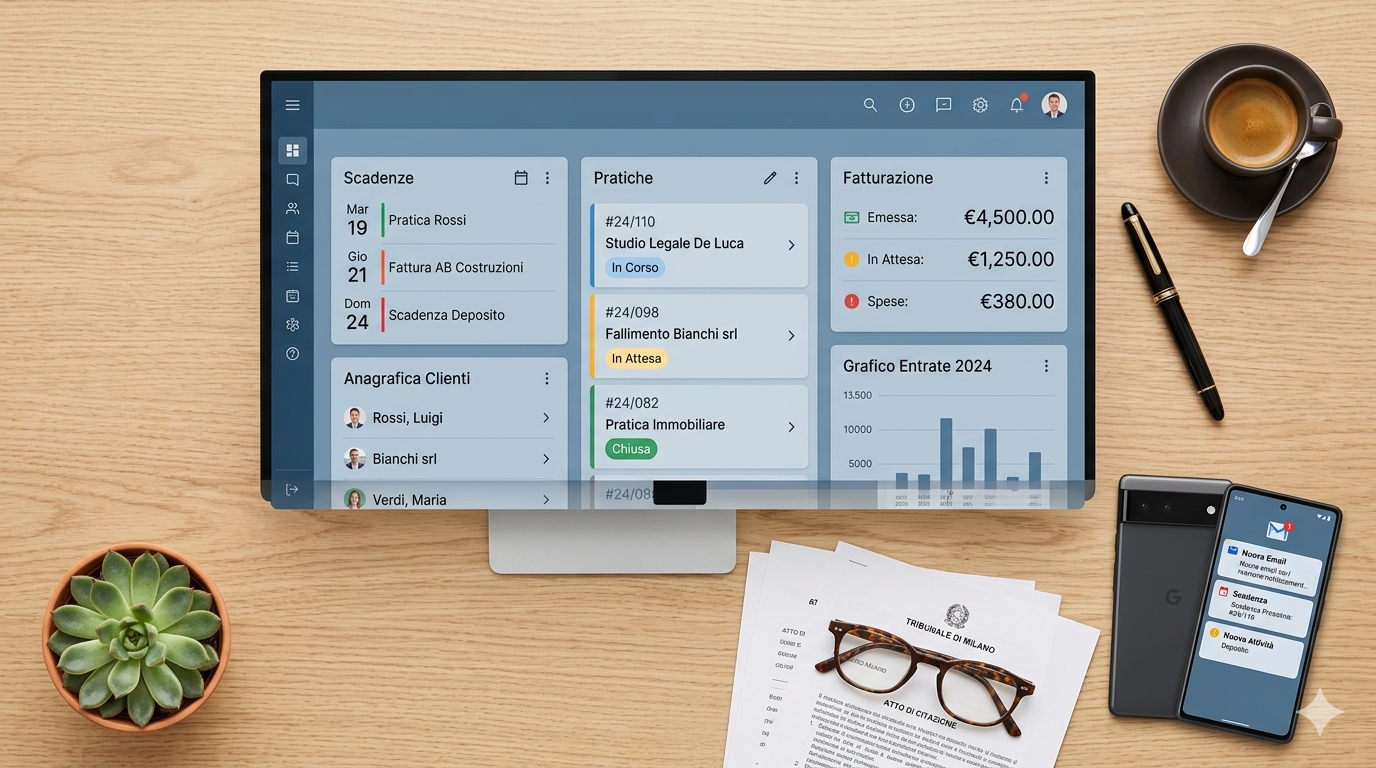
A website without management software is like a car without an engine: nice to look at, but it won't take you anywhere. Management software for a law firm or accounting practice is the operational heart of the firm: it manages cases, deadlines, billing, documents and client communications.
Here are the main software options on the Italian market in 2026, divided by category.
Management software for law firms
- Cliens — the most widely used among Italian lawyers. Case management, procedural deadlines, electronic court filing (PCT), fee calculation. Price: from €600/year for solo practitioner up to €2,500/year for associated firms
- Consolle Avvocato (Giuffrè) — native integration with legal databases. File management, court calendar, electronic notifications. Price: from €800/year
- iusManaging — cloud-native, modern, excellent for next-generation firms. Integrated CRM, time tracking, business intelligence. Price: from €50/month per user
- Lextel / LexDo.it — leaner platforms, ideal for freelance lawyers or small practices. Price: from €30/month
Management software for accountants
- TeamSystem Studio — market leader. Accounting, tax returns, financial statements, electronic invoicing, client management. Price: from €1,200/year per workstation
- Wolters Kluwer Arca Evolution / IPSOA — comprehensive suite with integrated regulatory updates. Price: from €1,500/year
- Profis by Sistemi — strong in tax returns and compliance management. Price: from €1,000/year
- Zucchetti Ago Infinity — scalable cloud solution, good for growing practices. Price: from €80/month per user
Management software for architects and technical studios
- STR Vision CPM — project management, bills of quantities, construction accounting. Price: from €1,800/year
- PriMus (ACCA Software) — cost estimation, BIM integration. Price: from €690 (perpetual licence) or €290/year subscription
- TeamSystem Construction — project management and integrated accounting for engineering and architecture firms. Price: from €1,500/year
How to choose the right software
The choice depends on five factors:
- Firm size — solo practitioner vs. associated practice with 10+ collaborators
- Specialisation — a criminal lawyer has different needs from a tax specialist
- Cloud vs. on-premise — cloud is now the standard for flexibility and security, but some firms prefer keeping data locally
- Integrations — the software must interface with electronic invoicing (SDI), certified email (PEC), digital signatures and, ideally, the website
- Budget — from €30/month for basic solutions to over €300/month for enterprise suites
The most important advice: don't choose the most famous software, choose the one that solves your problems. Many firms pay thousands of euros per year for features they never use, while ignoring more affordable and more suitable tools.
A common mistake is also underestimating the learning curve. The most powerful software in the world is useless if your team doesn't use it because it's too complicated. Before choosing, always request a demo with your team and evaluate: how long will training take? Is the interface intuitive? Is technical support available in your language? Does the vendor offer personalised training?
One final critical aspect: data portability. What happens if in 3 years you want to switch software? Can you export all your cases, documents, billing? Some vendors deliberately make migration difficult to lock in clients. Always verify that the software supports complete data export in standard formats.
How much does a website for a professional firm cost in 2026
The question everyone asks. Being transparent about costs is a core value for us at Ivemind, so here are the real price ranges for a professional website in 2026.
Basic showcase website — from €700
What's included:
- 5-7 pages (home, about, services, contact, privacy)
- Responsive design from customised professional template
- Contact form
- Basic SEO optimisation
- Google Business Profile setup
- HTTPS and basic GDPR compliance
Ideal for: solo practitioner who wants an essential but polished online presence.
Professional website — from €1,500 to €3,500
What's included (beyond the basic package):
- 10-20 pages with optimised content for each practice area
- Custom design aligned with the firm's identity
- Integrated blog with editorial strategy
- Advanced SEO (keyword research, schema markup, local SEO)
- Appointment booking system
- Multilingual (IT/DE for South Tyrol, IT/EN for international firms)
- Google Analytics 4 and Search Console integration
Ideal for: associated practice that wants to attract clients online and stand out from the competition.
Complete website with client portal — from €3,000 to €8,000
What's included (beyond the professional package):
- Secure client portal with login
- Document sharing and case updates
- Integration with the firm's management software
- Chatbot for automated responses outside office hours
- Online fee/retainer payment
- Automations (deadline notifications, appointment reminders)
- Team training on usage
Ideal for: structured firms that want to digitise the entire client relationship.
Recurring costs to consider
- Domain — €10-20/year
- Professional hosting — €100-300/year
- Maintenance and updates — €300-1,200/year (security updates, backups, minor changes)
- Content management — from €200/month for regular article publication
For a comprehensive breakdown of all cost items, read our dedicated article: how much does a website really cost for a small business.
Professional practice management software comparison 2026
| Software | Sector | Price/month | Cloud | Billing | Ideal for |
|---|---|---|---|---|---|
| Cliens | Legal | €40-100 | ✅ | ✅ | Small-medium law firms |
| TeamSystem Studio | Accounting | €80-200 | ✅ | ✅ | Structured accounting firms |
| Wolters Kluwer Lex | Legal | €50-150 | ✅ | ✅ | Medium-large law firms |
| PriMus (ACCA) | Technical | €30-80 | ✅ | ❌ | Architects and engineers |
| Custom Ivemind | All | €5,000-15,000* | ✅ | ✅ | Multi-professional practices |
*One-time investment, no monthly licence fees.
How much does management software cost for a professional firm
Transparency is essential for software costs too. Here are the realistic investment ranges for professional firm management software in 2026.
Basic / standard solution — from €5,000 to €8,000
Includes:
- Software licence (annual or perpetual)
- Installation and initial configuration
- Data import from previous system
- Basic training (4-8 hours)
- Technical support for the first year
This range covers software like Cliens for solo lawyers, basic TeamSystem for accountants or PriMus for architects.
Medium / customised solution — from €8,000 to €15,000
Includes (beyond the basic package):
- Workflow customisation
- Integration with electronic invoicing, certified email (PEC), digital signatures
- Additional modules (CRM, time tracking, business intelligence)
- Advanced training (16-24 hours)
- Complete historical data migration
- Dedicated support and updates for 2 years
This range includes solutions like full TeamSystem Studio, Consolle Avvocato with additional modules or integrated suites.
Custom / bespoke solution — from €15,000 upwards
For firms with specific needs that standard software doesn't cover: integration with proprietary systems, complex workflows, custom reporting, multi-office setups.
Recurring software costs
- Annual licence — €600-3,000/year (for subscription-based solutions)
- Regulatory updates — €200-800/year (essential for accountants)
- Technical support — €300-1,500/year
- Cloud backup and security — €100-500/year
Practical tip: when evaluating software costs, always calculate the TCO (Total Cost of Ownership) over 5 years, not just the initial cost. Software that is cheaper upfront but has high maintenance fees may prove more expensive in the long run.
Let's work through a concrete example for an accountant. TeamSystem Studio basic: initial investment around €5,000 (setup + training) + €1,800/year licence fee. Over 5 years: €14,000. A cloud-based option like Zucchetti Ago Infinity: no significant upfront investment, €80/month per user × 3 users = €240/month = €2,880/year. Over 5 years: €14,400. Similar costs, but completely different models: one requires a high initial investment, the other spreads the cost over time. The choice depends on your financial situation and preferences.
For a solo lawyer, the calculation is different: Cliens at €600/year + Lextel PEC at €30/year + technical support €200/year = approximately €830/year, or less than €70 per month. That's the cost of two dinners out. And the time saved managing procedural deadlines and electronic court filings is worth far more.
Want a personalised quote for your firm's website and management software? Ivemind analyses your specific needs and proposes the most efficient solution. Request a free quote →
Real results: how digital transforms professional firms
Numbers are convincing, but concrete examples are even more so. Here are three realistic scenarios illustrating the impact of digitalisation on professional firms of different types.
Tax law firm — from 0 to 15 online clients in 8 months
A law firm specialising in tax law based in a mid-sized city in Northern Italy. Two lawyers, one secretary, no online presence. All clients came through word of mouth and colleagues.
Intervention: professional website with 12 pages dedicated to practice areas (tax litigation, tax assessments, tax collection notices, etc.), blog with 2 articles per month on current tax topics, local SEO optimisation.
Results after 8 months:
- 1,200 monthly website visits (from zero)
- 35 contact requests through the website form
- 15 new clients acquired directly from the website
- Estimated value of new engagements: over €45,000
- ROI on website investment: over 10x in the first year
Associated accounting firm — 40% time saved with management software
An associated practice of 4 accountants with 3 collaborators, specialising in tax consulting for SMEs. They were using an obsolete management system from the 2010s, email for exchanging documents with clients, and Excel for time tracking.
Intervention: migration to a modern cloud management system with a client portal integrated into the website. Clients upload documents directly to the secure portal, the software automatically classifies them and notifies the responsible accountant.
Results after 6 months:
- 40% reduction in time spent on document management
- Zero lost emails or misplaced documents
- Deadlines met at 99.5% (previously: 92%)
- Client satisfaction: 90% reported appreciating the new client portal
- 2 new clients acquired through positive word of mouth about the digital experience
Architecture studio — online portfolio and new international commissions
An architecture studio with 2 architects and an engineer, specialising in premium renovations. No website, portfolio only in PDF format sent via email.
Intervention: trilingual website (IT/DE/EN) with high-resolution photo portfolio, detailed project pages, Google Maps integration to geolocate completed works, blog with articles on sustainable building and energy regulations.
Results after 12 months:
- 2,800 monthly website visits, of which 35% from Germany and Austria
- 4 commissions from international clients who found the studio through Google
- Total value of international commissions: over €180,000
- The online portfolio became the primary presentation tool even in face-to-face meetings
These examples show a common pattern: the investment in digital pays for itself in 6-12 months, often with margins far exceeding expectations.
An aspect that often surprises is the cascading effect of digitalisation. When a firm implements a website with a client portal, existing clients perceive it as a signal of modernity and reliability. This translates into greater loyalty and spontaneous referrals. "I have a lawyer who has a portal where I can follow my case in real time" is a phrase that generates far more effective word of mouth than "I have a good lawyer".
There is also an internal effect: the firm's team becomes more efficient and motivated. Eliminating double entries, lost emails and forgotten deadlines is not just a productivity issue — it is a matter of quality of working life. Collaborators who no longer have to spend hours chasing documents can focus on the work that truly matters: serving clients.
Website costs for professional practices — summary
| Package | Price | Includes | Ideal for |
|---|---|---|---|
| Basic site | €700-1,500 | 5-8 pages, basic SEO, Google Business | Solo practitioner |
| Professional site | €1,500-3,500 | Client area, blog, multilingual | Group practice |
| Site + management | €3,500-8,000 | CRM, billing, deadline tracking | Multi-professional practice |
| Custom software | €5,000-15,000 | Fully custom, APIs, integrations | Large / multi-site practice |
How to fund the investment: grants and incentives 2026

The good news is that you don't have to pay for everything out of pocket. There are non-repayable grants specifically for the digitalisation of professional firms. Here are the main opportunities in 2026.
Regional digitalisation vouchers
If your firm is based in South Tyrol, you can access digitalisation vouchers covering up to 60% of expenses for websites, management software, digital tools and training, with a maximum grant of €9,000.
In practice: if you invest €10,000 in a website and management software, you can receive up to €6,000 back without having to repay it.
Eligible expenses include:
- Website and e-commerce development
- Purchase and configuration of management software
- Cloud services and hosting
- Staff digital training
- Digital transformation consulting
Chamber of Commerce grants
Chambers of Commerce in various provinces offer grants for the digitalisation of businesses and professional firms, covering 40-50% of expenses. Calls are published periodically: it is important to monitor them regularly.
MIMIT Innovation Vouchers (Ministry of Enterprise and Made in Italy)
The national programme of digital innovation vouchers covers up to 50% of expenses, with a maximum ceiling of €20,000. It specifically includes:
- Digital transformation consulting services
- Development of technology solutions (websites, software, apps)
- Implementation of enabling technologies (cloud, AI, cybersecurity)
Tax credit for capital goods investments
Management software falls under intangible capital goods eligible for tax credits. The rate varies from 6% to 20% depending on the type of software (standard vs. Industry 4.0).
How to combine grants
In many cases it is possible to stack multiple incentives, reducing the net investment by as much as 70-80%. A concrete example:
- Total investment (website + software): €12,000
- Provincial voucher (60%): -€7,200
- Tax credit on remainder: -€480
- Net cost for the firm: €4,320
For full details on available grants, check our updated guide on non-repayable grants for small businesses.
5 mistakes to avoid when digitalising your firm
We have seen dozens of professional firms tackle digitalisation. These are the most frequent — and most costly — mistakes.
1. Choosing your cousin (or your client's son) to build the website
"But Doctor Rossi's nephew knows how to make websites!" Yes, but a website for a law firm is not a school project. It requires specific skills: technical SEO, GDPR compliance, schema markup for professionals, performance optimisation, content strategy. The initial savings almost always turn into a double cost when everything needs to be redone from scratch after 12 months.
2. Buying the most expensive software thinking it must be the best
The most expensive software is not necessarily the most suitable for your firm. A freelance lawyer doesn't need the same features as a firm with 20 collaborators. Start from your actual needs, not from the salesperson's brochure. Always request a demo and trial period before committing.
3. Not investing in content
The most beautiful website in the world, if it has no content, will never rank on Google. A blog with quality articles on your practice areas is the most powerful digital marketing tool for a professional firm. Publishing 2-4 articles per month for the first 12 months creates a foundation of organic traffic that works for you 24/7.
4. Neglecting local SEO
If a potential client searches for "divorce lawyer [city]" and you don't appear in the top 5 results, it's as if you don't exist. Local SEO is fundamental for professional firms: optimised Google Business Profile, client reviews, citations in professional directories, geolocated content. This is not something to do "later": it must be integrated from the start.
5. Not connecting website and management software
Website and management software are often purchased as separate systems that don't communicate with each other. Result: client data is entered twice, online bookings don't sync with the calendar, documents shared via email don't end up in the digital file. Integration between website and software is the investment that makes the difference between superficial digitalisation and real transformation.
Lawyer websites: professional ethics compliance
An often underestimated aspect: a lawyer's website must comply with the Code of Professional Ethics (Codice Deontologico Forense). Article 35 of the CDF regulates lawyer communications and imposes specific rules:
- Prohibition of misleading or comparative advertising — you cannot write "the best lawyer in the city" or "more cases won than anyone"
- Declaration of actual qualifications — you can list specialisations only if actually held and recognised by the National Bar Council (CNF)
- Fee transparency — you can (and should) indicate how fees are determined
- Prohibition of client solicitation — the website must inform, not make unrealistic promises
The good news: an informative, professional and transparent website is perfectly compliant with the code of ethics. In fact, the CNF itself has clarified that an online presence is a legitimate and desirable form of public information.
The same applies to accountants: the Professional Code of Ethics permits informative online communication, provided it is truthful, accurate and non-comparative.
The perfect integration: when website and management software work together
The real quality leap happens when website and management software are not two separate systems, but an integrated digital ecosystem. Here's how it works in practice:
- The client books online → the appointment automatically appears in the management software calendar
- The client fills out the form → the data is saved as a new contact in the software's CRM
- The lawyer updates the case → the client receives a notification in the website's secure area
- The invoice is issued from the software → the client finds it in the secure area and can pay online
- The accountant publishes a circular → it automatically appears in the website blog and is sent via newsletter to interested clients
This integration eliminates double entries, reduces errors, improves the client experience and saves the team dozens of hours per month. It is the difference between "having a website" and "having a digital system that works for you".
Frequently asked questions about websites and software for professional firms
How much does a website cost for a law firm?
A professional website for a law firm costs from €700 (basic site) to €3,500 (with client portal and integrated management software). With available regional grants (up to 50-60%), the initial investment is significantly reduced.
What is the best management software for a law firm?
It depends on the firm's size. For practices with up to 3 professionals, SaaS solutions like Cliens or Lextel (€30-80/month) are sufficient. For larger firms, custom-built software (€5,000-15,000) offers complete integration with the website, billing and deadline management.
Is an accountant required to have a website?
There is no legal obligation, but 80% of potential clients search online before choosing a professional. A professional website has effectively become essential for acquiring new clients and conveying credibility.
What grants exist for digitising a professional practice?
At regional level, many Provinces and Regions offer digitisation grants. For example, the Province of Bolzano offers grants of up to 50% for digitisation projects (websites, software, training). At national level, MIMIT provides vouchers of up to 60% for SME and professional practice digital transition.
Is it possible to integrate a website and management software into a single system?
Yes, with custom development the website and management software share the same database. The client books via the website, the professional manages the case in the software and the invoice is issued automatically — all in a single ecosystem.
Ivemind: the digital partner for your professional firm
Ivemind is a social cooperative and innovative startup based in Bolzano, South Tyrol. We design and develop custom digital solutions for professional firms: from websites for lawyers to management software for accountants, through to complete integrated systems.
Why choose Ivemind:
- Specific experience — we understand the needs of law firms, accounting practices and technical studios. You don't need to explain what PCT, electronic invoicing or a bill of quantities is
- Multilingual by nature — we work in Italian, German and English, we work in Italian, German and English. The websites we build are natively multilingual
- Total transparency — clear quotes, certain costs, no surprises. You've seen it in this article: our prices are public
- Grant support — we help you identify and apply for non-repayable grants to reduce your investment
- Social impact — 60% of our profits are reinvested in social inclusion projects. Choosing Ivemind is also a values choice
Our approach is straightforward:
- Free analysis — we understand your needs, analyse the competition, identify opportunities
- Tailored proposal — we present the most efficient solution for your budget and objectives
- Build and train — we develop the website and/or configure the software, and train your team
- Ongoing support — we don't abandon you after launch. Maintenance, updates and optimisation over time
Ready to take your firm digital? Contact us for a free consultation: we'll analyse your firm's needs together and propose the best solution, with a clear, no-obligation quote. Request your free consultation → or discover our web development services.
Related articles

How to Build a Successful E-commerce for Your Small Business
Complete guide for small businesses: the 5 pillars of an e-commerce that sells, costs, grants up to 60%, and mistakes to avoid.
Website and Online Booking for Medical Practices and Clinics: Complete Guide 2026
How to create a website for medical practices with an online appointment booking system. Real costs, comparison of MioDottore, Doctolib and custom solutions, healthcare GDPR compliance and practice management software.

Email Marketing for Small Business: How to Create a Newsletter that Converts in 2026
How to create a professional newsletter, build a mailing list and do email marketing with a ROI of €36 for every euro spent. Practical guide for SMEs.