
Website and Online Booking for Medical Practices and Clinics: Complete Guide 2026
Why patients want to book medical appointments online in 2026
The way patients search for and choose their doctor has changed dramatically. According to data from the Digital Health Observatory at the Polytechnic University of Milan (2025), 73% of Italian citizens would like to be able to book medical appointments online directly from their practice's website, without having to call. Yet only 28% of medical practices offer this option.
The numbers reveal an enormous gap between supply and demand:
- 89% of patients under 45 search for their doctor on Google before booking
- 67% abandon the process if they cannot find an online booking system and have to phone instead
- 42% choose a different professional if the practice doesn't have a professional website
- The average phone waiting time to book an appointment at a private practice is 4.7 minutes — an eternity for anyone used to booking anything in two taps
AGENAS (National Agency for Regional Health Services) has included the digitisation of bookings among the priority objectives of PNRR Mission 6 Health, allocating specific funds for telemedicine and digital health services. The message is clear: Italian healthcare must go digital, and private practices that don't adapt risk losing patients.
In several Italian regions, such as South Tyrol, Emilia-Romagna and Lombardy, regional healthcare systems are already among the country's most digitalised, and patient expectations are particularly high. Those accustomed to booking any service online expect the same experience from their doctor. In border regions like South Tyrol, comparison with Austrian and German healthcare systems — where online medical appointment booking has been standard for years — raises the bar even further.
The trend is also confirmed by ISTAT Healthcare 2025 data: 61% of Italians used at least one digital healthcare service in the past year, an 18% increase compared to 2023. Among the most requested services: the ability to book medical appointments online without having to call, download reports, and communicate with their doctor via secure messaging.
The good news? For a medical practice or clinic, getting a website with online booking has never been more accessible. In this guide, we analyse all the options — from a medical practice website with integrated booking to polyclinic management software — with real costs, GDPR requirements, and technical choices to do it right.
What a medical practice website must have
A medical practice website is not simply a shop window: it's the first point of contact with the patient. It must convey competence, reliability, and make the most important action simple: booking an appointment.
Here are the essential elements that cannot be missing.
Online medical appointment booking system
This is the most important element. Patients must be able to book medical appointments online simply, quickly and securely, 24 hours a day. The system must:
- Show real-time availability by doctor and specialty
- Allow selection of appointment type (first visit, follow-up, specific examination)
- Send automatic confirmation via email and SMS
- Handle reminders 24 hours and 2 hours before the appointment
- Allow patients to cancel and reschedule independently
- Be GDPR compliant for processing health data
Detailed doctor profiles
Each doctor at the practice should have a dedicated page with:
- Professional photo and biography
- Specialisations, training and publications
- Languages spoken (essential in multilingual areas or with foreign patients)
- Consultation hours and availability
- Direct link to book an online appointment with that professional
Specialty and service pages
Each specialty offered by the practice (cardiology, dermatology, dentistry, physiotherapy, etc.) deserves a dedicated page explaining:
- Which conditions and pathologies are treated
- Which examinations and procedures are available
- How to prepare for the appointment
- Indicative costs and insurance agreements
These pages are also fundamental for SEO positioning: a patient searching for "dermatologist [city]" (e.g., "dermatologist Milan", "dermatologist Bolzano") or "physiotherapist [city]" should find your practice. We discuss this in detail in the section on local SEO.
Dedicated section for dentists
If you run a dental practice, your website has specific requirements. Dental patients often search for information on specific treatments (implantology, orthodontics, whitening) and want to see before-and-after photos of treated cases. A good dental practice website should include a work gallery, information about materials used, details on available technologies (intraoral scanner, 3D X-ray), and of course the ability to book dental appointments online in just a few clicks.
Practical information and contacts
- Address with interactive map and directions
- Parking and disability access
- Phone numbers with reception hours
- Insurance agreements and NHS conventions
- Documents to bring to the first visit
Compliance and accessibility
A healthcare website must meet specific requirements:
- Healthcare GDPR — specific privacy notice for health data (covered in a dedicated section below)
- WCAG 2.1 accessibility — the site must be usable by people with visual, motor and cognitive disabilities
- Responsive design — perfectly usable on smartphones (78% of health-related searches happen on mobile)
- SSL certificate — HTTPS connection mandatory for any site handling personal data
- Cookie policy compliant with ePrivacy regulation
Online booking systems: how they work and which to choose
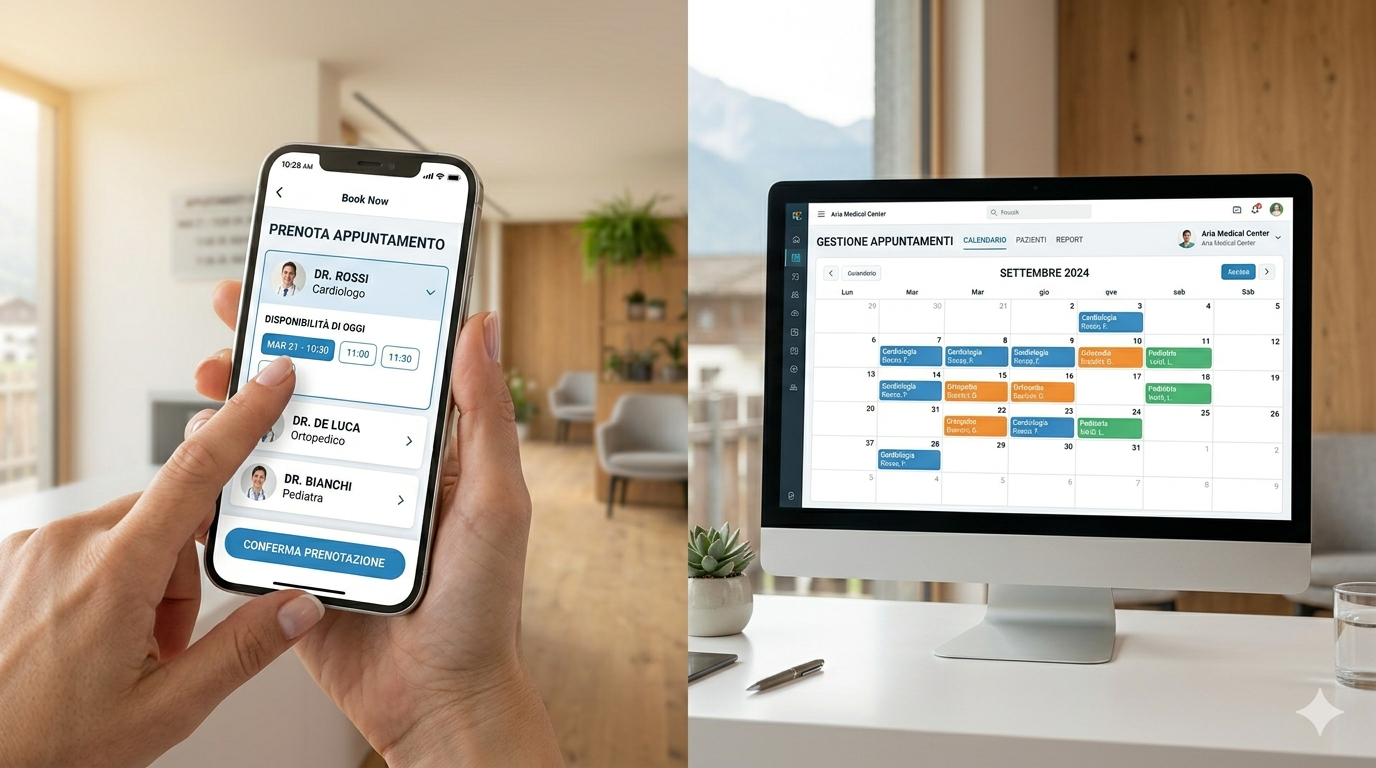
When it comes to online medical appointment booking, there are many options on the market. We can group them into three main categories, each with specific advantages and limitations.
1. Marketplace platforms: MioDottore and Doctolib
MioDottore (Docplanner group) and Doctolib are the most popular platforms in Italy. They work as a marketplace: the patient searches for a specialist, reads reviews and books directly through the platform.
Advantages:
- Immediate visibility thanks to the platform's organic traffic
- Ready-made and tested booking system
- Review management and online reputation
- Mobile app for patients
Limitations:
- High recurring costs — subscriptions from €80 to €300+/month per doctor
- Patients belong to the platform, not to you — patients are loyal to MioDottore, not your practice
- Direct competition — other specialists in your area appear on the same page as your profile
- Limited customisation — you cannot control the user experience
- Dependency — if the platform changes its rules or increases prices, you have no alternatives
2. Plugins and widgets for existing websites
Solutions like SimplyBook.me, Calendly for Healthcare or TuoTempo offer widgets that can be embedded in your website. The patient books directly on your site, but the booking system is managed by the plugin provider.
Advantages:
- Lower costs (€20-80/month)
- Patients stay on your site
- Integration with existing calendars (Google Calendar, Outlook)
- Quick implementation (1-2 weeks)
Limitations:
- Limited customisation of the booking flow
- Patient data resides on the provider's servers (healthcare GDPR concern)
- Advanced features often only available on premium plans
3. Custom development
A custom-built online medical appointment booking system tailored to your practice or clinic. The software is yours, the data is yours, every aspect is customisable.
Advantages:
- Full control over data, workflows and user experience
- Native integration with your management software, medical records and billing system
- No recurring licence fees (only hosting and maintenance)
- Full GDPR compliance — health data stays on your servers or controlled cloud
- Scalability — grows with your practice, from 1 doctor to 50
Limitations:
- Higher initial investment
- Longer development time (4-12 weeks)
- Need for a reliable technology partner for maintenance
Which should you choose? It depends on the size of your practice and your goals. Later, we compare MioDottore/Doctolib vs custom solution in detail to help you decide.
Checklist: what to evaluate in a booking system
Regardless of the solution chosen, make sure your online medical appointment booking system meets these requirements:
- Works perfectly on smartphones (over 80% of bookings happen on mobile)
- Supports multi-channel notifications and reminders (email + SMS) to reduce no-shows
- Allows booking on behalf of others (parents for children, caregivers for elderly)
- Includes a configurable cancellation policy (24h, 48h, with or without penalty)
- Offers online advance payment or at least a deposit (reduces no-shows by 30-40%)
- Generates shareable links to book directly for a specific specialty or doctor
- Integrates with your existing management system (if you already have one)
- Is GDPR compliant for health data (EU servers, encryption, consents)
Practice management software for medical offices and polyclinics
The medical practice website with online booking is just the tip of the iceberg. Behind the scenes, a modern medical practice needs comprehensive practice management software that handles the entire daily operation.
Good medical practice management software must integrate:
Patient management and medical records
- Complete patient records with visit history, allergies, pre-existing conditions
- Electronic health records compliant with Italian regulations
- Digital medical history forms that patients can complete before their visit (saves time at the practice)
- Informed consent forms with digital signature
- Attachments — reports, diagnostic images, previous prescriptions
Calendar and appointment management
- Shared calendar across multiple doctors and operators
- Synchronisation with the online booking system
- Room and equipment management (for polyclinics)
- Intelligent waiting lists with automatic notification when a slot opens up
- Statistics on no-shows, average visit duration, workload per doctor
Billing and accounting
- Electronic invoicing integrated with the Exchange System (SDI)
- Automatic submission to the Health Card System for patient tax deductions
- NHS and private insurance agreement management
- Cash book and financial reports
- Integration with the accountant
Prescriptions and reports
- Electronic prescriptions (dematerialised) integrated with the NHS system
- Customisable report templates by specialty
- Report delivery to patients via secure portal or encrypted email
- Doctor's digital signature
Patient communication
- Automatic reminders via SMS and email
- Recall campaigns for periodic check-ups
- Informational newsletters on prevention and health
- Patient portal for accessing reports, invoices and appointment history
For polyclinics, the polyclinic management software must also handle multi-site, multi-specialty and multi-operator complexity, with centralised reporting and differentiated access roles.
For dental practice websites, the management software must also include specialty-specific features such as digital odontograms, instalment treatment plan management, and connection with digital radiography systems (OPG, CBCT). Similarly, physiotherapy practices need modules for treatment cycle management, functional assessment, and integration with electrotherapy and rehabilitation devices.
Choosing the right practice management software depends on your practice's complexity. For a practice with 1-3 doctors, a SaaS solution may suffice. For polyclinics with multiple sites and dozens of operators, custom-built polyclinic management software offers decisive advantages in terms of integration, customisation, and data control.
If you want to explore the possibilities of custom-built management software, read our dedicated guide on custom management software for SMEs.
Need a website with online booking or management software for your medical practice? Ivemind designs custom digital solutions for the healthcare sector. Request a free quote →
GDPR and health data: what you absolutely need to know
This is the most critical topic for any medical practice looking to digitise. Health data is classified by the GDPR as "special category data" (formerly "sensitive data") and receives the highest level of protection under European law.
Getting this wrong is not an option: fines from the Data Protection Authority for healthcare violations can reach €20 million or 4% of annual global turnover. But beyond the fines, it's a matter of trust: patients entrust you with the most intimate information about their health.
What constitutes health data under the GDPR
Article 9 of EU Regulation 2016/679 defines health data as:
- Any information about a person's physical or mental health status
- Genetic and biometric data
- Information about past, present or future healthcare services
- Prescriptions, diagnoses, therapies
- Even the simple fact that a person has booked an appointment with a specialist can reveal information about their health
Important: even booking a medical appointment online generates health data. If a patient books a cardiology appointment, the system is recording that this person has (or suspects they have) a cardiac problem. This data requires the highest level of protection.
Legal bases for processing
To process health data in the context of online medical appointment booking, specific legal bases are required:
- Healthcare purposes (Art. 9.2.h) — processing is necessary for the healthcare service. Explicit consent is not required for this, but a clear privacy notice is needed
- Explicit consent (Art. 9.2.a) — required for purposes other than care: marketing, newsletters, data sharing with third parties, profiling
- Legal obligation (Art. 9.2.b) — for submission to the Health Card System, electronic invoicing
What your website must implement
A medical practice website offering online appointment booking must implement:
- Specific healthcare privacy notice, separate from the general website privacy policy
- Granular consents — patients must be able to choose separately: processing for care purposes, sending reminders, marketing, sharing with other doctors
- Consent register — full traceability of when and how the patient gave consent
- Data encryption — mandatory HTTPS, encryption of data at rest in the database, encryption of email communications
- Limited access — only authorised staff can view patient data, with access logs
- Data retention policy — clear policy on how long you retain data (for medical records: 10 years from the date of the last service, as required by Italian law)
- Data subject rights — procedures for access, rectification, erasure and data portability
- Data Protection Impact Assessment (DPIA) — mandatory for large-scale processing of health data
Where must the data reside
The GDPR requires that personal data of EU citizens be processed within the European Economic Area (EEA) or in countries with an adequate level of protection. For health data, the recommendation is even stricter:
- EU-based servers (preferably in Italy or Germany)
- Encrypted backups with keys managed by the practice
- No extra-EU transfers without adequate safeguards
- Caution with US cloud services: even with the Data Privacy Framework, the Italian DPA has expressed reservations regarding health data
This is one of the main reasons many medical practices choose a custom solution over international SaaS platforms: total control over their data.
Common GDPR mistakes in medical practices
In our experience working with medical practices and clinics, these are the most frequent errors we encounter:
- Booking form without specific privacy notice — the online appointment booking form collects health data, but refers to the generic website privacy policy. A dedicated notice is required
- Single consent for everything — one checkbox for care, marketing and data sharing. GDPR requires separate consents
- WhatsApp for patient communication — sending reports or health communications via WhatsApp is not GDPR compliant (data passes through Meta's US servers)
- Unencrypted emails — sending reports attached to unencrypted emails exposes health data. Use a patient portal or certified email
- Unencrypted backups — management software backups must be encrypted and stored securely
- No processing register — mandatory for any controller processing health data
For more on cybersecurity and regulatory obligations, also see our article on the NIS2 directive for SMEs, which introduces new cybersecurity obligations for the healthcare sector as well.
How much does a medical practice website cost
Let's get to the question every doctor and clinic owner asks: how much does it actually cost to build a professional website with an online booking system?
Below are Ivemind's real prices, transparent and without surprises. Each tier includes design, development, testing and launch.
Basic website — €700-1,500
Ideal for a solo practitioner or small group practice wanting a professional online presence.
- Custom responsive design
- 5-8 pages (home, about us, specialties, contact, privacy)
- Doctor profiles
- Contact form and appointment request (not automatic booking)
- Basic SEO optimisation
- Google Business Profile setup
- Basic GDPR compliance
Professional website with online booking — €1,500-3,500
The most popular choice: a complete medical practice website with an integrated booking system.
- Everything in the basic package, plus:
- Online medical appointment booking system with real-time calendar
- Automatic reminders via email and SMS
- Multi-doctor and multi-specialty management
- Dedicated page for each specialty
- Integrated blog for health and prevention content
- Full GDPR compliance for health data
- Multilingual (Italian/English, Italian/German or other combinations based on location)
Complete website with management system — €3,500-8,000
For polyclinics and clinics wanting an integrated digital ecosystem.
- Everything in the professional package, plus:
- Medical practice management software with electronic health records
- Electronic invoicing integrated with SDI
- Automatic submission to the Health Card System
- Patient portal for accessing reports and documents
- Statistics dashboard for management
- Multi-site management
Fully custom management system — €5,000-15,000
For organisations with specific needs: multi-site polyclinics, specialised clinics, diagnostic centres.
- Everything in the complete package, plus:
- Custom-built polyclinic management software
- Integration with diagnostic equipment
- Custom workflows by specialty
- Integration with NHS and regional systems
- Telemedicine module (video consultation)
- API for third-party system integration
- Staff training
In addition to these initial costs, there are recurring costs: hosting (€15-50/month), maintenance and updates (€50-150/month), SMS for reminders (€0.03-0.05/SMS).
Comparison with MioDottore: a MioDottore subscription for a practice with 3 doctors costs approximately €250-400/month, or €3,000-4,800/year. In two years, the cost exceeds that of a professional website with custom booking. And with the custom solution, the data stays yours.
Medical practice website costs — summary
| Package | Price | Online booking | Management | Ideal for |
|---|---|---|---|---|
| Basic site | €700-1,500 | ❌ | ❌ | Solo practitioner |
| Site + booking | €1,500-3,500 | ✅ | ❌ | Group practice |
| Site + management | €3,500-8,000 | ✅ | ✅ | Polyclinic |
| Custom software | €5,000-15,000 | ✅ | ✅ | Multi-site clinic |
Practical example: dental practice with 2 dentists
Let's look at a concrete case. A dental practice with 2 dentists and a hygienist wants a professional dental practice website with online booking. Here's the cost comparison over 3 years:
Option A — MioDottore: €150/month x 2 dentists = €300/month. Over 3 years: €10,800, plus patients "shared" with competitors and no control over data.
Option B — Custom Ivemind site: initial development €2,800 + hosting and maintenance €80/month = €2,880 in 3 years of recurring costs. 3-year total: €5,680, with full control over brand, data and patient base. With the 50% provincial voucher, the initial cost drops to €1,400, for a total of €4,280 over 3 years.
The difference is clear: a custom dental practice website costs half as much in the medium term and offers incomparable advantages in terms of autonomy, privacy, and brand building.
For a complete overview of professional website costs, you can also read our article on how much a website costs for a small business.
MioDottore and Doctolib vs custom solution: how to choose
This is the question we get asked most often: "Is MioDottore better or should I have my own site?". The answer depends on your situation. Here's an honest comparison.
Choose MioDottore/Doctolib if:
- You're a solo practitioner starting out and need immediate visibility
- You don't have the budget for an initial investment and prefer a monthly cost
- Your priority is acquiring new patients, not retaining existing ones
- You don't need integrated management software
- You don't handle particularly sensitive data (e.g., psychiatry, oncology, sexually transmitted diseases) where data privacy is even more critical
Choose a custom solution if:
- You're a practice with 3+ doctors or a polyclinic
- You want to control patient data and where it resides
- You need integrated management software (medical records, billing, NHS)
- You want to build your own brand, not be one of many on a platform
- You handle specialties where privacy is particularly critical
- You think medium to long-term: in 2-3 years, the custom solution costs less
- You want to integrate online booking with your specific workflow
MioDottore/Doctolib vs custom solution — comparison
| Criteria | MioDottore / Doctolib | Custom solution |
|---|---|---|
| Monthly cost (3 doctors) | €250-400/month | €80-150/month* |
| 3-year cost | €9,000-14,400 | €4,280-8,900 |
| Data ownership | ❌ Platform's | ✅ 100% yours |
| Healthcare GDPR | ⚠️ Provider's servers | ✅ Controlled EU servers |
| Customisation | ❌ Limited | ✅ Full |
| Competitors on page | ❌ Other doctors visible | ✅ Only your practice |
| Integrated management | ❌ Not available | ✅ Medical records, billing |
| Immediate visibility | ✅ Platform traffic | ⚠️ Requires SEO (3-6 months) |
| Brand building | ❌ Platform brand | ✅ Your practice brand |
*Hosting and maintenance only, after initial investment.
The third way: both
Many medical practices adopt a hybrid approach: they maintain their MioDottore profile to acquire new patients (leveraging the platform's visibility) whilst also having their own website with online booking where they direct existing patients. This way:
- MioDottore works as an acquisition channel
- Your own site becomes the reference point for retention
- Over time, dependence on the platform naturally decreases
SEO for medical practices: how patients find you on Google
Having a beautiful website is pointless if nobody finds it. 92% of patients use Google as their first point of search when they have a health problem or need to find a specialist. SEO (Search Engine Optimisation) is what determines whether your practice appears in the top results or remains invisible.
Local SEO: the decisive factor
For a medical practice, local SEO is everything. Patients don't search for "the best cardiologist in Italy" — they search for "cardiologist [city]", "dentist near me", "physiotherapist [city]".
Key elements of local SEO for medical practices:
- Google Business Profile — the listing is fundamental. It must be complete, with photos, hours, services, and regularly updated
- Google Reviews — practices with 4.5+ stars and 50+ reviews dominate local results. Actively ask satisfied patients for reviews
- Consistent NAP — Name, Address and Phone must be identical across your website, Google, medical directories, yellow pages, MioDottore
- Localised content — pages mentioning the city, neighbourhood, local landmarks
- Healthcare schema markup — structured data (schema.org/MedicalBusiness, schema.org/Physician) that helps Google understand who you are and what you do
Keyword strategy for the healthcare sector
Patient searches follow predictable patterns:
- "[specialty] + [city]" — "dermatologist [city]" (e.g., "dermatologist Milan", "dermatologist Bolzano"), "orthodontist Brixen"
- "book medical appointment online" — high-volume keyword with very low competition
- "online medical appointment booking" — similar high volume and low competition
- "online medical consultation" — growing search volume
- "[symptom/condition] + what to do" — "back pain what to do", "skin spot when to worry"
Capturing these searches with informational content on your blog is an incredibly powerful strategy: the patient finds you through an informational article, discovers you offer the ability to book medical appointments online, and books directly.
An often overlooked aspect is the boom in the "online medical consultation" keyword, reflecting growing demand for teleconsultation and video consultations. If your practice also offers online appointments, create a dedicated page: it's a high-demand service with little competition in search results.
Google Business Profile: your Google business card
For a medical practice, Google Business Profile is often more important than the website itself. When a patient searches for "doctor near me" or "dentist Bolzano", Google shows Business Profile listings (the "Local Pack") before organic results.
To maximise visibility:
- Complete every field — hours, services offered, accepted insurance, languages spoken
- Publish photos regularly — the practice, team, equipment (at least 1 per month)
- Respond to ALL reviews — both positive and negative, professionally
- Use Google Posts — to communicate news, holiday hours, new services
- Add the booking link — Google allows you to add a "Book" button that links to your online booking system
Healthcare content marketing
A blog with articles on prevention, common conditions and health advice is the best SEO investment for a medical practice. Each article is a gateway from the search engine to your website, and from there to the booking system.
Note: healthcare content must comply with Google's E-E-A-T (Experience, Expertise, Authoritativeness, Trustworthiness) guidelines, which are particularly strict for the medical sector. Every article should state the author (qualified doctor), sources and last update date.
Explore local positioning strategies in more depth in our comprehensive guide to local SEO: how to dominate Google in your area.
How to fund the investment: vouchers and grants for healthcare digitisation
Digitising your medical practice doesn't have to be entirely self-funded. There are various funding opportunities at national and provincial level.
PNRR Mission 6 — Health
Italy's National Recovery and Resilience Plan allocates €15.63 billion to healthcare, with a specific component for digitising health services. Key measures include:
- Electronic Health Record 2.0 — mandatory integration by 2026
- Telemedicine platform — funding for facilities activating teleconsultation services
- Technological modernisation — grants for digitisation of accredited private healthcare facilities
Regional digitalisation vouchers
Many Regions and Provinces offer specific grants for digitisation. For example, the Province of Bolzano offers grants for businesses and professional practices:
- Up to 50% contribution towards digitisation project costs
- Coverage for websites, management software, online booking systems
- Eligible expenditure from €5,000 to €50,000
- Also includes staff training on using new digital tools
This means a professional website with online booking costing €3,000 could effectively cost you just €1,500 thanks to available regional grants.
Tax credits for digital transition
The Transition 5.0 Plan provides tax credits for digitisation investments, also applicable to medical practices organised as businesses.
Professional bodies and sector-specific funds
Some Medical Councils and professional associations offer agreements and grants for practice digitisation. Check with your provincial Medical Council.
For a complete overview of all available funding, see our updated guide on non-repayable grants for small businesses in South Tyrol.
Frequently asked questions about medical practice websites and bookings
How much does MioDottore cost for a medical practice?
A MioDottore subscription costs from €80 to €300/month per doctor, depending on the plan. For a practice with 3 doctors, the cost is approximately €3,000-4,800/year. In two years, the cost exceeds that of a custom website with integrated booking.
Is GDPR consent required for online medical bookings?
For healthcare purposes (Art. 9.2.h GDPR), explicit consent is not required, but a specific privacy notice for health data is needed. Explicit consent is mandatory for marketing, newsletters and data sharing with third parties. Separate consents and a consent register are required.
How much does a medical practice website with online booking cost?
A professional website with an online medical appointment booking system costs from €1,500 to €3,500. With integrated management software (medical records, billing, Health Card System): €3,500-8,000. Many Regions offer grants of up to 50-60% (e.g., Province of Bolzano 50%, MIMIT vouchers up to 60%).
Where must patient health data be stored?
The GDPR requires health data to be processed on servers within the European Union, preferably in Italy or Germany. Backups must be encrypted with keys managed by the practice. The Italian Data Protection Authority has expressed reservations about using US cloud services for health data.
Is MioDottore or a custom website better for a medical practice?
For solo practitioners starting out, MioDottore offers immediate visibility. For practices with 3+ doctors or polyclinics, a custom website with personalised booking costs less in the medium term (2-3 years), offers full data control and allows you to build your own brand without competitors on the same page.
Does a dental practice have different website requirements?
Yes. A dental practice website requires specific features: before/after work gallery, treatment information (implantology, orthodontics), available technology details (intraoral scanner, 3D X-ray) and management software with digital odontograms and instalment treatment plans.
Ivemind: your technology partner for digital healthcare
Ivemind is a social cooperative and innovative startup headquartered in Bolzano, operating throughout Italy, specialising in custom digital solution development. We work with medical practices, dental offices, physiotherapy clinics and polyclinics throughout Italy.
What we offer for the healthcare sector:
- Professional websites with healthcare-focused design, optimised for conversion (from site visit to booking)
- Integrated online medical appointment booking systems, customisable and compliant with healthcare GDPR
- Custom management software for medical practices and polyclinics, with medical records, billing and NHS integration
- Healthcare GDPR consultancy — we guide you through privacy compliance specific to the medical sector
- Healthcare SEO and marketing — to bring your practice to the top of local search results
- Ongoing assistance and support — updates, maintenance and staff training
60% of our profits are reinvested in social inclusion projects. Choosing Ivemind isn't just a technology choice, it's a values choice.
Ready to digitise your medical practice?
- Discover our web development services
- Explore our custom management software solutions
- Contact us for a free, no-obligation consultation
We help you create a complete digital system — from a website with online medical appointment booking to integrated management software — tailored to your practice's needs.
Related articles

Website and Management Software for Professional Firms: Complete Guide 2026
Websites for lawyers, accountants and architects: how much it costs, essential features and which management software to choose. Real prices, software comparison, grants up to 60% and 5 mistakes to avoid.

Email Marketing for Small Business: How to Create a Newsletter that Converts in 2026
How to create a professional newsletter, build a mailing list and do email marketing with a ROI of €36 for every euro spent. Practical guide for SMEs.

How to Sell Online in 2026: Amazon, Marketplace or Your Own E-commerce?
Amazon, Etsy or your own e-commerce? Cost comparison, margins and strategies for small businesses. How much it costs and which channel to choose.