Local SEO: How to Dominate Google in Your Area (2026 Guide)
46% of Google searches are local. Is your business showing up?
Nearly half of all Google searches have local intent: "restaurant near me", "plumber Bolzano", "shoe shop centre". These are people searching for a business like yours, in your area, right now. And 76% of those who make a local search visit a business within 24 hours.
But here's the problem: most Italian small businesses aren't optimised for these searches. Only 26% of Italian SMEs have a high level of digitalisation, well below the EU average of 33%. This means that anyone who invests in local SEO today has an enormous competitive advantage — because most competitors simply aren't doing it.
In this guide, we'll explain how local SEO works, what factors Google considers when ranking you, how to leverage reviews and your Google profile, and why an optimised website is the foundation of everything. No tricks — just concrete strategies that work.
What is local SEO (and how it differs from "regular" SEO)
Local SEO is the set of strategies that help your business appear in Google results when someone searches for a product or service in your area. It's not the same as traditional SEO.
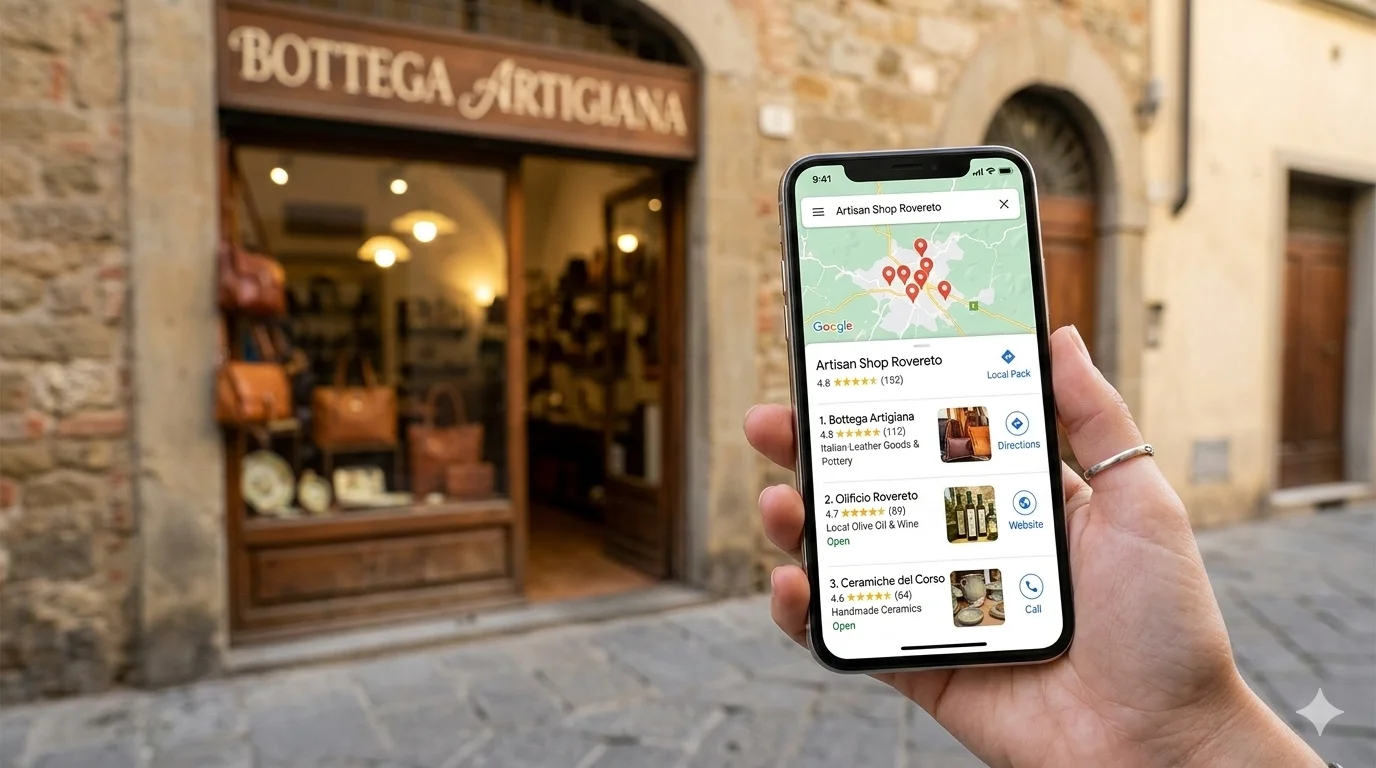
When you search for "best pizzeria Bolzano", Google doesn't show you the most authoritative results on the web. It shows you a map with three businesses (the so-called "Local Pack"), followed by organic results. Appearing on that map means intercepting the customer at the exact moment they're deciding where to go.
Local SEO is built on three pillars that traditional SEO doesn't have:
- Proximity — how close you are to the searcher. Google knows where the user is and favours nearby businesses
- Relevance — how well your business matches what the user is searching for. Category, description, services offered
- Prominence — how well-known and trustworthy your business is. Reviews, citations, links, activity on your Google profile
You can't control proximity (you can't move your shop). But you can work on relevance and prominence — and these are what make the difference between appearing in first position or being invisible.
The 4 pillars of local SEO
According to the latest industry analyses, 8 out of 10 of the most important local ranking factors depend on Google Business Profile. But the profile alone isn't enough. Here are the four pillars to build your local visibility on.
1. Google Business Profile: your digital business card
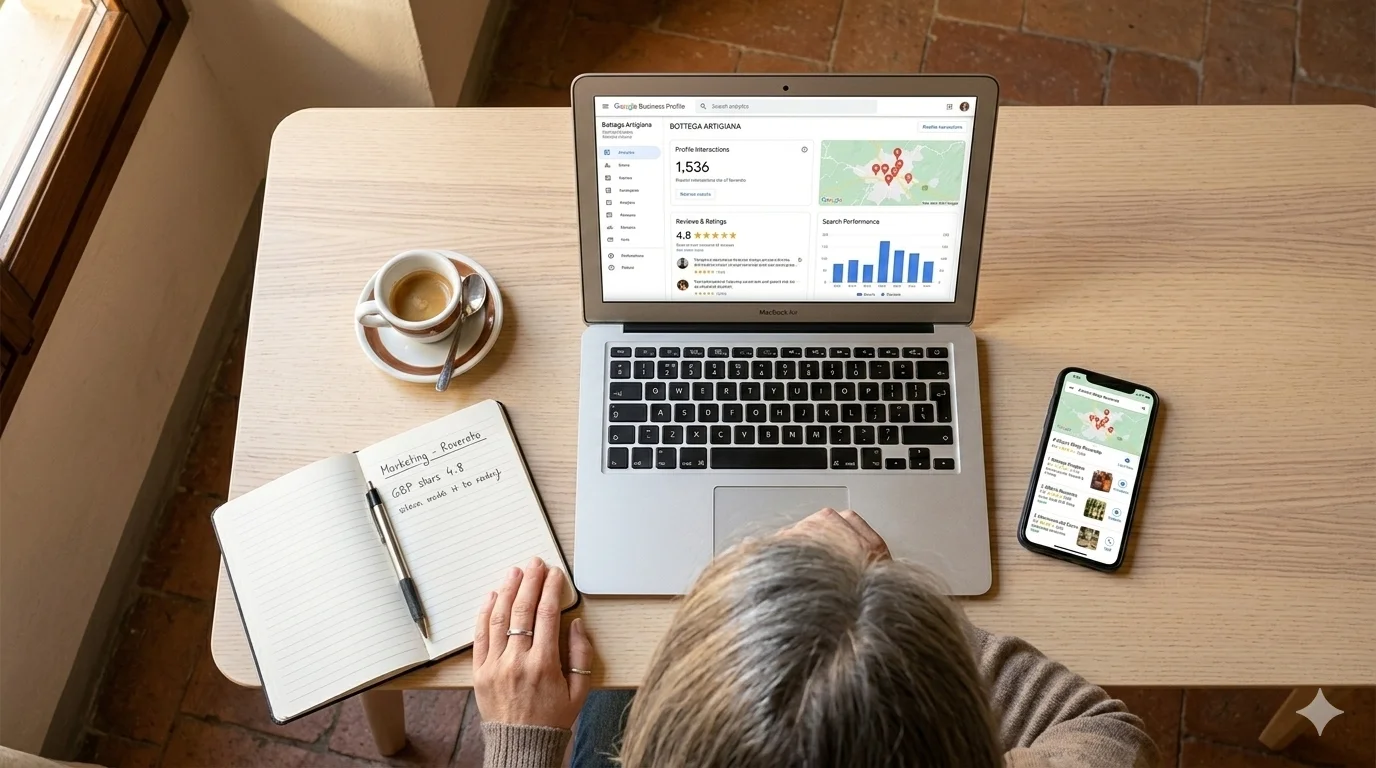
Your Google Business Profile (formerly Google My Business) is the number one factor for appearing in Google's Local Pack. Businesses with a complete profile get 7 times more clicks than those with incomplete profiles, and are 2.7 times more trusted by customers.
An optimised profile means:
- Correct primary category — this is the #1 ranking factor. Choose the category that exactly describes your core business
- Complete and up-to-date information — name, address, phone, opening hours, website. Every empty field is a missed opportunity
- Business description — 75% of top-ranking businesses have a complete description. Use natural keywords that describe your services
- Quality photos — businesses with photos receive significantly more clicks, calls, and direction requests. No blurry or stock photos: show your shop, your products, your team
- Regular posts — offers, news, events. Google rewards active profiles. An inactive profile gets overtaken by those who post regularly
If you don't have a Google Business Profile yet or want to know how to create one step by step, read our guide on how to list your business on Google for free. If you want to understand how to appear on the map, we've also written about how to appear on Google Maps with your shop.
2. Reviews: the currency of the local web
Reviews aren't optional — they're a direct ranking factor and the main reason a customer chooses you over your competitor. The numbers are clear:
- 96% of consumers read reviews before visiting a local business
- 68% won't consider businesses with fewer than 4 stars (up from 55% in 2025)
- 73% only trust reviews written in the last month
- Top-ranking businesses average 47 reviews
It's not enough to have many reviews. You need recent, consistent reviews with responses. Google rewards businesses that respond to both positive and negative reviews — 89% of consumers prefer businesses that respond to reviews.
The ideal score? Between 4.2 and 4.5 stars. Paradoxically, a perfect 5.0 generates less trust than a 4.5 with a few critical reviews handled well. Transparency always wins.
How to get more reviews? Don't buy them (Google penalises fake reviews). The best strategy is to ask at the right moment: after a positive purchase, after a successfully completed service. A simple message, a direct link to your Google profile, and a sincere "thank you".
3. Your website: the foundation of everything
Your Google profile is the shop window, but your website is the shop. Google cross-references your profile information with your website to verify your reliability. A website optimised for local SEO includes:
- Name, Address and Phone (NAP) visible and consistent with your Google profile — even small discrepancies (abbreviations, different numbers) confuse Google
- Dedicated pages for each service — not a generic "services" page. Google needs to understand exactly what you offer and where
- Localised content — mention your city, your neighbourhood, your area. "Plumber in Bolzano centre" is far more specific than just "plumber"
- Structured data (Schema markup) — code that tells Google: "this is a local business, at this address, with these hours, these reviews". It increases your chances of appearing in rich results
- Loading speed — 72% of local searches happen on mobile. A slow site on a smartphone loses customers before even showing them what you sell
If you're thinking about redesigning your website or building a new one, read our article on how much a website costs for a small business. A website built with local SEO in mind from the start is worth ten times a beautiful site that's invisible on Google.
4. Citations and NAP consistency
Citations are every mention of your business on external sites: directories, local portals, Yellow Pages, TripAdvisor, trade associations, Chamber of Commerce. Google verifies your business by cross-referencing data across at least 10 external platforms.
The golden rule is NAP consistency (Name, Address, Phone): your name, address, and phone number must be identical everywhere. Not "Via Roma 15" on one site and "V. Roma, 15" on another. Not "+39 0471 123456" on one and "0471-123456" on another. Every discrepancy reduces Google's trust in your business.
The most powerful links for local SEO don't come from generic national websites. They come from locally relevant sites: the Chamber of Commerce website, the municipality portal, neighbourhood blogs, local associations, sponsors of events in your area. Few links, but the right ones.
Want your business to appear in the top position on Google in your area? Ivemind builds websites optimised for local SEO from day one — and helps you build a complete digital presence that brings real customers. Let's talk →
Local SEO vs Google Ads: where to invest
Many business owners wonder: is it better to invest in SEO or in paid advertising on Google? The short answer: local SEO delivers a higher return on investment in the medium to long term.
Here are the numbers:
- Local SEO generates an average ROI of 700% within 6-12 months for small businesses
- Organic traffic accounts for 53.3% of all web traffic — 5 times more cost-effective than paid advertising in the long run
- Organic leads convert 8.5 times better than contacts obtained through outbound advertising
- The average cost per click on Google Ads rose to €5.26 in 2025, up 13% — and it keeps rising
Google Ads works like a tap: turn it on, traffic comes; turn it off, traffic disappears. Local SEO is an investment that builds a permanent digital asset. Once you're in the top position, you keep receiving customers without paying for every single click.
The ideal strategy? Start with local SEO and use Google Ads only to accelerate while SEO does its work. Your optimised website receives growing organic traffic; ads deliver immediate results for specific campaigns. For more low-cost visibility strategies, read our guide on how to advertise your business for free.
The 6 mistakes making you invisible on Google
Many businesses are invisible on Google not because the competition is too strong, but because they make avoidable mistakes. Here are the most common ones.
1. Incomplete or abandoned Google profile
A profile without photos, without a description, without updated hours tells Google (and customers) that your business might no longer be active. Google can even suspend profiles that appear illegitimate. A complete, active profile is the bare minimum.
2. Different information on different sites
If your address is written one way on your website, another way on your Google profile, and yet another way on Yellow Pages, Google doesn't know which one is correct. The result: it loses trust and ranks you lower. Modern verification systems cross-reference data across at least 10 platforms.
3. Ignoring reviews
Not responding to reviews — positive or negative — is a serious mistake. Google rewards businesses that engage with their customers. And potential customers see a business that doesn't respond as one that doesn't care about its customers.
4. Website not optimised for mobile
72% of local searches happen on smartphones. If your site is slow, hard to navigate, or unreadable on mobile, you're losing the majority of potential customers. Google uses the mobile version of your site as its primary reference for ranking.
5. Generic content with no local references
If your website says "we offer quality services" without ever mentioning where you offer them, Google doesn't know you're a local business. Every page should contain natural references to your area: city, neighbourhood, landmarks, areas served.
6. Stuffing keywords into your business name
Modifying your business name on Google by adding keywords ("Mario Rossi - Best Plumber Bolzano Emergency Service") violates Google's guidelines. You risk suspension or removal of your profile. Use your real business name, nothing else.
Voice search and AI: the future of local SEO
Local SEO is changing. Two trends are redefining how customers find local businesses.
Voice search
"OK Google, find an electrician near me." Voice searches are growing rapidly, and 76% have local intent. Today there are over 8.4 billion voice-enabled devices worldwide, and 50% of local businesses already receive customers through voice search discovery.
Voice searches are different from typed ones: they're longer, conversational, and more specific. Instead of "restaurant Bolzano", a voice search is "what's the best Italian restaurant near me open now?". To appear in these results, your website and Google profile need to answer specific questions with complete, up-to-date information.
AI in Google results
Google is introducing AI Overviews — AI-generated answers that appear before traditional results. For local searches, this changes the rules: instead of showing 3 businesses in the Local Pack, AI Overviews show only 1-2, surfacing just 32% of the businesses compared to the traditional map pack.
What does this mean for you? That being "good enough" is no longer enough. To appear in Google's AI results, you need flawless structured data, information consistency across all platforms, solid reviews, and content aligned with real customer questions. Those who prepare today will have an enormous advantage tomorrow. To learn more about how AI is transforming small businesses, read our article on AI for small businesses.
Ivemind: your local SEO partner
Ivemind is a social cooperative and innovative startup based in Bolzano, South Tyrol. We develop websites optimised for local SEO that bring real customers to your business — not empty visits, but people searching for exactly what you offer, in your area.
We don't sell standardised "SEO packages". We build your complete digital presence: a fast, optimised website, a curated Google profile, perfect structured data, and content that answers your customers' questions. We've helped 47+ companies and organisations build their digital presence, with 100% client satisfaction.
With Ivemind you get:
- SEO-optimised website — built from day one to rank on Google in your area, with structured data, localised content, and excellent mobile performance
- Google profile optimisation — complete setup, correct category, professional photos, posting strategy
- Review strategy — systems to consistently obtain genuine reviews and manage responses
- Ongoing monitoring and optimisation — analysis of rankings, local competitors, and improvement opportunities
- Access to grants — we guide you through accessing non-repayable grants to reduce your investment. The Province of South Tyrol funds up to 60% of digitalisation projects
60% of our profits are reinvested in social inclusion projects — choosing Ivemind isn't just a technology choice, it's a values choice.
Contact us for a free consultation or discover our web development and IT consulting services. Also need an e-commerce? We build it already optimised for local SEO.