
BlogTechnologyNews
PHP2Shell: how we defended our clients' websites before the official fix
PHP2Shell is an extremely serious PHP flaw, announced in October 2026. PHP is the engine that runs WordPress, WooCommerce, PrestaShop and a huge number of other websites. The flaw let anyone take control of the server without knowing any password, and the first attacks started four days before the announcement.
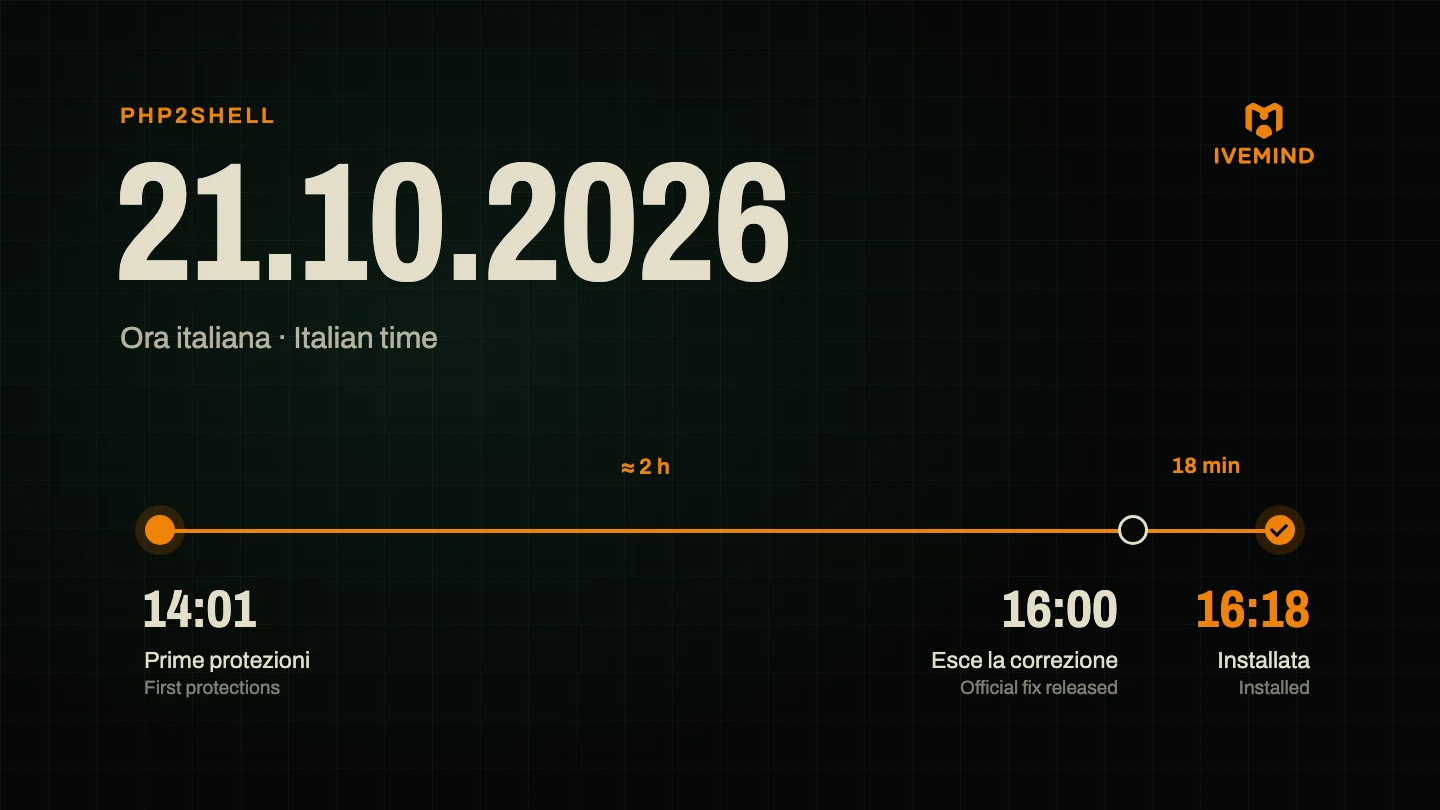
The official fix came out on 21 October at 16:00. On the servers we manage for our clients, the first protections had been active since 14:01, and by 16:18 the fix was already installed: our clients didn't have to do anything. Here we tell you what we did, hour by hour, and how we handled the other flaws that arrived in the following weeks. At the end you'll find five questions to find out whether whoever runs your website is really protecting you.
Is my website at risk?
If your website or online shop is built with WordPress, WooCommerce, PrestaShop or other PHP-based software, it is at risk until whoever manages the server has installed the security updates released between 21 October and 20 November 2026, and restarted the software.
Updating WordPress, PrestaShop or plugins is not enough: the flaws were in the server software, not in the website. It's a part business owners usually don't see, which is why it easily falls behind. Not sure where your server stands, or who looks after it? Write to us: we'll help you find out and tell you what needs fixing.
What a business risks with an outdated server
Whoever gets into a server can do anything the owner can, and they don't announce it: sometimes the intrusion is only noticed weeks later, when the damage is done. In practice, they can:
- steal your customers' data: names, addresses, emails, orders;
- use your website for scams: visitors end up on fake pages until Google flags the site as dangerous, and from then on visits collapse;
- use your server to send spam or attack other websites, and your emails may start landing in your customers' spam folder;
- stop your business: an online shop that is down doesn't sell, and getting a breached server back on its feet can take days.
If personal data is involved, under the GDPR the breach must generally be reported to the data protection authority within 72 hours. For companies covered by the NIS2 directive the obligations are even stricter.
PHP2Shell: why it was so serious
Usually, to break into a website, an attacker has to find a weak spot: an old plugin, an easy password. With PHP2Shell that wasn't needed. The flaw was in the part of PHP that receives the data and files visitors send, which runs before the website itself even starts. Having PHP on the server was enough to be exposed, whatever website ran on it. That's why CISA, the US cybersecurity agency, wrote that every installation was at risk, even with the standard settings. According to W3Techs, PHP is used by about 69% of websites whose technology is known. And the attackers were extremely fast:
- 17 October: Amazon sees the first attack attempts on the decoy servers it uses to study attacks, four days before the announcement;
- 21 October, 16:00: the official fix is released;
- 24 October: a researcher documents three decoy servers already breached;
- 26 October: CISA adds the flaw to its list of those actively used in attacks.
There's an extra problem for websites that are a few years old. PHP versions older than 8.2 no longer receive official fixes: this time some vendors fixed them on their own, but nobody guarantees they'll do it next time. And from 31 December 2026 version 8.2 will stop receiving fixes too. If your website is stuck on an old version, it's worth planning the upgrade now, before the next flaw: let's talk about it.
On 21 October, wherever it could be done safely, we moved our clients' websites to the latest PHP version, checking that every page stayed identical. Where an old version is still running, it's the client's choice: moving to a new version often means updating the website too. It's a choice we strongly advised against, but it's the client's to make and we have to respect it. In these cases we do everything we can to protect the website anyway, as you'll see in the times below.
How we handled it, hour by hour
Every day we follow security notices from the developers of the software we use and from cybersecurity agencies. When a serious flaw comes out the rule is always the same: protect the servers right away, without waiting for the fix, and install it as soon as it's out. These are the times of 21 October, Italian time, from our server logs.
- 14:01: the fix isn't out yet, but we know where one of the two attacks gets in: a small feature, the one used to show the progress bar when a file is uploaded. We switch it off on every server. On websites that, by the client's choice, still run old PHP versions, the most exposed, we also block file uploads until the next day.
- 16:00: the official fix is released.
- 16:18: the fix is installed. We restart PHP, check that the old version is no longer running and that every website responds.
- 16:53: we also secure the last parts of the servers that were waiting for a separate fix.
- 21:13: we install the fixes prepared for the old PHP versions too.
- That evening: we check every server for signs of intrusion, going back to 15 October, two days before the first known attack. We find none.
- 22 October, morning: the last fixes arrived overnight. Final check, all fine: we switch file uploads back on.
Blocking file uploads had a cost, and we knew it: on one shop the contact form was down for about a day. It's a choice we'd make again: a form that's down is fixed in a moment, a breached server isn't.
Four flaws in a month: what we did
PHP2Shell wasn't the only one. In the following four weeks three more arrived, in different software. For each one the method was the same: find out right away whether our clients' servers were exposed and, where needed, protect them without waiting for the fix.
| Flaw | When | What we did |
|---|---|---|
| PHP2Shell, in PHP | 21 October | First protections two hours before the fix, fix installed 18 minutes after release |
| Second PHP flaw | 23 October | Already protected: the remedy was the same one we had applied on the 21st |
| SSHole, in OpenSSH | 5 November | Already protected |
| NGINX2Root, in nginx | 18 November | Affected part switched off on the evening of the 19th, fix installed on the morning of the 20th |
The PHP flaw that went 27 days without a fix
On 23 October PHP warned about another serious flaw, this time with no fix ready. The only remedy given was to switch off that same progress bar feature, the one we had already switched off two days earlier. Our clients' servers stayed protected for all 27 days, until 19 November, when the fix came out. We installed it that same evening.
SSHole: attacked in under nine hours
OpenSSH is the service door technicians use to get into servers and manage them. On 5 November a flaw was fixed that, on some systems, let people in with any password, as long as it was long. According to the security firm Previdian, the first attack came less than nine hours after the announcement. Our servers were already protected: the way we configure them had closed this route long before the flaw was discovered.
NGINX2Root: five flaws in the server's switchboard
nginx is the software that receives visitors and delivers the website's pages to them, a bit like a company's switchboard. On 18 November five flaws were announced, all rated 9.2 out of 10 for severity. The most serious one was present in every version since 2015 and let anyone crash the server and, in some cases, take control of it.
On the evening of 19 November we switched off, on every server, the part of nginx the two main flaws went through, a feature that speeds up page delivery: the websites kept working normally. All night long an automatic check every ten minutes made sure they were reachable. At 6:28 on 20 November the fix arrived, and by 9:13 everything was back as before.
Three things we learned, useful for your server too
"Everything up to date" isn't always true
On 21 October itself, one of the vendors of the software we use changed the system it uses to certify its updates. The result: servers stopped receiving them without showing any error, and kept saying everything was up to date. We noticed because, after every important update, we check what is actually running, not what the screen says. Anyone trusting the "everything up to date" message can stay exposed without knowing it.
The version number can be misleading
The fixes for the older PHP versions came with the same version number as before: only a detail changed, one you only spot if you know where to search. Looking at the number alone, you can't tell a fixed server from one that is still exposed, and you risk thinking you're safe when you aren't. That's why you need someone who knows where to look, and does it every time.
Installing without restarting doesn't help
Until a program restarts, the old version keeps running, flaw included. It's like buying a new lock and leaving it in the box. For nginx, according to the security firm Qualys, even the "light" restart normally used isn't enough: it needs a full restart. That's why, after every intervention, we check that the old version is no longer running.
5 questions to ask whoever manages your server
You don't need to become a technician to know whether you're in good hands. Ask these questions to whoever looks after your website and listen to how they answer.
- Have you installed the October and November 2026 security updates? The right answer is yes, with a date. "I think so" isn't enough.
- After installing them, did you restart the software and check that the new version is running? If the answer is just "we updated", something is missing.
- Does my website use a PHP version that still receives fixes? If it uses 8.2 or older, you need a plan to upgrade it, with a date.
- Who reads security notices, and how quickly do they act? You want a name and a time measured in hours. "At the next maintenance window" is not good enough.
- When did you last test restoring a backup? You want a recent date. A backup that has never been tested is no guarantee.
If you'd like us to take care of it
If even one answer doesn't convince you, or you don't know who to ask, we can take care of it. From Bolzano we manage servers and hosting for websites, online shops and management systems of businesses like yours:
- we follow security notices every day;
- we install serious fixes by hand as soon as they're out, and other updates automatically every night;
- when there's no fix yet, we protect the servers with countermeasures, as in these cases;
- after every intervention we check that everything really works.
You don't have to do anything, or even know what PHP is. Tell us how your website is built: the first 30-minute consultation is free, and we'll tell you where your server stands and what needs fixing. The service details are on the managed hosting page.
Sources
Times and interventions come from our server logs. Information on the flaws comes from these sources and is up to date as of 26 November 2026.
Frequently asked questions
How do I know whether my website is safe from PHP2Shell?
Ask whoever manages your server whether they installed the PHP security updates released on 21 October 2026 and restarted PHP afterwards. The version number alone can be misleading, because for the older versions the fixes came with the same number as before. If you don't know who manages your server, that's the first thing to sort out.
Does PHP2Shell affect WordPress websites too?
Yes. The flaw was in PHP, the engine WordPress runs on, not in WordPress itself: updating WordPress and its plugins isn't enough. Whoever manages the server needs to update PHP and restart it. The same goes for WooCommerce, PrestaShop and other PHP-based websites.
What should I do if I think my website has been breached?
Don't delete anything and don't rush to shut the server down: you'd lose the traces needed to understand what happened. Call a technician right away, who will save a copy of the server and isolate it, and change the access passwords for the website and the control panel. If personal data is involved, under the GDPR you generally have 72 hours to report the breach to your data protection authority.